Few objects in the Marvel Universe are as powerful — or as dangerous — as the Cosmic Cube.
A reality-warping artifact capable of granting its wielder near-limitless power, the Cosmic Cube has shaped some of Marvel’s biggest stories and fallen into the hands of everyone from Red Skull to Thanos.
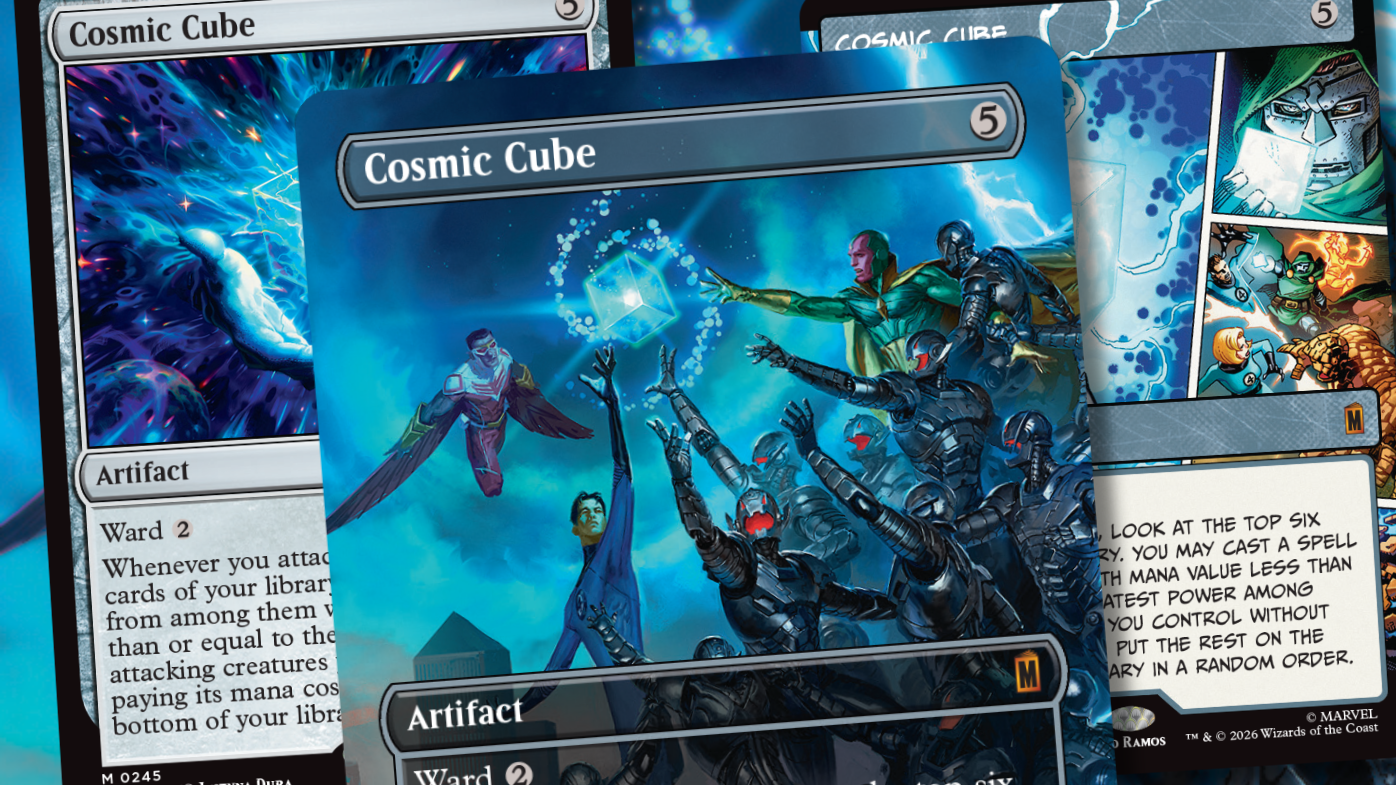
Today, we’re thrilled to exclusively reveal not one, not two, but three versions of Cosmic Cube from Magic: The Gathering’s upcoming Marvel’s Super Heroes set.
Introducing: Cosmic Cube

Cosmic Cube is an artifact that costs 5 mana and has Ward 2.
Every time you attack, you look at the top six cards of your deck: you get to cast one spell from those six that has a mana value equal to or less than the power of your stronger attacking creatures — the rest go to the bottom of your deck.
The Cosmic Cube is one of the most powerful objects in Marvel Comics.
Basically, it’s a reality-warping device that can make almost any wish become reality. If someone has a Cosmic Cube and knows how to use it, they can reshape matter, alter space and time, create worlds, transform people, or even rewrite reality itself.
READ MORE: Pirate Borg: Pirates, Cthulhu And Swashbuckling Tabletop Chaos
How to take advantage of Cosmic Cube’s abilities
As mentioned, the Cosmic Cube is incredibly powerful in Marvel lore — but how powerful is it on the tabletop?
The ceiling here is your biggest attacker, and in the right deck that number can get out of hand fast. A creature with 5 or 6 power — routine in a green-heavy Commander deck — is already enabling you to cast spells that might otherwise eat most of your mana for the turn. Push that power higher and you’re pulling Craterhoof Behemoth out of your deck for nothing.

A natural home for Cosmic Cube is a Xenagos, God of Revels deck. His combat trigger doubles a creature’s power before attackers are even declared, so the Cube is checking that inflated number when it fires. A 6/6 becomes a 12/6 at the beginning of combat, and a mana value ceiling of twelve means almost anything in your deck is on the table.
If you’d rather solve the card’s main limitation, that it only triggers once per attack step, Karlach, Fury of Avernus does that cleanly. She grants an additional combat phase and untaps your attackers, giving you two Cube triggers in a single turn without needing any external setup. She’s also a 5/4 herself, so the moment she swings you already have a five-mana ceiling to work with.

Beyond Karlach, the options for extra triggers are straightforward. Aggravated Assault is the repeatable version: pay five mana, get another combat phase, fire the Cube again. Strionic Resonator is the more efficient pick. Two mana to copy the trigger and pull a second free spell from the same attack, no extra combat step required.
At competitive tables, a five-mana artifact that requires an established board state and (ideally) an extra attack state to generate value is simply too slow. It lacks the immediate, game-ending impact required when fast combos can threaten a win by turn two or three.
However, at the mid-to-high power level where most Commander is generally played, Cosmic Cube is a powerhouse. It transitions from a slow piece of tech into a terrifying value engine. In these games, board stalls happen and players actually win through combat, meaning the Cube has the opportunity to take over the match.
It demands an answer from your opponents while asking nothing more from you than to simply do what your deck was already planning to do: swing big and cast massive spells.
Now that we’ve got the technical stuff out of the way, let’s dive into the origins of this thing…
Where did the Cosmic Cube come from?
The first Cosmic Cube was created by the villainous organization A.I.M. in the 1960s comics. They harnessed incredibly powerful extra-dimensional energy and contained it in a cube-shaped object.

Who has used it?
Some of Marvel’s biggest characters have wielded a Cosmic Cube, including:
- Red Skull
- Thanos
- Doctor Doom
- Adam Warlock
- Captain America
Is it the same as the Tesseract?
Not exactly.
In the MCU, the Tesseract seen in movies like Captain America: The First Avenger and Avengers: Infinity War contains the Space Stone.

In the comics, the Cosmic Cube is a separate artifact entirely. The MCU Tesseract was visually inspired by the Cosmic Cube, but its powers and origins are different.
READ MORE: Back to School: Your Guide to Collecting Secrets of Strixhaven
This is where it starts to get deep…
Marvel later revealed that some Cosmic Cubes are actually “developing life forms”. Given enough time, they can become sentient beings. Examples include Kubik and Kobik, both of whom began as Cosmic Cubes before evolving into powerful entities.
How powerful is it?
More versatile than a genie and capable of reshaping reality itself, the Cosmic Cube’s true limits are often defined not by its power, but by the imagination of its user.
That’s why whenever the Cosmic Cube appears in a Marvel story, it usually becomes the most important object in the universe — because whoever controls it can potentially remake reality however they choose.
In our three variants of the card, we can see multiple examples of when and how the Cosmic Cube was used.
Cosmic Cube – Main

In the Main card’s art, we see gloved hands holding the Cosmic Cube as power crackles around it. This cube is powerful! The artwork is by Johan Grenier, responsible for the artwork of over 60 Magic the Gathering cards.
Cosmic Cube – Showcase Panel

In the Showcase Panel treatment, the Cosmic Cube is presented through Magic’s comic book-inspired frame treatment, designed to look as though the artwork has been lifted directly from the pages of a Marvel comic.
Showcase Panel cards feature original artwork framed within stylised comic panels. This artwork comes from legendary Marvel artists Jim Cheung and Jay David Ramos.
Cosmic Cube – Borderless Scene

The Borderless Scene art forms part of a larger connected artwork that can be combined with other cards from the set to create an expansive Marvel-themed panorama.
The card above is designed to fit together into an 18-card scene, creating one massive piece of artwork when displayed side-by-side. You can see that it’d fit very nicely against this already unveiled Dr Doom card.

When can you get your hands on MTG: Marvel Super Heroes?
Players can set the table with a smorgasbord of products from Magic the Gathering: Marvel Super Heroes on June 26th.
There’s various Commander Decks, Collectors Edition decks, Welcome Decks, Boosters, Jumpstart Boosters, Draft Sets, Bundles, Heroes and Villains Scene Boxes… and more!
You can read more about the set over at the MTG website.
Whether you’re looking to cheat enormous spells into play or simply want to own a piece of Marvel fun in cardboard form, the Cosmic Cube card is shaping up to be one of the most exciting artifacts in Magic’s Marvel Super Heroes.
Thanks to Wizards of the Coast for supplying Quest Daily with this card to reveal.