You’re riding through the forest, you have a longsword on your hip that your father made just before he died — you reforged it, and it is stronger than ever.
Your horse has been with you through bandit attacks, sieges and all over this country. To your left, your faithful hound barks at something off in the sun-dappled undergrowth. Ahead, a traveller waves at you on the road. He seems normal enough — travelling gear and worn boots — but he has an axe by his side. Your dog begins to bark as three more step out from behind trees to you left.
Do you stand and fight — four against one? Or, do you barrel down the one in front and ride to the next town as fast as the horse can take you? It would be a much easier decision if you weren’t so hungover…
This is the world of Kingdom Come: Deliverance II, it’s a gritty, real, down-to-earth depiction of life in medieval times. Where an untreated sword cut could lead to you bleeding out on the roadside, and any encounter with an armed traveller is serious if you aren’t prepared.

Ready Your Gear: We’re Going On An Adventure
For those picking up Kingdom Come: Deliverance II after playing the original game, the story picks up not long after that first game’s conclusion. Henry is a bodyguard and retainer to the lordling Hans Capon, and they’re journeying to a castle called Trosky with an armed unit of soldiers. At the time in real world history, the country of Bohemia is embroiled in a civil war between King Wenceslas, and his brother King Sigismund. Sigismund has taken Wenceslas hostage, and Henry and Hans are on a diplomatic mission to gather support from the regional lords for their king.
As such, Kingdom Come: Deliverance II starts you out with very good gear, a band of merry men and a faithful hound and horse to help you along your journey. A fireside chat with your bandmates helps fill in the blanks of what happened in the first game, and what your starting stats are. These gear you more towards combat, stealth, diplomacy etc.
READ MORE: Review | Metaphor: ReFantazio ‘A Game Of Thrones’ (PS5)
Of course, the status quo doesn’t stay quo for very long, and you’ll end up at the bottom of the barrel fighting with rusted weapons and worn out gear to build yourself back up over the course of the game.
From then you’ll join Sir Hans in a journey that stretches across Bohemia, where you’ll fight bandits, raise armies, take place in castle sieges and overthrow warlords. It’s one hell of an epic, taking myself 80 hours focusing on the main quest, and one of the most detailed medieval simulators I’ve ever played.

Fortune Favours The Bold
Audentis Fortuna Iuvat — or ‘fortune favours the bold’ in Latin is the guiding principle of Sir Hans Capon, who we’ll spend much of the game protecting — mostly from himself. He’s a brash noble who always demands that everyone treat him with the respect he’s owed.
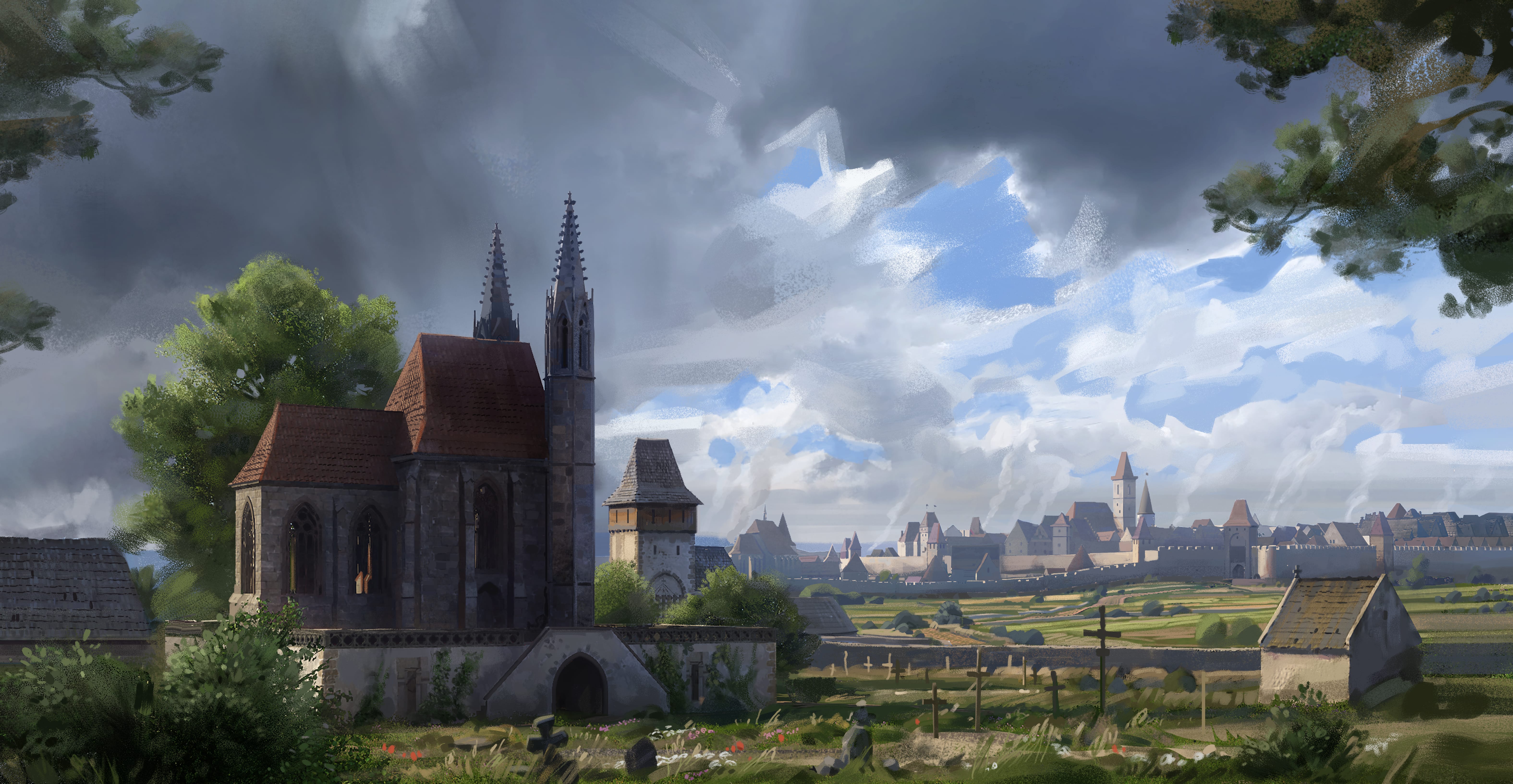
It must also have been the mantra of the dev team building Kingdom Come: Deliverance II, because it’s an absolutely massive adventure. The game spans two huge maps, each larger than the first game’s entire adventure. You’ll begin is small hamlets with a few huts, shops and always boasting a pub or two. The detail given to enacting the lives of townsfolk is wild when you look closely. Everyone has a routine, and you’ll see the shopkeeps unlock their doors for the morning, walk around the shops and serve customers during the day, head to the pub after closing and spend time with their family in the evening.
Then as you venture out into the countryside you’ll see camps of wandering merchants on the side of the road, hunters in the forests tracking deer, and hamlets, towns, outposts and military camps that each have their own purpose in the story and the wider world.
There was a great quest early on where you join a local mayor and his captain of the guard to go and find a cart full of goods that never arrived. The two of them banter like a pair of grizzled old adventurers coming out of retirement for ‘one last score’. The game is filled with side-quests that in other games would be primary pieces of the story, from helping a bathhouse owner set up her business, to tracking down lovers gone missing, to founding a sword school.
When you reach the second map (about 30-40 hours in my playthrough), you’ll get to the city of Kuttenberg. The city is huge, filled with tightly curling alleys, streets filled with shops and stalls, beggars, guards, rival shopkeeps and individual stories that tie them all together. It’s bold alright, and makes the world feel more lived-in than most other games get close to.

Hand-forged
One thing Kingdom Come: Deliverance II does very well is making you value new gear and upgrades. To begin with, you’ll get basic gear and then likely scavenged upgrades from the first enemies you fight. They’ll likely be bandits in the woods, and this filthy gear will reduce your ability to persuade NPCs. But when you get the chance to buy new gear it’ll feel like a great upgrade.
Despite the fact Henry is the son of a blacksmith, the first game didn’t let you craft your own weapons. So it was an absolute must for the sequel, and easily my favourite passtime outside of combat.
Blacksmithing itself is a minigame where you heat the metal in the coals by pumping the bellows and moving the metal back and forth in the flames. This is of course easier for items like axes that are smaller, while longer swords need to be heated evenly along the length of the blade. Then you’ll take it to the anvil and strike the hot steel into shape — hitting the right part of the blade with enough force while balancing your stamina and shaping it before the whole thing cools down.
Within the first ten hours, you’ll need to find a way into a royal wedding, and have a number of NPCs to speak with to help you get there. I jumped at the Blacksmithing route, obviously. To do so, you are apprenticed to a local blacksmith, at first proving you can work metal by making horseshoes, before being tasked with creating a wedding present worthy of the royal groom.
READ MORE:Review | Dragon Age: The Veilguard (PS5)
Your instructor tells you to whistle while working, because it helps keep you in time with your strikes, and once I got the hang of the timing I found myself bopping along to his tune as I was shaping my swords.
You’ll certainly become attached to the weapons you make rather than those you buy or find. The first sword that I was able to make felt all the more effective at cleaving into bandits because I’d forged it with my own (virtual) hands. And suffice to say for every town I entered, going to the blacksmith and checking out their blueprints for sale was my first stop.

Your Henry Or My Henry?
Levelling up Henry happens naturally over your journey; there are all manner of skill trackers for your swordsmanship, diplomacy, stamina, alchemy and more. The more you use these skills the more Henry will improve. Some quests require Henry to hold his liquor, and while he struggles at first… He builds up a tolerance over time and drinking side quests become easy fodder. Who would’ve thought drinking alcohol was a skill?
Perks are another way to customise your experience. As you level up the game’s four stats, nine skills and six weapon types you’ll gain perk points. These perks can add new active or passive abilities to your repertoire — for example, you might take the Locksmith skill under Craftsmanship, which makes lockpicking easier. But that’s not all, you get the added benefit of obtaining lockpicks whenever you forge items.
There’s a few perks that offer passive effects like this, whereas active skills like the Trample allow you to plow through enemies on your horse and cause them to flee.

It’s Dangerous To Go Alone, Take This
Like Kingdom Come: Deliverance, managing your inventory and equipment is complex, but rewarding. For the uninitiated, you’ll need to know a bit about medieval clothing to get the most out of Kingdom Come: Deliverance II. If you want to wear plate mail, it isn’t as easy as slapping a suit of armour into your inventory. You’ll need to select a shirt, padded jacket, gambeson, and padded pants, and then your armour goes on top. This means you also need to think about the weight of the gear you’re carrying and the noise, as well as the social impact of rocking up in full plate to a banquet dinner.
Beyond the defensive benefits of armour, there are plenty of ways to change how people react to you in game. Henry has three slots for loadouts that can each be set up to swap on the fly., I built my first loadout using all the heavy armour — I was essentially a tank. I also had an armour set made up for charisma. This came in handy for a noble’s wedding and featured embroidered golds and reds. I left my third slot open and changed it depending on what I was up to. Sometimes it was a crafting set with my blacksmith’s apron, other times it was for stealthy shenanigans that needed anonymity.
Along with the clothes you’re wearing, the state and cleanliness of your gear has a huge impact on how NPCs react to you. If you enter a shop covered in mud from the road, it’ll immediately impact your reputation in dealing with that shopkeep who’s worried about their nice clean floors. You’ll need to keep a close eye on what you’re wearing and whether that suits what you’re doing.
There were a couple of times I found myself in an unexpected combat encounter, and realised I was wearing my charisma set without my heavy steel armour. To that end, careful planning and reading the quest descriptions can save you a lot of headache down the road. There’s nothing worse than getting ambushed on the road in your swankiest civilian setup.

Not All Swords Are Created Equal
Weapons and combat have had a massive overhaul in Kingdom Come: Deliverance II. In the previous game, pretty much all weapons felt the same. Now, you’ll find each weapon type is built to handle a different situation. Are you fighting a skilled swordsman? You’ll want a sword to keep up with them. What about a fully armoured knight? A heavy war hammer will crack him open like a human lobster dinner. And if you want to keep your distance, spears and long weapons feel great.
Beyond typical weapon attack types — cutting, thrusting and armour-piercing — the options you have at your disposal, and the way enemies fight, are totally different from each encounter. A sword has the full range of slices, chops and thrusts, while an axe is built for chopping. Unlike the first game, you won’t find yourself trying to thrust with a mace.
Likewise when you encounter an enemy, you’ll quickly understand how skilled they are with their weapons. And once you learn the moves yourself, you can easily pick a weak spot in their guard. To that end, coming up against a very skilled swordsman will certainly give you a run for your money; these heavy hitters have access to all the advanced moves you can learn — they’ll be fully prepared to counter anything you throw at them.

Here Be Dragons
Journeying through 15th Century Bohemia is a huge experience — the game has made massive strides to improve on the first title. However, in my time there were more than a few bugs, difficulty spikes and weird issues with quests that slowed me down.
I had my fair share of NPCs walking into walls, enemies getting stuck on geometry. In one case, Henry fell through the drawbridge to Kuttenberg and broke both his legs.. Not the glorious arrival to a new city I hoped for.
There are also a few absolutely infuriating forced stealth sections that seriously killed the pacing for me until I could push my way through them. Towards the end of the first half, you go through two or three of these sections back to back. During these quests, you either don’t have your gear, or are seriously debuffed due to injury, so anything other than stealth is practically impossible. And if you’re spotted, fighting your way through is just unwinnable against heavily armoured soldiers.
For the most part, you’ll be able to tackle the game’s quests in your own way, but these sections that force you into one path or another make it quite hard to succeed if you haven’t geared your Henry for stealth or book smarts.

End Of The Road
Kingdom Come: Deliverance II is a modern-day epic in the grand scheme of gaming. It has its ups and downs, and fair share of bugs to be ironed out post launch. But in a game this size, with so many endless side-quests and stories to get caught up in, it’s easy to overlook the burned edges on a banquet like this.
At the end of the day, every time I boot up the game, and every time I left the safety of a city or town, I never really knew what trouble I’d get into — that’s the heart of this adventure.
Quest Daily scores Kingdom Come: Deliverance II:
8/10
A copy of Kingdom Come: Deliverance II was supplied to Quest Daily for the purpose of this review