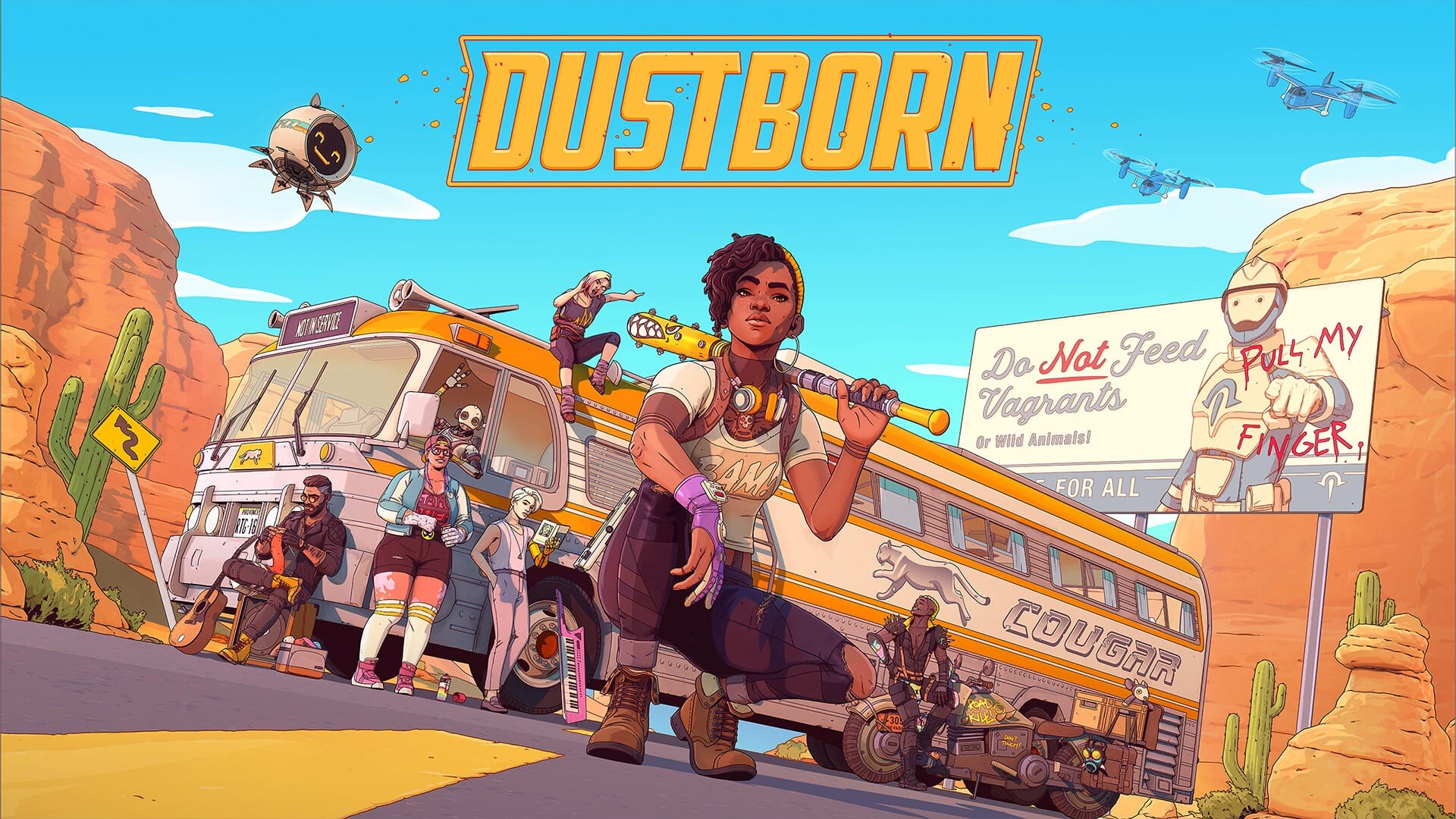
Developed by Red Thread Games, Dustborn is a narrative-driven action adventure that combines political commentary, colourful characters, and unique gameplay mechanics that make it a standout experience — if you’re willing to embrace its quirks.
In a world where JFK survived his assassination attempt and Marilyn Monroe is still strutting her stuff at 106, Dustborn offers an intriguing journey through the “Divided States of America”.

Meet the Superheroes of the Not-So-United States’
At the heart of Dustborn is a ragtag group of misfits, each with their own unique powers, strengths, and weaknesses. They’re not your typical caped crusaders; they’re everyday people who’ve been affected by “The Broadcast,” a major event in the year 2000 that divided North America and granted some individuals extraordinary abilities. A signal emanating from the centre of America unleashed a burst of concentrated information. Powerful words built from an ancient language have lingered in the form of “Echoes” continuing to spread misinformation, causing fear, paranoia, and violence. Among the chaos, a small few gained supernaturalistic powers and became “Anomals” humans with the ability to craft powerful words.
This band of heroes, led by the ex-con Pax, is on a mission to liberate those still reeling from the aftershocks of this cataclysmic event. Pax isn’t your typical protagonist. Her powers are inherently negative and usually cause trouble. Some of the outcomes of her choices to use her words feel painfully obvious or predictable. But thankfully, quite helpful in combat. As you guide Pax and her crew across the Not-so-united States, you’ll be faced with imperative objectives that lead to delays, detours, and some delightful distractions.
READ MORE: Review | Nobody Wants to Die ‘A Haunting Vision of a Dystopian Future’ (PC)

The Narrative: A World of Politics and Pop Culture
Dustborn is unafraid to wear its heart on its sleeve. The game’s focus on politics, diverse character design, and storytelling has made it what stands out most to me in a sea of similar narrative-based games. In a game where you can shout the word “cancelled”, I’m not surprised this game has sparked mixed reactions on forums like Reddit, or in the trailer’s comment section. However, this very willingness to push boundaries and embrace differences in every way possible sets Dustborn apart. The game has crafted a unique narrative sprinkled with colourful and layered characters that will stick with you long after the credits roll.

Dustborn also hosts broader conversations on sentience, autonomy, and self-identity. In a world where robots are badass sidekicks, nannies, cooks, and law enforcement, there is so much to be considered and explored when it comes to the various mechanical characters we’ll meet along the way.
The game is sprinkled with subtle retro pop-culture references, with a heavy focus on their alternate reality version of pop-culture. Most of the characters are over the age of 30, and I found the humour is quite millennial and in reflection of that. It skirts on the edge of corny and cringe. Nothing, in particular, had me belly-laughing but there were a few chuckles and loud nose exhales from my Generation Z self on occasion.

A Visual Novel in Disguise
Though not officially a visual novel, Dustborn plays like one. It’s dialogue-heavy, with a lot of focus on character development and relationship management. Each character gets an introductory card when you meet them, similar to Borderlands, complete with their age, pronouns, and powers. You can track your relationships with the main characters and see how they evolve based on your interactions. You can also find items to gift in locations to help form stronger bonds (or weaken them if you give them the wrong gift).

While the ending is relatively predetermined, your decisions influence certain aspects, giving you just enough agency to feel invested. But don’t expect to save scum your way to a perfect playthrough. Dustborn saves very often and occasionally you’ll need to live with your choices. Though you can usually make amends over time. This adds a layer of tension, especially as you get closer to the end and begin to worry about how your decisions will affect the final outcome.
The game is separated into comic book issues in which the player can read to reflect on the story and the decisions made.

Breaking Up the Dialogue
To keep things interesting, Dustborn introduces a few gameplay mechanics to break up the dialogue-heavy experience. There’s combat, sure, but the real standout is a Guitar Hero-esque rhythm game that pops up at various points.
Pax and the gang are transporting an important package to Nova Scotia across the Justice-controlled American Republic. With multiple factions hot on their heels, they need a cover story to cross through the borders without suspicion. And what better than a pop-rock band on a robot-driven tour bus? The band dubbed “The Dustborn”, must make it to key events throughout their journey, craft songs, and perform them along the way to prove their legitimacy. At first, the music feels a little “cringe”, mostly because these characters are not actually seasoned musicians. However, towards the end of the road trip, I was singing along to every song.

Even if rhythm games aren’t your forte (and they’re certainly not mine), there are settings to adjust the difficulty so you can still enjoy these moments without feeling overwhelmed or having a particularly negative crowd reaction.

Gameplay: More Talk, Less Action (And That’s Okay)
Dustborn attempts to be many things: a rhythm game, a comic-book-styled beat em’ up, a choose-your-own-adventure, and even a pong emulator… If you’re coming into Dustborn expecting intense combat or fast-paced action, you might want to adjust your expectations. This game is more about dialogue and self-reflection, akin to titles like Life Is Strange or Telltale’s The Wolf Among Us. It’s easy to sit back and get lost in the story. Even the rushed moments don’t feel rushed and you can choose to walk around for any missed loot before you make your escape. There are many opportunities to dive into even deeper conversations with your crew or explore the environment around you, and they’re mostly completely optional.
The game’s pacing is slow and deliberate, making it ideal for those who enjoy taking their time with a narrative. However, this also means it’s not a game you can easily play in short bursts—an hour will fly by without you even realising it.
READ MORE: Review | The Crush House (PC)

Fighting the Good Fight
For the most part, it’s a simplistic combat system. Hit-enemy-make-health-go-down. You can block incoming damage and barrel-roll away from incoming damage. Pax charges up two special ways to attack, one is her taunt which involves following a prompted combo to focus your attack on a single enemy and do a lot of damage. The second is similar to an ultimate ability charge-up, where Pax can use her special abilities to choose from a menu of known words to create a powerful shout, each with a different effect (think Thu’ums from Skyrim). Pax can also combo her shouts with her gang, for example, she can use ‘Hoax’ to convince her enemies are taking burning damage and call Eli to conjure the “Bit-u-man” to attack alongside them temporarily.

Pax is armed with a modified baseball bat. You can upgrade this throughout the game with electronic parts you find throughout your travels. It’s possible to unlock every upgrade by the end-game combat sequences and you can refund upgrades as you go.
Early on, there was an in-game pop-up where the game asked if I would like MORE combat. More combat?! It wasn’t super clear what this meant, but of course, I opted to add more. Overall, the amount of combat and the difficulty I received felt stock-standard.
Combat was really only there to make sense within the story and play around with the shouts the only way Pax really can. If we ever see a sequel, I’d love to see this area of the game evolve into more complicated combat scenarios.

Mini-Games
Other than concerts and combat, there are a few mini-games to diversify the gameplay experience. Throughout the game, you will come across echoes, collecting them with your trusty “MEEM” (yes, I know), you can then use them in word crafting to learn more ‘shouts’. But some sequences are a little more involved like throwing Molotovs in a motorcycle chase; taking on a turn-based, pixel art styled combat sequence; playing arcade games, and more.
READ MORE: Preview | Ace Attorney Investigations Collection (Switch)
Accessibility & Settings
Dustborn may not revolutionise accessibility, but it offers a handful of thoughtful features that make the game more approachable for a variety of players.
- Modifiable Subtitles: modify subtitle font, size, and colour. These settings help to break up the visual clutter, making conversations easier to follow the frequent overlapping dialogue in the game.
- Considerate NPCs: If you interrupt a background conversation by engaging in another, the NPCs will politely pause and pick up right where they left off with a “so anyway” once you’re done. This ensures you don’t miss out on any dialogue, even if you’re juggling multiple interactions. Additionally, in the pause menu of the game, you can re-read conversations in bubble text to catch up.
- Optional Combat Banter: During combat sequences, you can turn off Pax’s chatter and the enemies’ banter. This allows for a quieter, more focused combat experience if that’s your preference.
- Adjustable Quick-Time events: Simplify and tweak the interaction speeds up or down, giving you control over how challenging these sequences are.
- Streamer Mode: Automatically blocks copyrighted audio from playing.
The Perfect Couch Game!
Playing Dustborn on my PS5 was a refreshing change of pace from my usual PC gaming. It’s the perfect game to relax with on the couch for a couple of hours, and I can see it being a great game to play with friends or even livestream. Just keep in mind that the game’s slower pace might make it hard to stay focused at times, especially during the longer dialogue sequences. But if you’re in it for the story, there’s a lot to enjoy.
If you’re a completionist, this game will easily take you above the 20-hour mark. But I think a standard playthrough will have you looking at roughly 15 hours.
READ MORE: WolfEye Studios Teases Dishonored-like Gadgets and Powers in New Sci-Fi RPG

Bumps in the Road
Dustborn had a fantastic first impression when it came to quality. However, towards the end you could see the blemishes that hadn’t yet been smoothed over. Disappearing textures, a handful of floating objects, one count of bugged dialogue that halted progress until I restarted, and three complete crashes stretched out across the final 10 hours. Hopefully the day one patch solves these issues.

The Verdict: A Slow Burn Worth the Time
Dustborn isn’t a game for everyone. Its slow pace, heavy focus on dialogue, and political themes might turn some players off. But for those who appreciate a well-crafted narrative with complex characters and a world that feels both familiar and strange, it’s a journey worth taking. Whether you’re a fan of more simple narrative-driven games or just looking for something different, Dustborn offers a unique experience that’s hard to forget.
Dustborn is planned to be released on the 21st of August on PC via Steam & Epic Games Store, Xbox Series X|S, and PlayStation 5. You can catch a glimpse of Pax’s story in the demo available now on the Steam store.
Quest Daily scores Dustborn:
7.5/10
A review copy of Dustborn was supplied to Quest Daily for the purpose of this review.