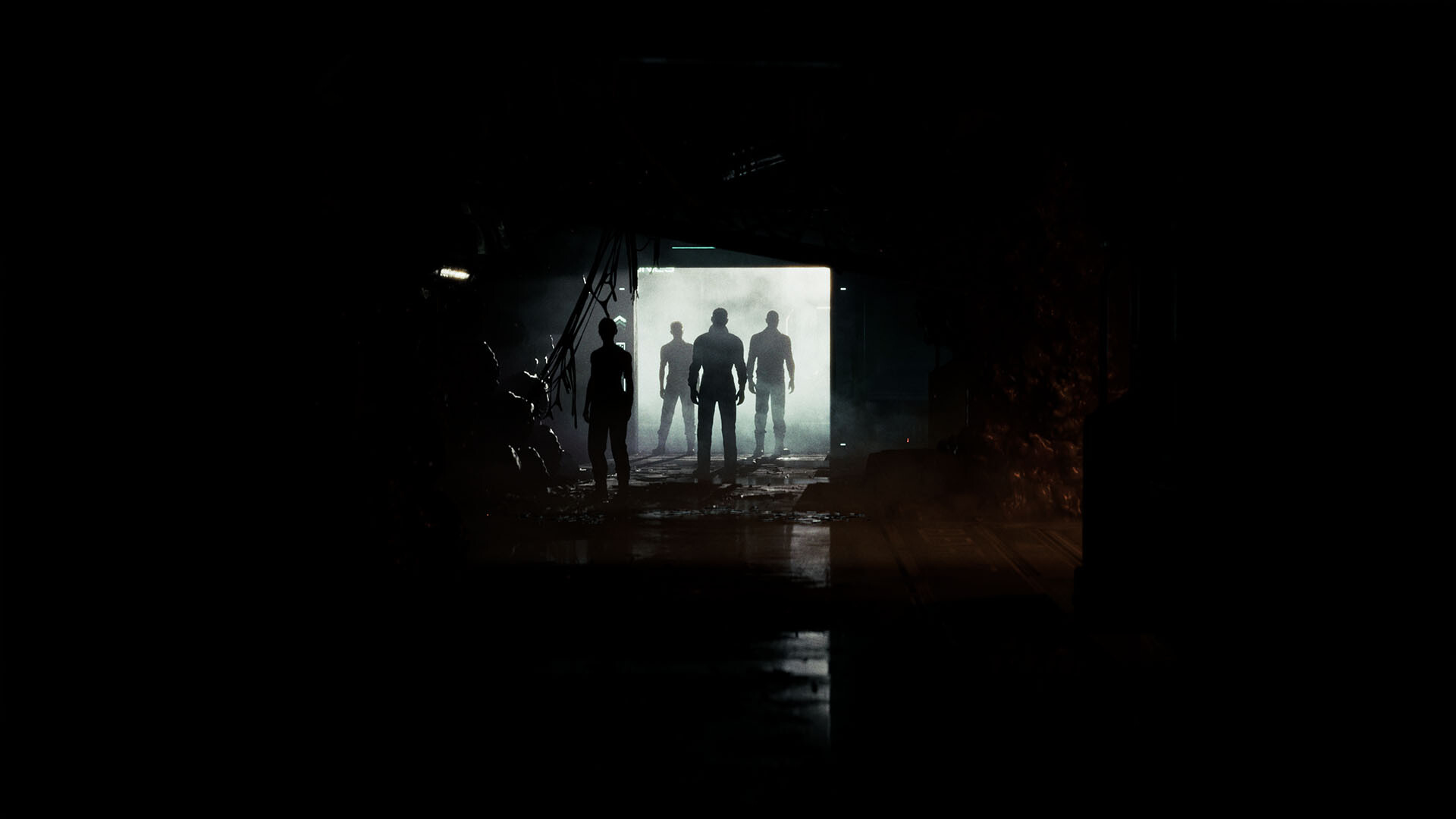
Space is already terrifying. Being trapped on a ship with an alien threat while your crew slowly falls apart makes it worse. Throw in a scattered story, broken tension, and some lacklustre gameplay mechanics… and that’s the icing on the cake.
Supermassive Games trades haunted houses and summer camps for deep-space horror in Directive 8020, the latest entry in the Dark Pictures anthology. While it experiments more with player choice than previous games in the series, it is the systems around decision-making — rather than the horror itself — that end up defining the experience.
READ MORE: Review | SAROS: ‘Bullet-Hell Bliss’ (PS5)

Getting Lost in Space
A four-year journey halfway across the galaxy for the salvation of Earth sounds stressful enough already. Unfortunately for the crew of the Cassiopeia, things only get worse from there…
One of the biggest changes comes through a new rewind system that allows players to instantly undo major decisions rather than live with the consequences. I thought I would hate this change — after all, part of the fun of these games is accidentally getting someone killed and living with the regret — but I surprised even myself and quickly embraced it.

Rather than weakening the tension, it shifts the experience into something far more experimental. Playing in Explorer Mode, you are encouraged to test outcomes, correct mistakes, and learn from failures in a way previous entries never really allowed. For a more traditional experience, play the game on Survivor Mode ..
There is still no option to skip cutscenes, which makes rewinding and replaying sections a little frustrating. Even so, accidentally killing off a character and immediately rewinding after learning from your grave mistake felt weirdly heroic. No one is dying a horrible death on my watch… well, no one important.
READ MORE: Review | Life is Strange: Reunion (PS5)

The story itself is difficult to discuss without wandering into spoiler territory, especially because the game constantly jumps through time. Episodes frequently leap forward by hours, sometimes longer, while new crew members are gradually introduced from sleep pods throughout the journey.
Video messages, old emails found on tablets, and CCTV footage all help piece together what happened aboard the ship before everything spiralled out of control.
Some of the time jumps worked well, but others felt too abrupt and removed potential suspense. One moment involving a crew member becoming infected by an alien entity felt like it skipped over important tension and build up entirely.
Small Steps Forward

Gameplay innovations are fairly limited. Puzzle solving mostly revolves around swapping power nodes between doors and searching for access codes to unlock lockers or restricted areas. It gets the job done, but it never evolves much beyond that.
One new mechanic I did enjoy was the ability to send messages to crew mates. While most conversations are fairly scripted, you can usually choose the tone of your responses, whether that means being serious, supportive, or throwing in a joke to lighten the mood.
READ MORE: Review | Pragmata: ‘To The Moon’ (PS5)

When the game slows down and lets the crew interact naturally, Directive 8020 shows flashes of something stronger. Quiet conversations between crew members help make the Cassiopeia feel lived in, even if the broader experience never fully leans into that strength.
Some crew members were instantly likeable. Samantha, Brianna, and Nolan stood out early, while others had me counting down the minutes until their inevitable demise. *Cough* Williams *cough*.
The performances are mostly solid throughout, even if some dialogue is a little stiff — or slips into familiar sci-fi horror territory.
The game is also broken into episodic chunks, with each chapter lasting around thirty to forty minutes before opening up more branching paths and story outcomes.
Horror In The Dark
In terms of horror, the bones are there, but it builds tension in bursts rather than sustaining it consistently. Moments of genuine unease appear, particularly in confined sections like vent crawling, but the overall experience never fully reaches the same intensity as Until Dawn or The Quarry.

Visually, the game also struggles with environmental variety. Supermassive clearly leans into a bleak sci-fi aesthetic, but spending roughly ten hours moving through dark grey corridors and dim industrial hallways eventually becomes exhausting. A brief moment near an indoor tree and some plants stood out purely because it was one of the only visually distinct locations in the entire game.
For a game set in space, I also expected more moments that actually embraced the setting. The crew wear anti-gravity boots designed to keep them grounded — something the game specifically points out — yet I never encountered a proper playable low-gravity sequence where characters floated through the ship. Even the early space walk felt restrained.
READ MORE: Review | Resident Evil Requiem: ‘Bloody Brilliant’ (PS5)
Should you play Directive 8020?
At the end of the day, Directive 8020 is still very much a cinematic choose-your-own-adventure experience first, with occasional stealth sections and light puzzle solving layered on top. Gameplay remains relatively simple, but the addition of the rewind system meaningfully reshapes how you engage with decisions and consequences.
While it does not reinvent the Dark Pictures formula, it does make it more flexible, approachable, and experimental than previous entries.

If you are looking for Supermassive’s most frightening or tightly crafted horror experience, this is not it. The tension comes in bursts rather than sustained dread, and the sci-fi setting never fully reaches its atmospheric potential.
However, if what you want is a more forgiving, experimental take on the Dark Pictures formula then this is one of the more interesting entries in the anthology. Directive 8020 may not be the scariest or most memorable entry in the series, but it is a confident evolution of the formula that earns its place in the lineup.
Quest Daily scores Directive 8020:
7/10
Directive 8020 is out not on Xbox Series X|S, PlayStation 5 and PC via Steam.
Access to Directive 8020 was supplied to Quest Daily by the publisher.