Experience the searing heat of the Australian outback like never before in Drop Bear Bytes Studio’s latest RPG, Broken Roads.
Imagine facing the harsh climates, dangerous wildlife, and giant spiders of Australia’s wilderness, now add a post-apocalyptic twist. How would you survive?
After spending the past two weeks venturing into this challenging world myself, I’m happy to say it was all worth it in the end. Though every decision meant life or death, Broken Roads has been a thrill and put my gaming skills to the ultimate test.
READ MORE: Review | Botany Manor (Xbox Series X|S)

World Building
Throughout the development of Broken Roads, there has been a significant emphasis on the inclusion and respectful portrayal of First Nations culture.
Working closely with First Nations consultants, the team behind Broken Roads prioritised gathering feedback from elders and collaborating with Indigenous artists to ensure that all aspects were not only approved but also deeply respected.
This commitment underscores the studio’s dedication to honoring and authentically representing First Nations within the game. You can read more on the inspiration and the process of identifying culture when making the game from Quest Daily’s interview with Drop Bear Bytes Co-Founder and Developer Craig Ritchie.

Your story begins by choosing between four different origins: Hired Gun, Surveyor, Barter Crew, and Jackaroo. Each origin has different starting stats and includes a brief back story.
If you are a mercenary player who loves their weapons, the Hired Gun is your best choice. Surveyors are all about exploration and cartography, with an origin story focusing on intelligence statistics. If you talk the talk and love bartering for better loot you may look towards Barter Crew.
My personal choice for a well-balanced character that can hunt, heal, and has tinkering skills, is the Jackaroo.
READ MORE: Review | Children of The Sun ‘One Bullet, One Goal’ (PC)
Morality
In Broken Roads, character design is streamlined with a choice of eight pre-designed characters, followed by the freedom to select your name. The game’s standout feature, the Moral Compass, takes center stage next.

This unique mechanic serves as a reflection of your morality within the game world, shaping how you navigate your persona.
Divided into four distinct ideologies — Humanist, Utilitarian, Machiavellian, and Nihilist — the Moral Compass defines your character’s ethical stance.
To ascertain your position on this compass, you’ll answer a series of thought-provoking questions, culminating in a Golden Arc that encapsulates your guiding principles and ideals.
READ MORE: Review | Spirit City: Lofi Sessions (PC)
The Moral Compass and your Golden Arc are influenced by dialogue, quests, and your relationship with your party and NPCs, creating personalised gameplay. As confirmed by the developers, there are 150,000 options players can complete the game, now imagine that amount of influence on your morality. Your choices matter!
The Story Begins
It’s time to embark on your journey across the diverse landscape of Noongar country, where your story begins near the settlement of Brookton. Depending on the origin you’ve chosen, your starting point may vary. As a Jackaroo, my adventure kicked off on Taylor’s Farm, plunging me into immediate tasks and challenges.

The locals in the settlement are not shy of suspicion and will expect you to earn your place and pull your weight if you want to be a part of their community.
After a few introductory quests, where you meet other main characters and learn the mechanics of the game, you discover that the settlement of Brookton is not the haven it appears to be. You eventually meet Brookton’s Mayor who speaks of settlements being attacked by raiders, and that communities are struggling to survive with the harsh conditions of the barren outback.

The looming threats ominously foreshadowed soon materialise as Brookton falls under the control of raiders. With no alternative, you must fight and evacuate your newfound community.
Setting out into the Wheatbelt of Western Australia, you embark on a quest to discover a potential new home for your people. Along the way, you’ll confront a myriad of challenges and hardships, each presenting its own set of obstacles on the horizon.
Navigating the World
The isometric RPG adopts point-and-click mechanics when it comes to gameplay. Playing on PC, you move and click your mouse on where you want to go, and what you want to discover or interact with.
The user interface is clean with everything you need to find located at the bottom of your screen. You can find your character sheet, inventory, quests, map, dialogue, and tutorials all in one very convenient place.

The character sheet also holds all your skills and traits; when you level up you will receive one point to put into one of your main traits and 20 points to divide out into your skills. It’s a great way to develop your character and unlock bonus perks to help you in combat or on your journey.
READ MORE: Review | Planetiles ‘Tetris Had A Spherical, Galactic Baby!’ (PC)

I found the gameplay mechanics of Broken Roads to be thoroughly enjoyable, as they allowed me to fully immerse myself in the story while seamlessly navigating exploration and combat, all without feeling overwhelmed.
You Call That Knife?
The game features turn-based combat where you will enter upon initiative order. You’re not only controlling your own character but your party members as well – it’s very Baldur’s Gate. Here, strategy comes into play as combat can be randomly scaled up to increase the challenge.

READ MORE: Review | Pepper Grinder (Nintendo Switch)
You share an inventory with your team, so before setting out on exploration or before an upcoming fight you can prepare yourself and your party with ease.

As you explore and travel between locations you may be surprised by random raider parties or animal attacks where you can choose to fight or flee.
The game does a great job at creating pacifist options, you’re able to avoid fighting in every encounter. You can talk your way out of an intense situation, intimidate your enemy, or bribe your way; the combat style is accommodating for any preference.
Art and Sound
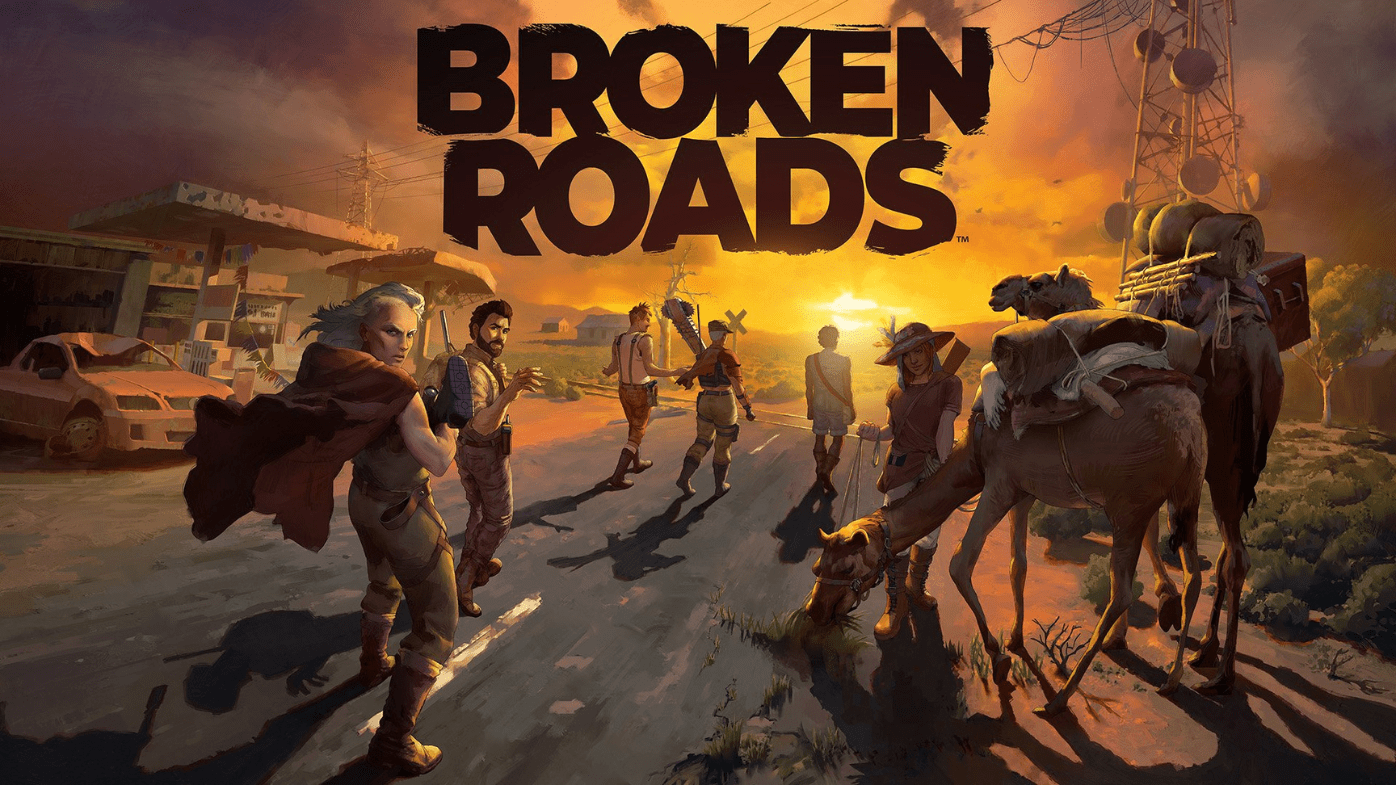
Trust me when I say this: the art style of this game is stunning.
The visuals are wonderfully detailed, with characters and landscapes offering a hand-painted aesthetic. The art style brought me back to my childhood, reading picture books such as The Magic Possum and Animalia. The developers hit the nail on the head when designing the Australian outback. I felt like I was directly under the hot sun, with the colour palette featuring various shades of red, orange, yellow and brown.

The game’s music features calming sounds from indigenous culture, soft strums of a guitar and deep vibrations of the Didgeridoo. When entering certain areas you even heard faint sounds of native animals and birds. The sound was subtle but fit the overall gameplay experience perfectly.
Voice Acting or No Voice Acting?
Broken Roads is very story-rich, and with that comes a lot of dialogue and text. The game features a narrator who speaks through defining events of the game or when moving on to the next chapter.
However, the voice acting falls short within the gameplay, as random bits of dialogue are read aloud. When playing the game I would forget about the voice acting until suddenly a character I interacted with was speaking through my headset, this can be a bit startling. I found that when reading dialogue I had imagined what NPCs voices would sound like and when the character would randomly start talking, it became quite disruptive to my imagination.

The game could still work well without voice acting. I believe the developers should choose one or the other instead of having the odd character orate.
Australian Themes
This game is Australian through and through, especially when it comes to slang. If you aren’t familiar with the Aussie slang such as ‘old mate’, ‘hard yakka’, ‘cobba’ and the confusing ‘yeah, nah’ and ‘nah, yeah’ then no need to feel uneasy as the game has done a brilliant job at highlighting these phrases and providing a definition.

As Australians, swear words start to become every second word in our sentences and the game does not shy away from curses. They may not appear as frequently as a punter at your local footy match, but it is important to be aware of them.
A note for Aboriginal and/or Torres Strait Islander peoples, be aware that Broken Roads may feature the names and voices of people who have passed away. The game also offers this warning, however, I believe it should be included in this review before deciding to play the game.
Is The Journey Worth It?

Broken Roads is a treasure trove of immersive storytelling, vibrant culture, deep lore and challenges, making it a refreshing addition to the world of post-apocalyptic RPGs.
During my gameplay experience, I encountered only minor bugs, none of which were game-breaking. Given the vast number of potential endings in Broken Roads, it’s possible that players may encounter occasional bugs or errors.
However, considering the game’s earlier delay this year for further development and refinement, I’m confident that the team at Drop Bear Bytes is committed to addressing any issues through updates.
As a player, I’m thrilled to explore a game set in our own backyard; the experience has been an absolute delight from start to finish.
Broken Roads releases on PC (Steam), PlayStation, and Xbox on April 11th, the Nintendo Switch version will be released in May, as confirmed by the developers.
Quest Daily scores Broken Roads:
8/10
A review copy of Broken Roads was supplied to Quest Daily for the purpose of this review.