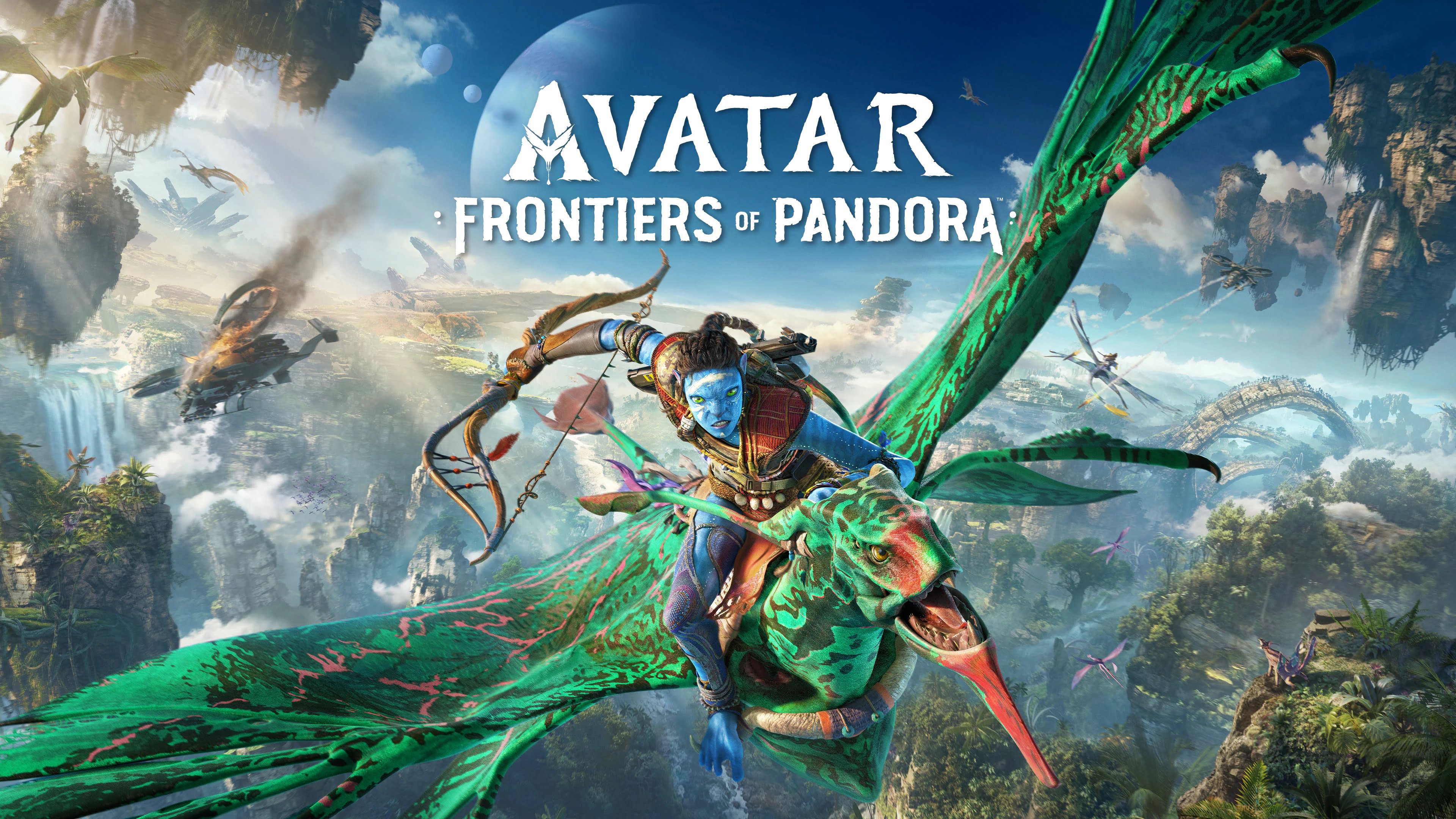
The first Avatar video game in over a decade has arrived, just 12 months after the second installment in the billion-dollar film franchise.
This is no spin-off, Frontiers of Pandora is a direct continuation of the story we know and love.
READ MORE: Review | Turnip Boy Robs a Bank (Xbox Series X)
Set deep in James Cameron’s Avatar world, the game is filled with beautiful environments and action-packed adventure.

World and Story of Avatar: Frontiers of Pandora
Frontiers of Pandora is an open-world marvel, with stunning landscapes and bright glowing flora to boot.
You play as an orphaned Na’vi, who grew up in captivity under the watchful eye of humans. You and the other Na’vi orphans are told of their family’s betrayal, but you’re not buying it.

The opening scene has the children in a classroom learning the ways of humans, after a confrontation they decide they need to escape.
READ MORE: Review | Dredge: The Pale Reach DLC (PlayStation 5)
John Mercer (the bad guy) shows no mercy. He catches them and stops them in their tracks.
Following a little sing-song, Mercer fires a shot that changes everything.

After creating your character, you awake and take the reins for the first time. Through the eyes of your Na’vi, you must escape the facility.
Now Pandora is being evacuated, with the Navi told that a “Jake Sully” is on the attack…
Hearing that name alone grounded me, placing me directly in a story I’ve been familiar with for years.

A maze of hallways and ventilation shafts, a very simple stealth sequence and glimpses of the world to come are teased as you navigate the dark hallways.
Exiting the human facility, your prison for years, and seeing Pandora for the first time was a big “Wow” moment.
This game is beautiful.

Seeing the world for the first time is reminiscent of exiting the vaults of Fallout or emerging from the cave in Breath of the Wild.
The game is visually stunning, and at times highly detailed.
Take the bugs of the world, tiny little things you’d walk past without blinking. But jumping into photo mode reveals a lot more.

Creating your Na’vi
When it comes to character creation, it’s all very same-same. There are three nose presets; short, slightly longer and slightly longer again.
The mouth is very much the same, with slight increments in size. Ears, you guessed it, slight size implements there too. And eye colours are a mix of greens and yellows.

You can also choose your Bioluminescence pattern, yet these are nearly impossible to see. There are 12 patterns to choose from, but you can’t see them well in the character creator. They’re little dots on your body that glow in certain environments.
In addition to this, you can choose your skin pattern and shade of blue.

Overall, character customisation seemed obsolete, with minimal changes. I would’ve rather picked from three or four premade characters.
READ MORE: Review | Pokémon Scarlet And Violet: The Indigo Disk (Switch)
But if you’re unhappy with your appearance, very early on in the game there’s a place to change it up.
Exploring the world of Pandora
After picking up a bow, your natural instincts kick in and shooting arrows is like riding a bike.

Despite being made in the same engine as Far Cry, they’re very different games. Bow play did feel similar at first but there’s so much more to it. In Avatar, you need to, climb a tree, spot the baddie, shoot an arrow if you like. Sure, you can go running in and pummell the puny humans with your fists, or a machine gun, but I’m a sucker for stealth and bow-and-arrow combat.
Also, this game is quite difficult on the default setting!
It’s your choice and you can spec your character accordingly.
Holding ‘R1’ unlocks your Na’vi senses, highlighting useful environmental details, in addition to your objective.

The PlayStation DualSense controller’s adaptive triggers come into play when harvesting fruit and plants – more on this in a moment.
READ MORE: Review | A Highland Song (PC)
There’s a skill tree to upgrade your Na’vi’s moveset, but special abilities must be acquired at certain locations. These are highlighted on a map in the skill menu.
Connecting to worldly flowers, known as Tarsyu, you can learn unique skills and abilities. The first one you acquire is a double jump – and they only get more useful from there.

You can also use gear to improve your base skills like strength and stamina. You’re able to buy gear from a trader, or craft it once you collect the right resources.
Some traders only deal with specific clans, build enough rapport with a clan to unlock new equipment.

The map is quite grand in scale, there’s plenty to see and do, especially when you eventually take to the skies.
Thankfully there’s fast travel to get you back to base in a flash, and key locations are marked on the map with waypoints available.

There’s also a handy ability to choose your respawn location when you die, not something you see too often in gaming.
READ MORE: Review | Tekken 8 ‘Gorgeous, fluid, fast and impactful’ (PS5)
In addition to the main quests, there are dozens of side quests for you to take up.
Speak to Na’vi around the Hometree, take up jobs from the friendly humans at the resistance base – there’s no shortage of tasks to take on.

The game throws a lot at you, and it doesn’t all stick. As the player, you’re given the freedom to power through the story, or stop and cook a meal, climb a tree and craft a bow.
There’s so much going on here, it’s almost overwhelming. But thankfully you’re not being forced to play in any particular way.
Graphical and Gameplay Settings
There are two visual modes to choose from: Favour Performance and Favour Quality.
I swapped between the two but landed on performance in the end. Even with the extra frames, the game still looks nice.

When you start a new game, there are a few options for gameplay. Three difficulty modes affect combat; low, medium and high. You can then choose from a further two gameplay modes, with one focused on exploration.
READ MORE: Review | Like a Dragon: Infinite Wealth ‘Goofy, heartfelt and exciting’ (PlayStation 5)
One of my big gripes is seemingly lazy cutscenes. Every cutscene begins with a dip to black. Quick cutscenes, no more than 10 seconds long, are met with a black screen…
One scene was a simple aircraft flyover, a moment on screen, that was interrupted by black. It really voids immersion and takes the player out of the game.
I also found some cutscene animations were clunky, notably when large groups of characters were sharing the screen at the same time.

It’s a shame, as the cutscenes generally look great, they just aren’t seamless. It’s very last-gen, and not at all what you’d expect from a AAA, current-gen console game.
DualSense Controller
The DualSense is an absolute treat with this game. It’s as if this game was made specifically for PlayStation 5. Adaptive triggers come into play more than any game I’ve played in recent times (besides from Spider-Man 2).
I love to see it.
Snapping branches off trees and collecting fruit requires precision pressure on the adaptive trigger and you’ll need to force through that final resistance to snap it.

Using the SID tool, human-tech for hacking, utilises the triggers again. As you scan for wiring and faults you’ll need to apply just enough pressure on the right trigger to pinpoint frequencies and repair pathways.
And as you’d expect, when pulling back the drawstring on your bow and firing an arrow. You can feel it all.
READ MORE: Review | Prince of Persia: The Lost Crown (PlayStation 5)
Climbing rocks and cliffs is felt through the haptic vibrations in the controller, as is jumping and landing. Even standing by a crackling fire or standing in the rain can be felt through the controller haptics.
The DualSense goes hard.

Multiplayer
Online multiplayer unlocks after you complete the quest titled “The Aranahe Clan”. It’ll take you a couple of hours of game time to reach this point.
So if you’re hoping to jump into multiplayer from the start, you’ll be disappointed.

Frontiers of Pandora
This bold and bright world almost came out of nowhere. It certainly wasn’t on my radar until weeks before its release, but I’m so glad I chose to experience it.
Avatar: Frontiers of Pandora is one of the best movie-based video games I’ve ever played and a faithful entry to the Avatar series.
The main story is jam-packed, taking me just over 50 hours to roll credits. Its beautiful graphics and open world are only slightly let down by its rough cutscene transitions and clunky animation.
Avatar: Frontiers of Pandora is out now. There’s also DLC on the way, the first scheduled for mid-2024.
Quest Daily scores Avatar: Frontiers of Pandora:
8/10
Quest Daily was granted early access to Avatar: Frontiers of Pandora with thanks to the publisher.