
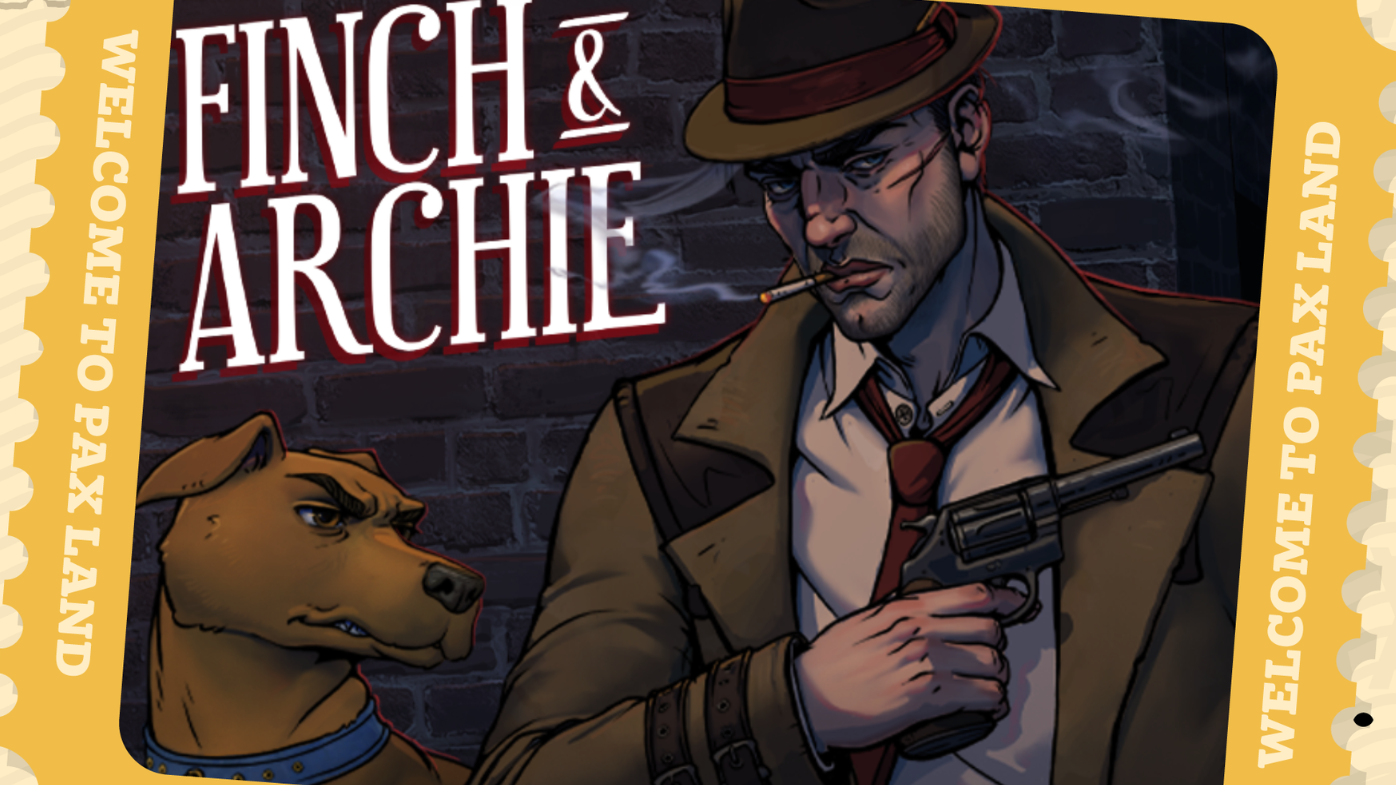
Who doesn’t love a good murder mystery, especially one where you can play as a dog?
In the lead-up to PAX Australia 2026, we caught up with Indie Showcase winners Dickson and Rhys from Octarine Arts to unmask the mystery behind developing Finch & Archie.
Finch & Archie is your debut title. How has your development journey been so far?
This has been an incredible journey so far. Of course, there’s been little bumps in the road (we definitely look back and laugh at our INCREDIBLY optimistic project timeline) but overall our gasts have well and truly been flabbered by how well Finch & Archie has been received.

Don’t get us wrong, we think it’s a great game, but when you’re a first-timer, you have no idea what to expect.
You’re just making something you love and hoping people will love it too.
And we’re extremely fortunate that people are genuinely so excited about the project, and share our passion for grumpy Finch and very good boy Archie. It’s been such a fantastic experience and we’ve had so many seriously cool opportunities come up because of it (I mean, showcasing it at PAX?! Hello?! So awesome!), we’re really just riding the high and enjoying the adventure!
READ MORE: Preview | Finch & Archie: ‘Hot On The Right Track’ (PC)
How did the idea of Finch & Archie come about, and how did you settle on this idea as the first game for the studio? What influenced you to make Finch & Archie a co-op experience?
It started when we were all studying at University, we had an assignment that essentially meant we had six weeks to prototype a game with a “core meaning”.
We would frequent Chinatown in the city between/after classes (nothing gets the creative juices flowing like good food and beer), and while there Tom and Dickson got talking about the concept of Perspectives as the core meaning. The idea of having two totally different and unique perspectives within one game – that two players could experience the same world and story, and yet experience it totally differently to each other. That idea really intrigued us.

The idea grew from that to include communication. How could communication work between the players in a way that would help bridge the gap between those different perspectives? We didn’t know, but we were super excited to find out.
From there Finch & Archie were born… the buddy cop duo of a human and his dog solving the same case but getting two different sides of the murder mystery.
Obviously it was a “little” overscoped for a uni project, but we knew even then we had something pretty unique and interesting on our hands. Once we’d graduated we sort of just knew we wanted to stick together and give Finch & Archie the time and work it deserved.
Was the character of Archie always a dog? Were there other considerations, such as another human or animal?
I think we knew from the very first idea of the game, it was always going to be a human and dog partner — we wanted a classic archetype that the players could understand and want to play as.
The idea that people have to play as two different characters, it would have been a hard sell for many different combinations, but people understand a human and dog partnership. Man’s best friend!
Every time we pitch the game to anyone and we say it’s a two-player murder mystery game about a human and dog detective, people get excited to play as a dog – and then they start to rattle off all the ideas and mechanics they want to do as a dog – and we have them all! Smello-vision, animal talking to animal, barking, patting. It’s second nature to everyone, its not something that we have to teach in game.

Currently, Finch & Archie supports text-based communications in-game as well as gestures such as whistling or barking.
As communication is so important to the player experience, how do you see the in-game communication tools expanding or evolving?
The communication system has been the most iterated mechanic across the whole development – we have debated and prototyped and spitballed more communication ideas than we can (and in some cases, care to) remember.
We had the idea of making communication symbol based – emoji style comms, we had it be totally closed – no mic at all, we had (in the original prototype) it be a set lexicon that the players could communicate in, Dark Souls style, just to name a few.
We have landed on what we believe to be the best system.

Our biggest counterpoint that we were always facing was the innate relationship that the players will inherently have with each other, that they will want to speak live-mic while they are playing.
They are likely friends or partners that will want to joke and have fun and talk about the game while they play it, but as our game is about finding clues and information the other player cannot find, and then sharing those findings with the in-game communication system, it was always a concern – if they’re just talking over the mic, what’s to stop them just telling the other player what they found, instead of sharing leads in-game like we intended?
It took watching players experience the game to realize that really, it all comes down to fun. If players want to chat and laugh, all the better, and we adjusted the comms system to reflect that, we want it to still be a challenge and want to encourage player creativity, but it doesn’t have to be serious if they don’t want it to be. The game doesn’t at all differentiate what the players message each other, or detect if the clue or lead they send is “correct”, but by the end of the game, there will be so many leads that if they don’t have some sort of system or coherency, then it will be their own downfall. And we’ve found that players love this. No, you don’t have to do the “right” thing, but if you don’t… well, good luck Detective!
When you’re playing together, who is your go-to character: Finch or Archie, and why?
#TeamArchie. It’s funny how, even as the devs, you fall into the same character roles during testing. At the start anyway, we definitely found this. Obviously that created some blind spots so we learnt to keep switching it up. If you ask our writer, Liz, she will always say Finch is her favourite (she loves a broken man with a heart of gold), but let’s be honest… we all want to play as Archie, really.

Although Finch & Archie is about solving the mystery together, each player is out there questioning different suspects and finding unique evidence or items for the case.
What was the process like to come up with this asymmetrical style of gameplay? Did it affect how the narrative and cases were written?
Oh boy. Yes, it massively affected how the narrative was written. We’ve constantly battled with the story, trying to make the plot and perspectives as balanced as possible – but intrinsically, it never will be. You can try to write the same word count for each player’s unique dialogue, you can try to make each puzzle they solve individually the same size and scope, but gamers have different play styles, they read at different speeds, and while one player may understand something immediately, the other might be wandering around admiring the environment… so, basically, the asymmetrical aspect will mean that we can never have a truly balanced game, but we’ve also come to realise, that that’s okay, and that the players understand that.
As the cases cannot be solved without teamwork, how does the team balance Finch and Archie so that both players feel like their roles are just as important as each other?
As stated above, balance was incredibly tricky. Ensuring each player felt vital to the team, felt they had enough to do, felt they understood enough of the mystery… it was a real challenge. We wanted to make sure that the player’s both had abilities that would mirror each other — this being Archie’s smell-o-vision (his ability to sniff out clues and link evidence together via a smell trail) and Finch’s magnifying glass (his ability to see tiny details that give him better insight into evidence and events).
The idea being that each had a similar amount of things to sniff/magnify, and with this new-found information, they would send each other leads to clue the other player into what they’d found. This constant line of communication between them helps ensure they’re on the same wavelength so-to-speak, and helps balance each character.

The other thing we did was playtest, playtest, playtest. There’s no better way to tell if something feels wrong or unbalanced than just getting in there and getting a feel for it.
What can players expect at Octarine Arts’ booth for PAX Australia 2026?
We’re most excited about showing off a new, never-before-seen murder case! Finch & Archie will be heading to a new location, solving a new mystery and interrogating a whole new cast of suspects… and PAX gamers will get to experience it before its official release!
We’ll also have a little communication-based puzzle for those keen to flex their creative muscles. Come by the booth to collect a lead in need of decoding… and follow instructions for a chance to win a set of Finch & Archie pins! We know there’s going to be some hilarious, clever submissions.
Finally, what’s your message to gamers; what’s the one thing you want people to know about your game?
I think a lot of people don’t realise that we’re just a small team of five core devs, working on the project while working other jobs. We hope that the love and care we’ve poured into this game is evident for players, and that — with Finch & Archie being our first ever game — they are keen to follow our studio’s journey, support us in this project and those to come.
Overall we want to say THANK YOU, it wouldn’t be possible to get this passion project to PAX without the positive reception from all the gamers out there, and we’re so grateful for it. We hope you all love Finch & Archie just as much as we do.
Finch & Archie is currently in early access on Steam via PC.


