Final Fantasy 14 is a one-of-a-kind MMO, fuelled by a welcoming fanbase and a development team matching its passionate players’ energy year after year. After building immense goodwill through its infamous launch, award-winning expansions, transparent communication, and live in-person events worldwide, Final Fantasy 14 has become a uniquely positioned titan in the industry.
Next year will see the launch of Evercold, the MMO‘s sixth expansion, continuing the overarching story the game has been telling for over 17 years now. This entry will see players journeying to a new reflection frozen over by ice, inhabited by people who fled to the skies in massive airships to survive the apocalyptic event. The upcoming expansion will also introduce major revamps to its core experience, introducing a new Evolved Mode that aims to streamline spell rotations for all classes. Other changes target the game’s daily grind, shifting it to a weekly mode and adding more seasonal content throughout the expansion’s life cycle.
READ MORE: Review | Final Fantasy XVI: Echoes of the Fallen (PlayStation 5)
On October 30th, the team will hold its final FanFest event of the year in Tokyo, where it will announce the last few details coming to the expansion in January.
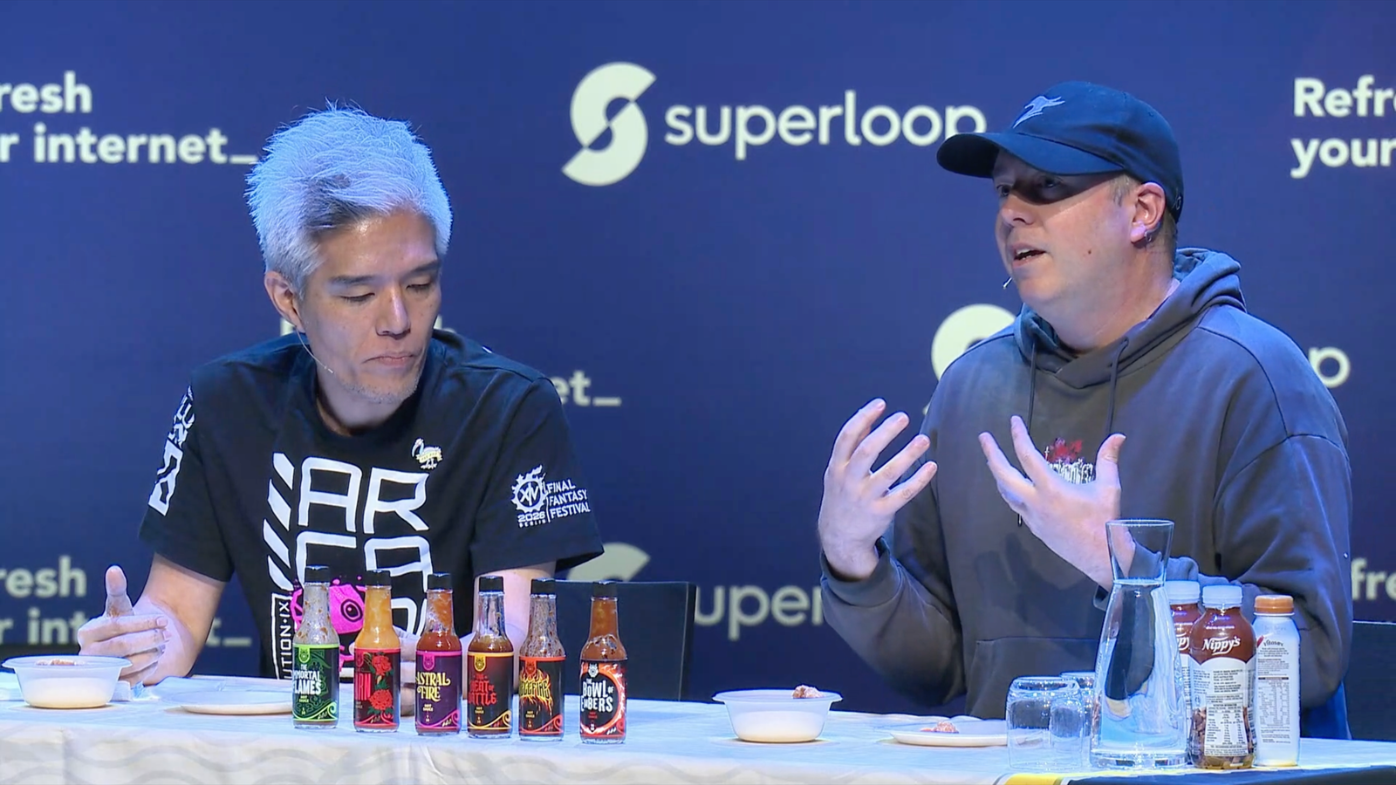
Ahead of the event, Quest Daily spoke with Michael Christopher Koji-Fox, Lead Localisation Director for Final Fantasy 14 (and occasional rapper for The Primals), and Toshio “Foxclon” Morouchi, Head of Square Enix’s Community & Service Division and Global Community Producer for Final Fantasy XIV at PAX Australia.
The pair have been beloved figures in the Final Fantasy 14 community, often appearing at fan events and co-hosting livestreams to communicate directly with players over the years. In our chat, we spoke with the two about the MMO’s localisation process ahead of Evercold, Wicked‘s Jonathan Bailey voicing the beloved cat boy G’raha Tia, and how much they’re preparing for the upcoming multi-hour live letter at Tokyo FanFest.
Preparing For The Last Live Letter of the Year

Despite their visit to Australia, we were sadly not the venue for this year’s Fan Fest. That honour will go to Tokyo later this week, which at the time of our chat, Foxclon, Koji-Fox, and the wider team at Square Enix are all hands on deck preparing for.
“Right now we’re at the end of the development period,” Koji-Fox admitted, torn between his responsibilities and enjoying his trip in Australia. “Especially in localisation, everything comes at the end. Everyone spends the time making [the game], and when they’re done, it’s time to translate it. I love being here in Australia, I’d love to stay longer, but part of me is like, ‘I need to get back and do some work,'” he’d laugh.
A busy period before the launch of an expansion isn’t all too surprising. But it’s the upcoming Live Letter on October 30 that’s adding to the pair’s stress.
“I can’t imagine how long the [Live] Letter will be,” Murouchi admitted, the duo nervously laughing together.
“It’s going to be hours. I’m already dreading it,” Koji-Fox would add in. “I’m sure it’s going ot be great, and I’m sure fans are going to love it. There are so many new things coming in Evercold, and [director] Yoshi-P wants to communicate the changes because it’s very different from expansions we’ve had in the past. We’re not just adding new content that continues the story. It’s all about evolution this time, and changing the systems.” As a result, Koji-Fox said the team expects to host even more live events to explain the changes coming to the game.
“I think [Yoshi-P] wants to explain everything so everyone knows what’s coming and not really be surprised by any of these bigger changes,” he clarified.
How Final Fantasy 14’s Localisation Team Works

One of the rarer aspects of Final Fantasy 14 is how interwoven the localisation team is within the company. In other games or series, localisation is treated as merely translating, but for FF14, it’s a core part of the game’s storytelling.
“We have a very large localisation team,” said Koji. “We have at least five in-house, then we have just as many freelancers as well. We have our own Slack channel and we’re always communicating. People all over the world [including] West and East Coast America, the southern part of America, and the UK. We have two translators from Australia: one in Perth and another in Canberra. They’ve been on the project since the beginning.”
It goes without saying that the FF14 team is a tight-knit group, with working relationships spanning back to before they even started on the MMO. “They (the Australian translators) were with me on Final Fantasy 11, and I brought them over, so they’re veterans on the project.”
READ MORE: Dune Awakening: ‘Unlike Any MMO Out There’
Koji-Fox went on to explain that the team has a direct line to FF14’s scenario writers, who write not only the game’s main storyline but also the many side quests, FATEs, and raids throughout the series. “A lot of the time, localisation are the first people that see a quest. The quest team will do internal reviews, but localisation is the first to see anything. Even before Yoshi-P checks, localisation work will already start.”
Localisations’ contested access to the scenario writers was a viral topic earlier this year, as Koji-Fox admitted in an interview with Anitrendz that they were told they weren’t allowed to talk to lead writer Natsuko Ishikawa at work. “She’s so busy we’ve been told by the assistant producer that we’re not allowed to talk to her, and there’s a block now,” he’d share in our chat.
“The thing is, though, her desk is really close to mine. Every now and then she’ll go to the water cooler, and I’ll say, ‘I’m over here! Can I ask you about…?’. She’s really nice, and she’ll answer them because it’s not like she doesn’t want to. But the thing is, there are 500 other people who want to ask her questions as well, and she’ll end up answering them, and then she’ll get back to her desk and be like, “Oh, the day is over, and I have done nothing. What do I do?”, he admitted.
“So, other than Ishikawa-san, we have direct lines to all those scenario writers, and that’s kind of why I think we can get something that is very true to the original writer’s intent. Because we have that insight into what they’re writing and can ask them questions when content becomes weird.”
The Pivot to Theatre Actors After A Realm Reborn

Early in Final Fantasy 14’s life cycle, the team reinvented itself a second time, pivoting its voice cast away from traditional voice actors to theatre actors. “We first started with Hollywood actors in 1.0,” Koji-Fox shared. “We wanted to have a Game of Thrones type of feel, and that was something we had discussed internally with the lore creator Kenichi Iwao at the time.”
That inspiration eventually led them to settle on a more British-style dialect for the game, although the team were admittedly inexperienced as to how to authentically capture this. “At the time, we didn’t have any studios in the UK that we were working with at Square Enix; it was all in Hollywood. So, of course, we went to the Hollywood studios, and they’re like, “Oh, British? Yeah, we can do British, no problem.’ And it was just nothing but American actors doing British accents.”
Koji-Fox went on to explain that, internally, everyone agreed what they heard matched their expectations of a British accent. However, once the rest of the world heard it, especially players in the United Kingdom, it was clear the performances were closer to an imitation than something authentic.
“Americans were like, ‘Yeah, this is great,’ but the rest of the world was like, ‘These aren’t British actors’. We had Nolan North, Nathan Drake from Uncharted, as Papalymo, but he’s doing his British accent. I thought it sounded okay,” he conceded. “I’m not too proud to admit that was a learning point for me in understanding that accents are very important.”
READ MORE: Review | FINAL FANTASY RESONANCE: ‘This one resonated’ (NS2)
Still, fan feedback prompted the team to recast the game with talent found through SIDE Studios in the UK, which Koji-Fox said was a very different experience for the team.
“Going with theatre actors is a very different vibe from TV or movie actors. Theatre actors take a different approach. It’s less about the voices and more about the acting. I think a lot of times with dubbing in anime or games, people kind of get focused on a voice and mimicking a certain voice, whether it be in the source, in the Japanese, or whatever, it can end up sounding gimmicky. Theatre actors, they’re about the acting. You’re not getting as many different types of voices, but you’re getting such better acting”.
One of the biggest names in Final Fantasy 14’s cast is Jonathan Bailey, who’s gone on to star in hit series like Wicked and Bridgerton. In 2025, People Magazine named the actor the sexiest man alive, a fun bit of trivia Koji-Fox was happy to remind us of.

Despite his growing profile, Bailey has still been reprising his role of G’raha Tia in the game, and according to the developer, he’s still actively reaching out to get back in the booth.
“He’s super humble. He loves the project so much. He’s always personally sending emails and asking us, ‘So, we in? When’s the next recording?’ I truly believe he loves the character and loves playing [G’raha], and I think that shows in his performances because they feel so authentic, because he’s so fully behind him”.
Exploring New Settings and Cultures Throughout Final Fantasy 14

Throughout Final Fantasy 14’s history, the game hasn’t shied away from drawing inspiration from different cultures and time periods to shape new settings. In its most recent expansion, Dawntrail, players visit the lands of Tuliyollal, which was heavily inspired by Central and South America. In Evercold, the game is looking to flex its mythology muscles by tackling a heavier Norse-themed setting, which, according to Koji-Fox, has led to many down Wikipedia rabbit holes.
“I think one of the requirements to be on the localisation team is that you love to do Wikipedia dives,” Koji-Fox half-joked. “There are a few people on the localisation team that pretty much specialise in working with the lore team. The Japanese team will say, ‘We want to do something that’s themed like Old Norse’, but they know as much about it as we do. So they’ll come to us, and there’ll be things they might not be able to find through their searches in Japanese, and they want us to go in and help them find it. Then we bring our knowledge to help each other.”
However, story and cultural research is one thing. For the localisation team, the toughest challenge comes down to pronunciation. “The great thing about FF14 is that we have a very large internal team of not just English translators, but also the German and French translators,” he’d share. “Those translators then will have their network of friends and, so it turns out, we have somebody [on the team] who knows a professor from Iceland so we can get help on Icelandic words.”
READ MORE: Review | Final Fantasy XVI ‘This Is Why I Play Video Games’ (PlayStation 5)
“We can bring all of [this] knowledge together, then share that with the Japanese team to [build out these ideas] that are based on real mythology, but also has a Final Fantasy 14 twist to it.”
It’s not a process that’s unfamiliar to Final Fantasy, as fans might quickly point out. Since some of its earliest titles in the 90s, the series would borrow famous religious and mythological characters such as Shiva and Ifrit, who have gone on to become iconic figures within the franchise.
“We’re using adjacent mythology, then making it our own. What you’ll see [in] Evercold, is that there will be familiar older terms, and you’ll be able to recognize them, but they’ll be used in a way that is unique to Final Fantasy 14,” Koji-Fox explained.
Preparing For Evercold

Evercold is shaping up to be another Heavensward-level defining statement from the FF14 team. While it would be unfair to call Dawntrail a mistep, it’s hard to deny it had a bit stacked up against it. Without its previous story arc and the game’s older gameplay style and narrative style starting to show its age, it was clear there needed to be a major shake-up to the game.
The devs apparently seem keenly aware of this, and have spent the years leading up to Dawntrail to lay the foundations for all the changes to come through in Evercold. While Evolved Mode and the change from daily’s to a weekly format will be some of more immediate changes to the game, the team are also enthusiastic about the coming additions to character customisation.
“Character customisation is very huge to the community,” Foxclon shared. “There will be lots of new cosmetic options, [like choosing] the animation when you teleport. For sure, the new content and the new storyline are very big things. But, to me, the more options for your avatar is the biggest thing.”

“A lot of players have been playing for 10 years, and while, yes, everyone looks forward to the story, once it’s over, you’re back in your daily routine,” Koji-Fox would add. “To have more options to customise that daily routine is what’s really exciting about Evercold. New ways to customise your housing, your character, your adventuring, moving from the daily schedule to weekly, you don’t have to do the same thing every day. You can bring variety to it, because you have more options, and be able to customise that in-game experience so it doesn’t feel monotonous.
“You can bring a little bit more excitement to it, make it more personalised to you, because ultimately, that’s what an MMO is. It’s about bringing you into the game and being able to express yourself to the fullest.”
Final Fantasy 14: Evercold launches in January, 2027 and will be available on the PlayStation 5, PC, Xbox Series S|X, and the Nintendo Switch 2.