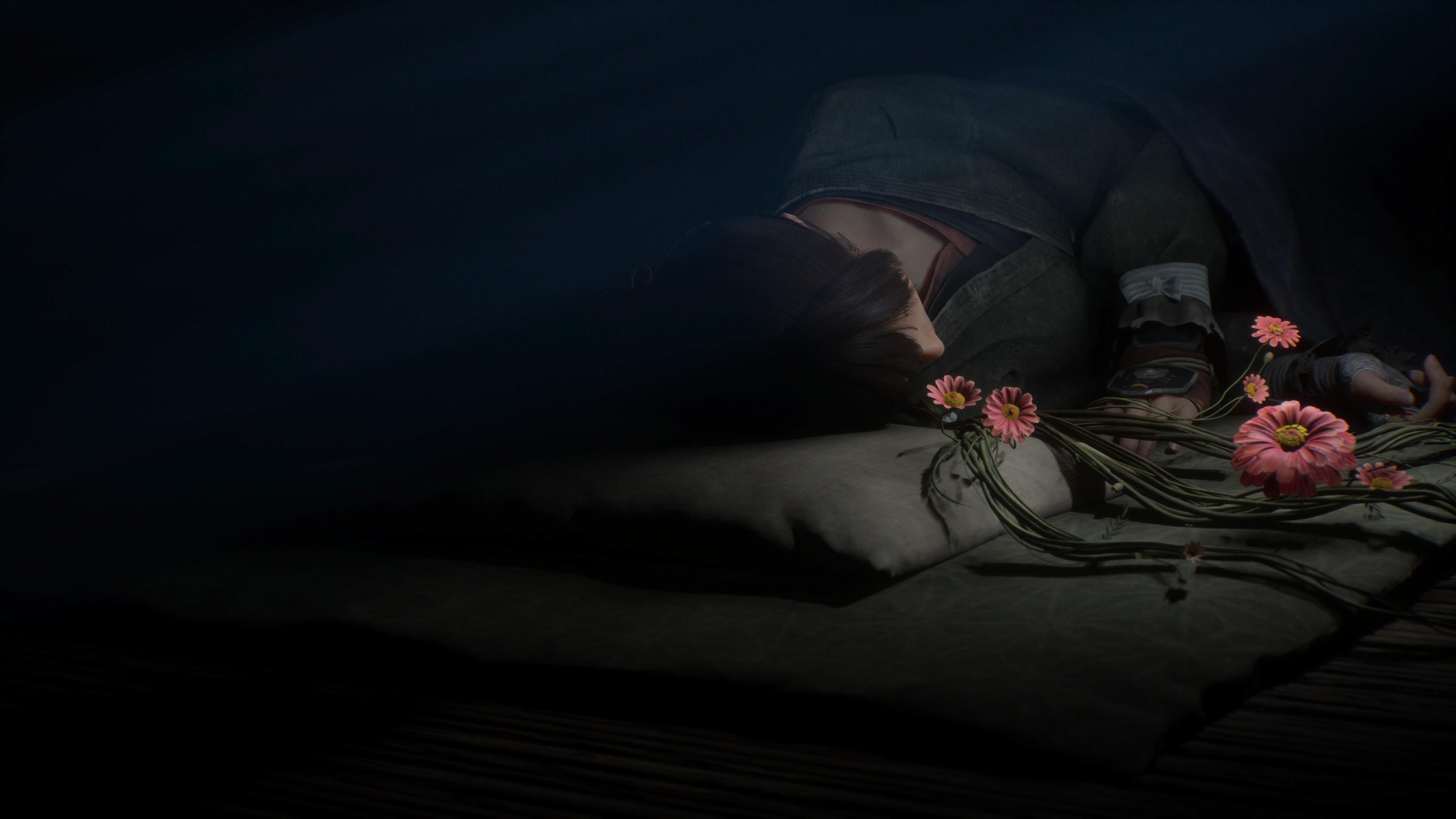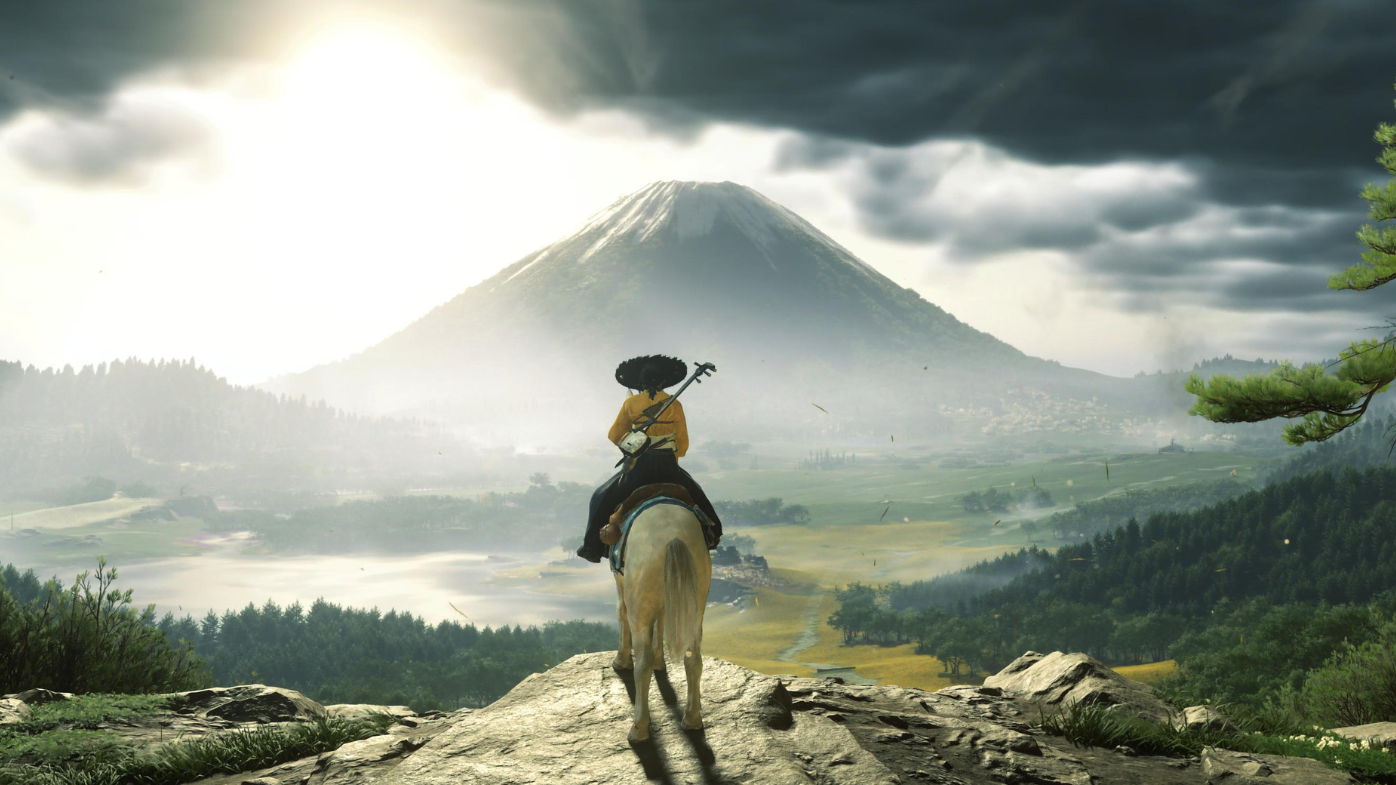
In a year overflowing with excellent samurai and ninja titles, Ghost of Yōtei had a big job to do. After spending every waking moment of the past couple of weeks playing it, I’m happy to say it’s a hit. Yōtei isn’t reinventing the blade, but it continues to satisfy my sharp steel cravings — and fuel my photo mode obsession.
Set 300 years after Ghost of Tsushima, this is an indirect sequel. You don’t need to have played the first game to understand what’s happening here. It’s full of tightly written narrative, intense action, and spectacular landscapes.
All images were captured on the PlayStation 5 Pro.

The Ghost of Yōtei
When she was a child, our protagonist Atsu’s family was slaughtered by a deadly group called the Yōtei Six. She dedicates the rest of days to training and taking them all out. 16 years since that fateful night, she’s sharpened her blade and is on the hunt.
READ MORE: Review | DEATH STRANDING 2: ON THE BEACH: ‘Out-Stranding’ (PS5)

The story wastes no time, throwing you straight into the action. The opening sequence has you tracking down one of the Yōtei Six for a brutal showdown — a moment that cements Atsu’s reputation as a deadly force.
She earns the title of Onryō — a spirit of vengeance — early in the story, highlighting the game’s central themes of revenge and survival. As players progress, flashbacks to Atsu’s childhood share insight into her motivations, making her actions and choices in the present day far more impactful.
By the time the credits rolled, I had tears in my eyes — the Yōtei narrative is truly spectacular.

Unlike Tsushima‘s Jin Sakai — whose morality was tested as he strayed from the samurai way — Atsu is more single-minded. She’s here to kill, and doesn’t particularly care how it’s done.
Most cutscenes can be skipped, though I don’t know why you’d want to — the English voice acting is excellent. The story is one of the game’s strongest points; I was drawn in and found it almost impossible to put down (unless life forced me to). After 100 hours, I’ve completed and collected almost everything.

That said, Yōtei lacks replayability. Once a quest is finished, it’s finished — enemy outposts can’t be replayed, and by the endgame I had maxed out Atsu’s abilities and gear with no worthy enemies left to test them on.
Ezo

The map gradually expands into a sprawling world. From the grasslands surrounding Atsu’s family home to freezing mountain peaks, there’s plenty to discover.
Each main zone has a town where Atsu can collect bounties, buy or sell resources and meet with local bow and armour merchants. You can also upgrade her health at hot springs, earn new abilities at altars, and gain charms from shrines.
Fox dens return, bamboo strikes make a comeback, and we have a new coin-flicking minigame called Zeni Hajiki — one of my favourite additions. Zeni Hajiki adds a skill-based minigame, rather than the luck-driven gambling minigames we see in so many open world games these days — super refreshing.
Combat and Gameplay

Atsu is an absolute beast on the battlefield. Where Tsushima relied on stances, Yōtei focuses on weapon choice — it’s a nice change and I’m here for it. The katana is best against other swordsmen, dual katana counter spear users, and the kusarigama excels against shields — while doubling as a brutal stealth tool. There’s plenty more to find and embrace.
READ MORE: Review | Baby Steps: ‘Failing Upwards’ (PC)

Weapons can be upgraded, and resources are abundant. Exploration pays off, though there’s little grind — materials stack up quickly, and later armour even collects flowers automatically while you ride. I never really found myself buying resources or searching for any.

One of the most welcome additions is Atsu’s bond with a mysterious wolf.
The wolf can leap in during battles to save your skin, and you in turn help it at dens across Ezo. There’s also an ability to call the wolf to your side before taking on an enemy outpost.
Atsu’s relationship deepens over time, and without spoiling anything, it becomes a core part of the journey.

One particular game mode named “Miike Mode”, named after 13 Assassins director Takashi Miike, increases blood and mud effects, while it was fun to try it out I didn’t leave it on for long.
Customisation
There’s an incredible library of vanity items for Atsu to collect, from helmets and headbands to robes, armour and masks. Not to mention the dozens of colour variables you can apply to some of them.
I had four loadouts that I would constantly switch between, each with their own armour set and charms. One was great for exploring, another was great for ranged attacks, another was perfect for close combat and my fourth just looked bloody awesome.

While many armour pieces are perk based, if you choose your charms right there’s some incredible combos you can knock together.
There’s also dozens of weapon skins to discover.

Novelties and The Dualsense
Crafting activities such as cooking fish or forging steel are highly detailed, though largely cosmetic. Cooking up a mushroom or a fish (they’re the only options) can give you a major or minor perk once a day. Though there’s no consequences for burning the food.
Thankfully, you can skip these sequences — which I found handy playing on the PlayStation Portal. Didn’t quite like the idea of using my Portal as a hammer…

The DualSense controller is really put to work here — sometimes impressively, sometimes needlessly. Lighting fires requires touchpad swipes and trigger “blowing,” while cooking mushrooms or fish has you tilting the controller over the flame. There’s even an option to blow into the mic. These interactions are fun novelties.
READ MORE: Review | Metal Gear Solid Δ: Snake Eater (PS5)
The touchpad is useful throughout the game in more traditional sequences, like checking the wind direction, bowing and playing music.
Immersion and Performance
Ghost of Yōtei is a feast for the senses on PS5 Pro. Forests, mountains, and fields are brought to life with ray-traced lighting, smooth 60fps performance, and a refined UI that feels sleeker than Tsushima’s, with softer prompts and cleaner alerts.

The world feels alive, with plenty of wildlife — deer, birds, and other creatures — adding to the sense of a living, breathing Ezo (you better believe there’s a wildlife article coming).
Even minor details, like particle effects in the wind or the shimmer of sunlight on snow, enhance immersion.
That said, NPC populated areas feel a bit stale. They just stand around, repeating the same task… and never sleep.

Environments are also less interactive than in Assassins Creed: Shadows; you can cut through doors, but most objects in Yōtei are set dressing. Still, both games carve out their own space on 2025’s “samurai hall-of-fame”
Performance-wise, the game mostly runs beautifully. Load times are quick, and I thank autosave for keeping my progress safe. A few crashes dampened the vibe, and a handful of other bugs cropped up over 100 hours — invisible coins in the mini-game for one — but these were rare and didn’t significantly detract from the experience.
The one major issue I came across was a bounty and altar locked behind a gate. I’ve submitted a report to PlayStation and am awaiting a fix.
Music and Photo Mode

Music plays a key role in the game. Atsu’s shamisen is more than a narrative tool; learning new songs along the way unlocks gameplay abilities, while the soundtrack swells and settles with traditional Japanese instrumentation, perfectly complementing the world’s mood.
There’s also a game mode that brings in some lo-fi beats to the world.
READ MORE: Gallery: The Wildlife of Assassin’s Creed Shadows
Photo mode enhances this further, letting you capture animated backgrounds, particle effects, facial expressions, and musical overlays.
I admittedly spent many hours in photo mode…
Here’s a collection of some of my favourite snaps, all captured on the PS5 Pro:


Should I Buy Ghost of Yōtei?
Is it the ultimate open-world samurai experience? Not quite — but it doesn’t need to be. Yōtei is one of the most beautiful PS5 titles yet, with stellar combat, a gripping story, and a deeply personal protagonist. While its immersion doesn’t quite match other recent titles, it still holds its own.
If you loved Ghost of Tsushima, this is a no-brainer. With new weapons, fresh locations, refined systems, and an emotional journey, Yōtei is easily one of my favourite games of the year.
Quest Daily score Ghost of Yōtei:
8.5/10
Ghost of Yōtei launches on PlayStation 5 on October 2nd and retails digitally for $124.95.
Early review access to Ghost of Yōtei was supplied to Quest Daily by PlayStation Australia.