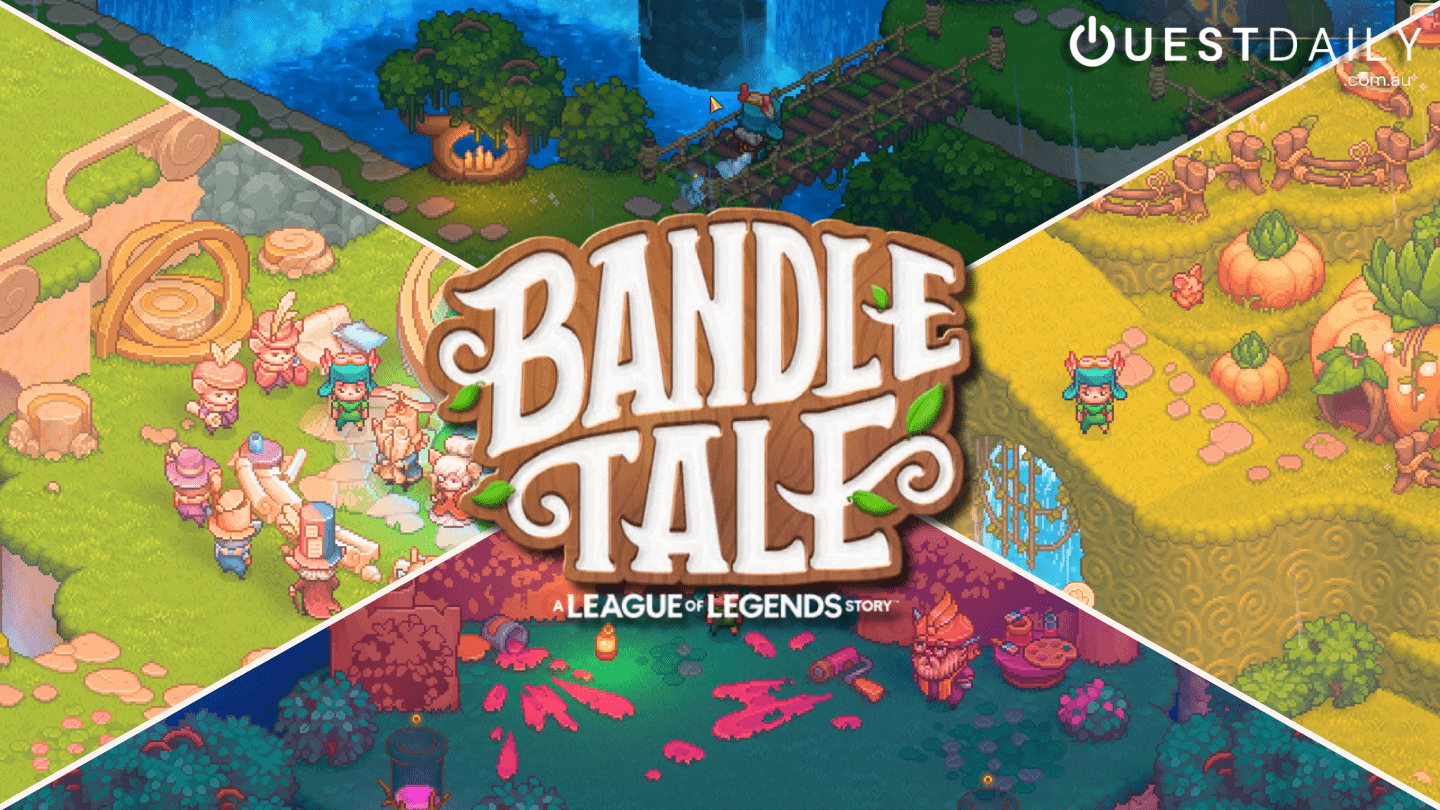
Bandle Tale is a captivating journey into a whimsical world; inviting players into the boots of a resourceful yordle, a mystical creature from the League of Legends universe.
Players will embark on an adventure through vibrant and meticulously designed pixel islands, offering both fans of League of Legends and newcomers a delightful new adventure.
READ MORE: Review | Tomb Raider I – III Remastered (PS5)
Exploring the world of Bandle Tale
Developed by Riot Forge, Bandle Tale is where cuteness and creativity collide to forge a world that’s as aesthetically pleasing as it is imaginative.
The game’s pixel graphics are nothing short of adorable and the game’s map design cleverly incorporates illusions and labyrinthine paths. Each of the game’s beautiful islands are teeming with unique challenges and mysteries.


Despite its cosy veneer, reminiscent of games like Stardew Valley, Bandle Tale is firmly rooted in the RPG genre. It features a linear storyline, with the player usually juggling two or three quests with lots of fetch and crafting-based objectives; trying to figure out the order of completion as they are all woven into each other in some way. There is not a lot of freedom, and the player needs to be strategic as they work their way through four lengthy skill trees.
READ MORE: Review | Helldivers 2 ‘Explosive and Incredible Game Design’ (PS5)


The initial simplicity of the gameplay lasts the first five or so hours, where players are slowly introduced to many of the game’s concepts and kinds of crafting. But ultimately, you can expect to be thrown into the deep end once locations beyond Bandle University are unlocked.

Puzzling Puzzles
The puzzles quickly escalate in complexity and scale. Initially confined to one island, you soon find yourself navigating between three, and eventually four. Gathering distinct resources and utilising specialised aura spots to create specific items, you frequently shuttle between islands for each crafting stage, which can become tiresome.
READ MORE: Review | Mario vs. Donkey Kong ‘A completionist’s dream’ (Switch)
At one stage, I found myself stuck on all my quests. I encountered the need to craft Charged Zipcans (batteries) to fix elevators and progress to a higher level on an island. However, crafting them required more than just unlocking the skill. I ended up deeply engrossed in figuring it out, resorting to scribbling on a physical notebook page. I found this amazing diagram already completed on a walkthrough on Neoseeker after the fact (of course).

Fortunately, if you have crafted yourself an abundance of Portal Yarn at the beginning of the game, you can rely on this to make use of a few portals to help make traversing the world a little easier. Additionally, you can consult your map and filter by yordles to streamline locating specific characters.
Despite your yordle’s false leg, there’s still a considerable amount of running involved. The interchangeable prosthetic legs introduce a dynamic element to traversal, incorporating a stamina bar. This leads to a mix of annoyance and admiration as you navigate the islands’ somewhat deceptive layout.
READ MORE: Review | Final Fantasy VII Rebirth (PlayStation 5)
Managing Skills and Orbs
In Bandle Tale there is a lot of pressure to manage your skill points efficiently. Skill points are used to enhance your crafting abilities and progress the game. It’s wise to unlock things only as you need them, rather than what feels most interesting to you. Though it may seem fun to research mechanical bugs, you may find yourself in a grind trying to farm more points later on (note zipcans).

Skill points are mainly earned by collecting ‘Emotion Orbs’. To gain these Orbs, players can harvest resources and craft items. However, they must continue to undertake new activities, as repetition doesn’t count over time. This ‘diminishing returns’ mechanic emphasises the importance of exploration and pushing forward.
Almost all actions in the game help gather Emotion Orbs. When you rest, these Orbs convert into Skill Points. You can also gain skill points from hosting successful parties which is an easy way to progress if resource gathering is no longer generating enough. Quest completion also gives you a big chunk of them.
READ MORE: Why Persona 3 Reload Should Be Your First JRPG
Mini-games

Hit a wall in skill points? Just throw a party or two! (Supplied) 
There are many different parties to plan! (Supplied) 
Build party furnishings according to what your party needs! (Supplied) 
Food stands help you get guests excited for a party! (Supplied) 
So many recipes to learn! But you only really need to know three to progress. (Supplied) 
Running through a few of these guarantees you can invite as many people as possible.
Mini-games inject a fun diversion into the gameplay. While necessary at times, they’re mostly customisable, allowing players to adjust complexity as they prefer. For example, Food Stalls work a little like a pixel art version of Overcooked; the player takes orders and uses their various stations to fulfil orders in the right order while on a timer. Players can invest in learning more about cooking and food production, and create more complex meals. I mostly stuck to making the same three simple meal variations when I needed to participate. But it was nice to know I could have delved deeper if that was my thing.
Inventory Management


Inventory management is also a notable pain point. It was a less-than-intuitive organisation system using small un-upgradable chests that ultimately disrupt the crafting process. Thankfully, you have your travelling backpack home which can be upgraded. The player’s backpack is a dynamic hub for crafting and customisation. It stores materials and artifacts gathered during adventures and doubles as a portable workshop, enabling players to craft wherever they set down their backpack. While this mechanic is crucial, it often doesn’t provide enough flexibility.
READ MORE: Review | Suicide Squad: Kill The Justice League (PS5)
Gripes aside, Bandle Tale is an extremely polished game, and nothing about it seemed particularly rushed or unfinished to me.

Crafting in Bandle Tale
In Bandle Tale, the crafting system plays a central role in gameplay, intentionally posing a significant challenge. With vague mission directives and diminishing returns on XP, players are encouraged to engage in problem-solving and strategic thinking — every aspect of this game feels like a puzzle to solve, which can test your limits if you’re not into that sort of challenge.
Despite having a day/night cycle, no objective is timed allowing players to immerse themselves without the pressure of rapid problem-solving. However, if you are solely looking for a simplistic cosy experience, this game may not be for you.


For fans of the League of Legends universe, Bandle Tale offers a treasure trove of references. From artifacts that reference specific champions to an artful depiction of Baron — meeting our beloved yordle champions feels magical. Helping them solve problems, navigating relationships, and bringing them joy is quite heartwarming and rewarding. While the dialogue may not break new ground, its occasional humour and references add a layer of charm. It all provides a sort of respite in a game that demands a lot of patience and strategy.
READ MORE: Review | Like a Dragon: Infinite Wealth ‘Goofy, heartfelt and exciting’ (PlayStation 5)

This gentle rhythm encourages players to take their time, explore, and perhaps, in those quieter moments of resource management or quest diversions, find the solutions they were seeking all along.
Is Bandle Tale a must-play?
At its core, Bandle Tale is a cosy puzzle game, blending the tranquillity of games like Animal Crossing with the satisfaction of assembling a complex Lego set or a 1000-piece puzzle. Admittedly, puzzles aren’t usually my go-to, but the allure of the League of Legends universe drew me in.
After about 40 hours of gameplay, accounting for some idle moments, I can confidently say that the $40 investment was well worth it. It was challenging, and I feel proud of myself for working through something not usually in my comfort zone.
For those on the fence, catching Bandle Tale on sale would be the perfect opportunity to dive in—I’d more than recommend trying it out.
Quest Daily scores Bandle Tale:
8.5/10