A review copy of Final Fantasy VII Rebirth was supplied by the publisher.
Taking one of the most beloved games of all time, breaking it up into three pieces, and still managing to maintain the soul of the original is no small feat. Developers Square Enix have done that — so far anyway.
Final Fantasy VII Rebirth is the second part of a fantastic retelling. It elevates the original story while weaving new mysteries throughout. The scope of this sprawling RPG is so vast, with so much content, it’s clear why the game needed to be split into parts.

READ MORE: Review | Like a Dragon: Infinite Wealth ‘Goofy, heartfelt and exciting’ (PlayStation 5)
It launches just a month after another Japanese RPG, Like a Dragon: Infinite Wealth, and they share a lot of similarities. Both games have protagonists with wacky hairstyles, are packed full of mini-games, and even feature ridable segways (which is wild) but mainly, they’re just bloody excellent video games.
A Tale Of Two Buster Swords

Oh boy, how to talk about the story of Final Fantasy VII Rebirth? The plot that can be talked about has been around for 27 years, and any big changes or new content is obviously spoiler territory.
In the same vein as FFVII Remake in 2020, Rebirth expands and elaborates on the story we know and love from the 1997 original, creating a much more in-depth experience than even my childhood imagination could come up with.
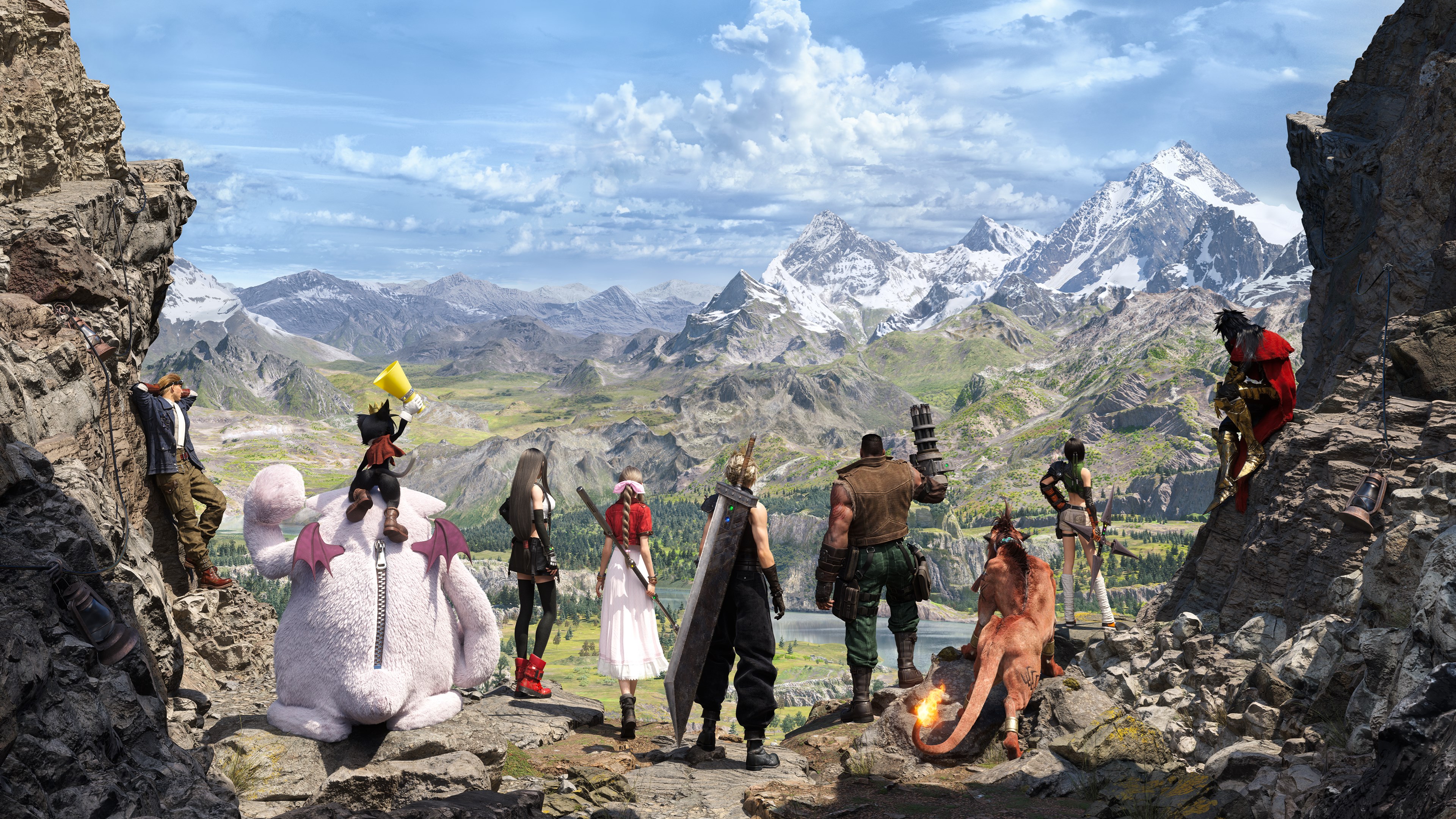
The game follows Cloud and friends as they continue their quest to take down Sephiroth, who is hell-bent on planetary destruction.
Rebirth does an excellent job of balancing seven separate characters and giving each their chance to shine, while not distracting from the main overarching story. Cloud and co. develop strong bonds throughout the game, often joking around and tossing quips back and forth. At times feeling akin to a Marvel movie in that sense.

Cait Sith is a delight, his thick Scottish accent and cutesy cat mannerisms are a surprising match. Yuffie is a ball of bubbly energy, addicted to materia like a junkie, which results in some pretty funny scenes. Barret’s backstory was the highlight for me. Even though I knew his story already, the way his tragic past is portrayed in Rebirth really hit home and left me sobbing.
As expected, Rebirth deviates from the original story in various ways, both big and small. From the get-go it had me on the back foot, mind racing to connect the dots. It drops a huge mystery into your lap, then weaves the explanation throughout the rest of the game, allowing you to slowly piece it together as you play. I can’t really say more than that but I think the story does well to serve superfans and newcomers alike.

The final chapters of the game tick along at speed, packed with excellent boss fights and ‘get hype’ moments. I won’t say I completely understood the ending, there’s a lot at play here and I think that’ll take some unpacking. Because it’s the middle part of a whole story, it leaves the fates of a fair few characters up in the air; all to be wrapped up in the final part of the game.
READ MORE: Review | Banishers: Ghosts of New Eden (PS5)
Confusion aside, the game ends with a bang that left me both satisfied and thirsty for the final part.
PSA: There’s an excellent ‘story so far’ video recap in the main menu to refresh your memory on the events of the last game. It’s even narrated by everyone’s favourite wolf/lion Red XIII… Seriously though, what animal is Red supposed to be?
The World of Rebirth

The world of Rebirth is vast and varied. Between dense townships are expansive open areas with plenty to see, do and fight.
Being able to experience fully fleshed out versions of places like Kalm and Cosmo Canyon is such a nostalgia trip. Towns are bustling with life, with conversations happening all over the place and people doing their own thing. While walking through the streets admiring shops and architecture, I would often stop and listen to the NPC chatter, chuckling at how real they all felt. The man waiting with a giant bouquet of roses stressing over whether he had been stood up, a couple of Shinra grunts gushing over the design of The Highwind airship… Or this guy, overloaded with plushies, begging his girlfriend for money to buy even more!

There’s so much detail packed into the world that could easily be overlooked, like chocobo racing posters on the walls of general stores, a vendor selling ‘materia pop’ ice creams in Costa del Sol, or the punching bag and gloves in the corner of Tifa’s house in Nibelheim. Add in the flora and fauna of the world, like deer galloping across grassy plains or cats lounging in the sun, and it builds up a sense that this is a living and breathing planet.

Not just the world but the characters too, a lot of love has been put into design, characterisation and animation. For example, as a gun-arm isn’t the best tool for climbing, Barret literally scales cliffs and ladders with one hand! Those muscles aren’t just for show.
All six of the wide open-world areas are enormous, have their own aesthetics, and are filled with points of interest and tasks to complete. While they’re a joy to explore, they can be a bit of a slog on foot. I would recommend making a beeline to the Chocobo Ranch ASAP to grab yourself a feathered friend.
So Much To Do, So Much To See

Being an RPG, the main thrust of the gameplay is obviously the story quests, but with dozens of sidequests, scores of mini-games and hundreds of open world activities, there’s a lot to do within the game.
READ MORE: Review | Tekken 8 ‘Gorgeous, fluid, fast and impactful’ (PS5)
Sidequest quality varies from good to great. As a merc, Cloud will take almost any job, big or small. You might be fighting off fiends as you patch up a broken mako pipeline, tracking down a meal for a giant condor, or helping a chocobo jockey to get back in the saddle after a nasty fall.

Once you link up with tech expert Chadley, dozens of tasks will become available within the open-world. Much like an Assassin’s Creed game, there are towers dotted around the world that need to be activated, which then mark your map with the surrounding tasks. Defeating powerful monsters in combat assignments and chasing down moogles at the local ‘mogstool’ are just two examples. It all feeds back to Chadley, who uses the data gathered to develop new materia and add fantastic new battles to the combat simulator.

Speaking of which, Chadley has version 3.1.0 of the combat simulator up and running, allowing you to take on wave-based battles for precious rewards, or test your mettle against formidable new summons. Summon battles can be pretty hard and frustrating, but the pull of obtaining new summon materia makes them a must-do bit of content. Fortunately, there is the option to weaken the summon before fighting it, by analysing three corresponding crystals on the world map.
Traversal has evolved since Remake. Cloud can now climb objects and vault over obstacles, allowing for a much more dynamic experience than having to navigate around knee-high fences for example. Outside of towns, instead of following a linear path from one area to the next, there’s now wide expansive spaces filled with terrain for Cloud and co to parkour over. It allows a sense of freedom in deciding the route you’ll take to your objective, or how to approach an enemy for a pre-emptive strike.

Navigation is simple and easy. With a compass/mini-map and the ability to drop a waypoint, I never felt lost. There’s also the main map, that zooms out into the world map, for planning your next destination. The menus and map are super snappy, loading almost instantly, making a quick check of the area a breeze.
You’ll come across a LOT of collectible materials in your travels. These can be used to craft accessories and consumables within the ‘Item Transmuter’. While you can craft some really useful items, it can be a bit tedious running up to each material and pressing a button to collect them, you’ll be doing this thousands of times after all. The bizarre thing is, there IS an option to have them auto-collect as you run over them, but it’s locked until after you finish the main story.
Swords, Spells and Summons
Combat in Rebirth is fast, fluid and diverse. The ability to assign any ability, spell or item to four shortcut buttons means you’re effectively able to fight non-stop. But if you want to take a more measured approach you can open a menu to slow down time and carefully plan your next move.
READ MORE: Review | Prince of Persia: The Lost Crown (PlayStation 5)
You’re able to freely move around the battlefield attacking, dodging and defending. It’s a breeze to either issue commands to your party members, or to switch over to them and take control. From special abilities to magic, limit breaks to summons; there are so many ways to take on your foes in battle that they never get boring.

Yuffie’s ‘Doppelganger’ ability was my absolute favourite. Summoning a mannequin clone of herself using ninjutsu, temporarily mimicking whatever attack/spell/ability she throws out at enemies. It’s not only flashy and fun, but can decimate foes. Cloud’s classic ‘Braver’ attack was also a staple in my arsenal, dealing a punishing blow from above.
New abilities, synergies and other perks can be obtained through the new Folios progression system, which works in a similar way to Final Fantasy X’s sphere grid, only on a much smaller scale. The SP you earn when you level up can be used to unlock new ‘cores’.
Synergy attacks are the new kid on the block and a fantastic way to team up to take down an enemy. These team combos not only do damage but can have a variety of effects on battle too, for example allowing you to cast spells without using mana for a short time. Like all of the different moves and abilities in Rebirth, synergy attacks are lovingly animated and look flashy as hell.
Monster and boss designs meet the high bar that Remake set. Whether you’re exchanging blows with one of the Turks, taking on a terrifying quetzalcoatl or chasing a cactuar round the battle-field, every fight looks and plays beautifully.

You can’t just hope to hack and slash either, many enemies need to be pressured then staggered before you can start making a dent in their health bars. Scanning an enemy and exploiting their weaknesses is essential for the tougher enemies in the game.
HOT TIP: Having ‘cure’ materia equipped to every party member can be a literal lifesaver, especially when your main healer gets incapacitated or their mana dries up.
(Not So) Mini-Games

Playing the fantastic Like a Dragon: Infinite Wealth last month, I was wowed at the sheer amount of mini-games on offer. I didn’t think I would have that feeling again so soon, but Rebirth smashes it out of the park.
READ MORE: Quest Daily’s Game of the Year 2023
There’s a great mix of mini-game sizes and time commitments, striking a good balance between offering a wide-variety and not overwhelming the other elements of the game.

Some games you’ll play just once through the course of the story, like dolphin riding or marching in the Shinra parade. Others you might go back to a few times, like the Rocket League inspired ‘Run Wild’, the fantastic fair-ground shooting gallery ‘Pirates Rampage’, or ‘Jumpfrog’, which plays pretty much like the Jump Club level in Fall Guys. Then there’s the games that will suck you in and never let you go, like the new card game ‘Queen’s Blood’, and the returning tower-defence game ‘Fort Condor’.

There’s also a piano in most towns that plays similarly to the guitar mini-game in The Last of Us: Part 2, offering an incredible amount of control over note selection. It’s something that music nuts will get deep into, re-creating symphonies within the game, but for me it was a little too complex.
Heart of the Cards

While Final Fantasy VII is hands-down my favourite in the franchise, it was missing one thing: A cracking card game.
Queen’s Blood has fixed that.
Each player places cards into three separate lanes, with the goal of taking up more spots than your opponent, and building a higher lane score. Get more points in a lane than your opponent and you’ll win that lane, your lane score is then added to your overall total. The cool thing is that it’s your overall total that decides the winner, so you could lose two out of three lanes, but still win the game with a high enough total!

Every card has a different pattern of positions that it can affect around it, raising tile ranks, claiming new tiles and even taking over enemy tiles. Cards also have ranks and can only be placed in an equivalent space, so you’ll need to raise tile ranks before more powerful cards can be played. There are even cards with special abilities that can enhance, weaken or destroy other cards.
READ MORE: Review | Final Fantasy XVI: Echoes of the Fallen (PlayStation 5)
My favourite card was the ‘Chocobo Jockey’, which added an extra 10 points to my total, if I won the lane it was placed in. There’s a good amount of depth to the game, allowing for a tonne of different deck builds and strategies

With dozens of opponents to challenge throughout the world, and multiple tournaments to take part in, I ended up playing for hours upon hours.
While it doesn’t quite hit the lofty heights of Triple Triad or Tetra Master from FFVIII and FFIX, it does come in a close 3rd place.
Gold Medal

But that eclectic mix of mini-games doesn’t hold a candle to the majesty of the Gold Saucer. The Disneyland-like adventure park is everything I ever dreamed of and more! It welcomes you in style with an epic dance-battle cutscene and the hype only builds from there.
All the classic favourites have been revamped to look and play better than ever.

There’s G-Bike, which has Cloud fleeing Shinra troops on a motorbike, hacking and slashing along the way. 3D Brawler, a sort of a paper-scissors-rock type boxing game, you’ll need to study your opponent to anticipate their next move. Battle Square, is the obligatory RPG colosseum and then of course there’s the legendary Chocobo Racing.
Speed Square had the biggest facelift, being reworked from a roller-coasting shoot-em-up into the Starfox style space-shooter, Galactic Saviors.

The Gold Saucer glow-up in not only visual, but auditory too, they clearly let the composer cook here. Every area has its own theme and they’re all bangers. From the hyperactive main hub melody, to the fabulously spooky Ghost Square theme, or my personal favourite, the fiddle-riddled chocobo racing ditty!
Choco-Bros

Chocobos have been a staple of the Final Fantasy series for 35 years. In some games they play an integral part, in others they’re glorified horses. Rebirth is definitely the former, the team has given players plenty of activities to do with our choco-bros.
Their main use of course IS to be the transport carrying you around the map much faster. But often a question mark will appear over their head, indicating there’s a treasure nearby. You can then sniff it out and have your bird dig it up. There are excavation sites around the world with multiple buried items, which are often needed for quests.

Before playing I was curious as to how they would implement the different breeds of chocobo as they all had pretty specific use cases in the original game. In Rebirth they’ve designed the various open world areas around a specific chocobo ability. In the Junon area, grey chocobos can climb specific vertical surfaces to access new areas, while in Cosmo Canyon the green chocobos can launch off cliffs and glide around.
READ MORE: Review | Final Fantasy XVI ‘This is why I play Video Games’ (PlayStation 5)
There are various courses around the world to test your riding ability. One is a time trial, another has you gliding through rings for points, needing to dive and use updrafts to nab them all.

Of course, when talking about chocobos, the crown jewel is the racing at the Gold Saucer. I poured countless hours into the original, which was a pretty basic racer. You pretty much just held the run button, strategically activating your speed boost. The chocobos breed and stats were key to winning a race.
In Rebirth your bird’s stats are still affected by breed, but more so, the gear you equip them with. Different outfits can be purchased at Chocobo Ranches around the world and each piece has its own perk. One might give you an extra speed boost when you start the race, another could lessen the slowdown you experience when you go off-course, or another might have the rescue-moogle grab you faster when you fall off the edge of the track. There are plenty of perks to mix and match, if you’re struggling to nab first place on a track, a quick gear change could make all the difference!

The racing itself is very Mario Kart-inspired and one of the best parts of the game. As you race around the track you can drift into corners, giving a boost in speed, but drifting off-course will slow you down.
There are three types coloured balloons to collect as you race. Blue will raise your overall speed up to 10 increments, but these can be lost if you crash. Yellow are akin to mushrooms in MK, giving a temporary burst of speed. And Red, which builds up your ability gauge. Each breed of bird has its own special ability; for example ‘Birdshot’ gives you three light balls that can be fired at other racers like green shells in MK and ‘Hoverbird’ lets you float just above the ground to avoid traps and out-of-bounds penalties.

There are dozens of bright and colouful courses to run, which have been designed to be both fun and challenging. It’s a great little racer and almost a full game in itself! I’ve never played any of the stand-alone chocobo racing games… But maybe I should.
SIDE NOTE: Gear not only affects how a chocobo performs in the races, but also its drip. You can bling out your bird at a Chocoboutique at any chocobo ranch.
Two Sides to the Graphical Coin

Rebirth is a bit two-faced when it comes to its graphics. On the one hand, the cut-scenes look magnificent, with exquisite attention to detail. On the other, during gameplay, the game seems to have some fidelity issues, background objects and characters can get noticeably low-res. The issues are much more apparent in Performance mode, so you’ll have to decide whether you want to champion resolution or frame rate.

Character models can be incredible, especially hair and skin textures. I could count the pores on Barret’s skin in some scenes and Cait Siths fur looked so real my daughter wanted to give him a big cuddle!
In-fact, hairstyles themselves need a shout-out, Final Fantasy VII is inundated with quirky characters with even quirkier cuts. Of course we have the iconic styles of Cloud and Sephiroth (I could admire that silver mane all day) but Zack, Vincent, Roche and Reno deserve their own recognition.

I love how characters’ clothes change within the menu, to match what they’re wearing in-game. For example when Cloud, Aerith and Tifa don Shinra outfits to go undercover in Junon, or wear the gang slip into their bathers for a bit of R&R on the beach.
I did run into a couple of bugs during my 75+ hours with the game (performance mode), but mostly it ran really well. There were a few fleeting light issues when moving from bright outdoor settings to darker indoor ones, at times background character models could look quite low-res, and Cloud would sometimes suffer from a dead-eyed stare. In one cutscene in Under Junon, textures were popping in and out on walls and other surfaces, which was a bit distracting.
Symphonic Nostalgia

The music. Man, the music — it’s just incredible.
Despite being as excited as a child on Christmas morning, I just couldn’t start the game right away. I HAD to sit on the title screen and absorb the overture. So dramatic and bold, the orchestral grandiosity assaulting my ears with nostalgia. Man, nothing can bring the poet out of me like a Final Fantasy soundtrack and VII has the best of the best.
Rebirth is packed to the rafters with excellent new music tracks, as well as contemporary compositions of old classics. Character themes seemingly have dozens of different renditions, not to mention the unique town, area and boss-battle themes.

The bagpipe melody of the Gongaga region had a distinctly Scottish highlands feel that I loved, while Cosmo Canyon is scored by a delightful pan pipe track that adds a sense of history and tradition to the area. I also clearly have some deep seated trauma around Sephiroth; that ‘One Winged Angel’ theme never fails to send shivers down my spine.
Just a few examples of the 400+ Individual music tracks lovingly crafted for your listening pleasure.
One Hell Of A Ride
Final Fantasy VII Rebirth does a fantastic job retelling the middle part of the FFVII story, all while holding on to what made the original game great.
There are so many dopamine hits from so many sources; story, combat, music and mini-games are utterly fantastic. The way the world has been expanded on and fully realised is something truly special.
While a few visual bugs blemish a near perfect experience, this melodramatic, comedic, heartfelt nostalgia trip is a must play game.
Quest Daily scores Final Fantasy VII Rebirth:
9.5/10