In a world where you can battle robotic alligators in Horizon Zero Dawn Remastered on the PS5, and soar over the deserts of Las Vegas in Horizon Forbidden West — what’s the value of replaying Zero Dawn in LEGO form? Like Romeo and Juliet, stories are told and retold a thousand times over, and each retelling lets the storyteller put their own spin on it. And while we’ve stepped into Aloy’s shoes before, experiencing her story from a new perspective is very exciting.
Suffice to say, retelling Horizon Zero Dawn in LEGO form as a straight-up comedy was a big question mark when I started, but a joy every time I went to play more.

Looking over the LEGO Horizon
LEGO Horizon Adventures tells a loose approximation of the Horizon Zero Dawn story. You’ll play as Aloy through her coming-of-age story and go up against Helis and his Sun cultists while fighting off against corrupted machines. I say it’s a simplified story because many of the more complex story beats like Project Zero Dawn, the Pharos Plague and all the inter-tribe politics are absent.
However, this simplification works in the game’s favour, putting the focus on the world and your core quartet of characters: Aloy, Varl, Erend and Teersa.
READ MORE: Review | Dragon Age: The Veilguard (PS5)
Unlike the pair of core Horizon stories, this is a mission-based game. You’ll head out into the wilds and fight machines, cultists and unpick the various threads of Aloy’s historic past solo or in co-op. Between missions you’ll land back in the hub of Mother’s Heart where you can spend coins, customise shops, and dress up Aloy as a hotdog.

Each level you can play as any character you’ve unlocked, and each has their own play style. Aloy has the most variety with elemental arrows, Varl has piercing attacks with a throwing spear, Erend does melee with a big hammer while Teersa throws explosives.
To suit the simplified story, each has their own basic recurring character traits; Varl is obsessed with comic books, while Erend is hunting for doughnuts as some long-lost treasure. Then there’s Sylens, who is now the town DJ, obsessed with setting up his dance floor in Mother’s Heart.
The benefit of this lighter tone is that the voice actors seem to be having a blast throughout. It feels like a What If? scenario, hearing Aloy and Erend argue about the Long Lost Horde of Doughnuts feels utterly foreign, but is a lot of fun.
The character Sylens has been recast after the passing of Lance Reddick — there’s no complaints about the new voice actor’s performance, but it’s a very hard act to follow.
READ MORE: Review | Astro Bot ‘Bloody Spectacular’ (PlayStation 5)

The Stars of the Show
While I love Ashley Burch’s new approach to Aloy — seeing her consistently cracking jokes with the four main characters — the real stars of the show are the machines.
The designs of the individual machines were always a highlight for me in Horizon Zero Dawn and Forbidden West, and learning the patterns, attacks and weaknesses of each one was always a joy. The same is true in LEGO Horizon Adventures, and the individual designs work incredibly well in LEGO form.
In the same way as the core games, when a new machine is introduced you need to take a second and study their attacks, find openings and plan how you’ll deal with them. For the most part, the machines that you’ll find are similar, if simplified versions of their main-game counterparts.
Watchers will stay at range and fire Aloy-seeking projectiles unless you cross through patches of long grass. Shell Walkers have huge shields that will stop arrows and perform big radial slam attacks that require you to jump over.

More complex machines become more bullet-hell in their combat patterns. This starts with the scrappers who fire projectiles in an expanding arc that you can dodge or jump over. When you eventually cross corrupters, which were some of the hardest creatures in the first game, be prepared for rocket pods that cover huge areas of the battlefield.
When you enter an arena with multiple machine types you’ll need to quickly determine the order of priority — do you take out the Chargers first, as the ones that charge in and knock you around, or the Shell Walker at the back who’s doing big slam attacks and blocking your arrows?
There’s a wonderful tactical feeling when you’re able to target specific weak points on enemies to disable their abilities. These include rocket pods, shield generators and horns that can all be knocked off with targeted attacks.
READ MORE: Review | Stellar Blade (PlayStation 5)

The Tools of the Trade
Along with your core weapon for each character, you’ll collect secondary weapons and tools to help you survive combat encounters. In both instances, these have limited uses, and you’ll find random items and weapons throughout the maps.
Some examples of these are alternate weapons the Spreadshot Bow, which fires a fan of arrows, there’s also elemental weapons to spread fire, ice and lightning damage. Each character has some very unique weapons, like Varl’s Boomerang Spear which you throw out and comes back to you, damaging every enemy it passes through. Or Erend’s Giant Hammer, which causes enemies to drop bricks when you hit them, and increases the hammer size (and damage) when you collect the bricks.
READ MORE: Review | Warhammer 40,000: Space Marine 2 (PS5)
There are also limited-use items like double jump boots or player decoys that can be used to sow a bit of chaos amongst the enemies. There are also several more LEGO-themed items, the LEGO Brick Separator is an incredibly meta weapon that was a personal favourite.
I was stunned at how well items like the Tripcaster made their way over into the LEGO world. You drop one end down, then walk and drop the second wherever you like to lay traps for enemies to wander through. It’s super satisfying, and suddenly, a whole new layer of combat was added.
I had a couple of little glitches where switching quickly from weapon to weapon stopped the targeting arrow from showing up, but it was never enough to ruin the fun.

A Living Diorama
Working through the story, you’ll fight machines in the mountains, deserts and jungle around Mother’s Heart and venture into a handful of Cauldrons.
The LEGO-ness of the environments constantly impressed me. As I said in my preview article earlier this year: I’m convinced that an enterprising LEGO builder could build dioramas of each
In the mountain region, the world is blanketed in LEGO snow, with cultist campfires and frozen lakes for you to battle through.
The jungle area is more dangerous to traverse – you’ll see Indiana Jones-style arrow traps that fire at you, as well as spikes that shoot out of the ground. You’ll also find more environmental effects in the combat arenas, such as huge stone columns to knock over onto your enemies and sections of scrub to burn or avoid.
READ MORE: Review | Empire of the Ants (PS5)

Lastly, the desert is filled with wide open spaces and brambles that you can hide behind and trick enemies into charging through.
The variety of visual styling in each area is great, but as you progress through the story, the cycle of platforming, and then arena fight can wear a little thin. That being said, each arena being filled with a random assortment of machines makes each fight feel unique.
READ MORE: Review | The Smurfs: Dreams (PS5)
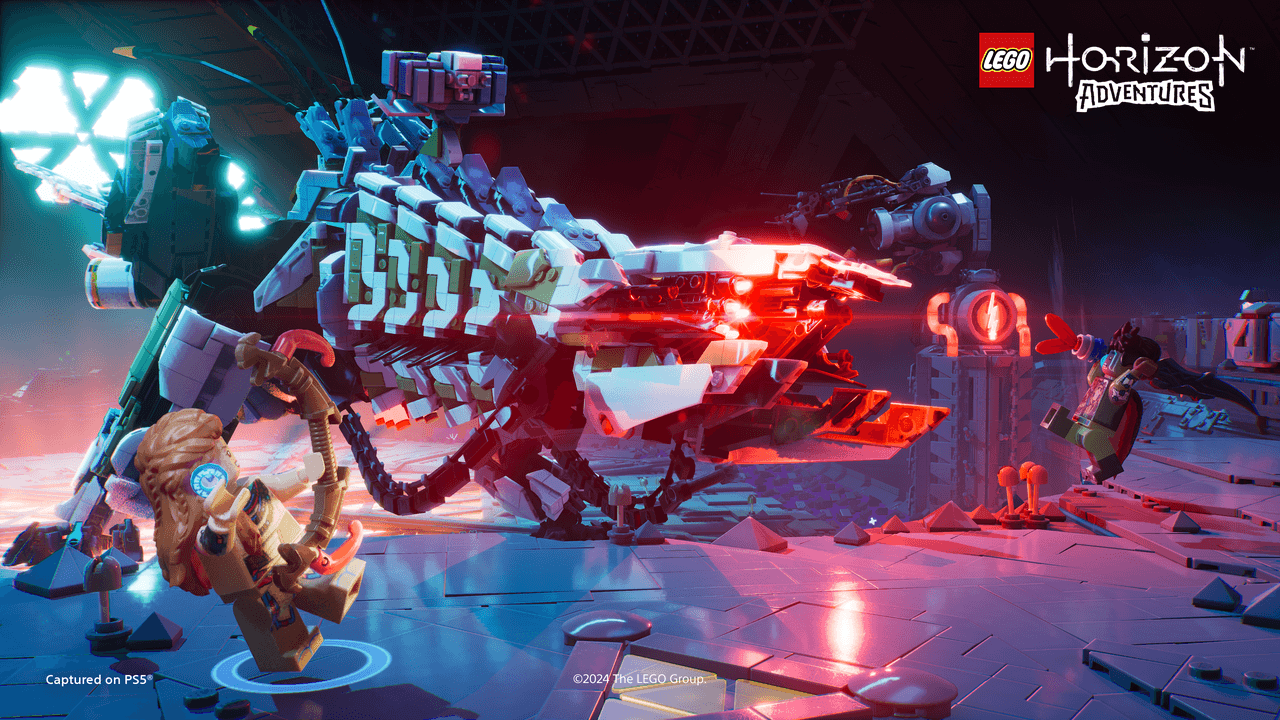
The cauldrons look absolutely amazing in LEGO form. They’re just the right mix of sleek and menacing, with crackling electricity and red laser walls everywhere. It’s in the cauldrons that you’ll have some of the most demanding platforming of leaping over yawning chasms and activating doors to progress. It’s here you’ll also fight some of the biggest machines, including a set piece fight with a Thunderjaw that’s quite good. Unfortunately, I had one hard crash in this fight, so had to replay it from the start, but that was the only crash in my time with the game.

A Living (LEGO) World
Outside of the core game missions, there are a range of extra pieces to keep you building your collection of studs.
In the middle of Mother’s Heart, there’s a notice board that gives varied sub-objectives to be completed throughout the missions: 8 enemies killed with elements, 15 enemies killed with gadgets, missions completed dressed as a chicken and others. Completing these objectives rewards you with Golden Bricks, which are used to unlock new building plots in Mother’s Heart.
This cyclical economy of the game is very compelling, there are a lot of different ways to spend the studs you find out on your adventures: new costumes for your characters, or placing custom items around the hub town of Mother’s Heart. You’ll unlock a range of buildings and yard plots made from machines you’ve fought and plenty of cross-promotional LEGO themes like Ninjago and LEGO City.
READ MORE: Review | Rise of the Ronin (PS5)

Once you progress through the story, you’ll unlock Apex Machine Hunts, which are single-arena boss fights with beefed-up versions of the monsters you’ve already faced. They’re definitely harder than the base monsters, with some new abilities and more variety to their tactics. These are a great way to explore new tactics and try out some more complicated fights.
While LEGO Horizon Adventures is a great entry point for younger players, its more mechanically demanding battles offer plenty for veterans to enjoy. It’s moments like these that make LEGO Horizon Adventures one of the best LEGO games ever made.
Should you buy LEGO Horizon Adventures?
LEGO Horizon Adventures is incredibly joyful to play, it retells the story of Horizon Zero Dawn in a way that is both nostalgic and fresh.
For those who played the game and want to relive it in a lighter, more digestible format — this is the way to do it. And for those with young kids just starting to game, this is a way to share one of gaming’s great modern stories — albeit crammed with jokes about doughnuts and LEGO hotdogs.
Quest Daily scores Lego Horizon Adventures:
9/10
LEGO Horizon Adventures is out on November 14th on PlayStation 5, PC via Steam and Nintendo Switch.
A copy of LEGO Horizon Adventures was supplied to Quest Daily for the purpose of this review.