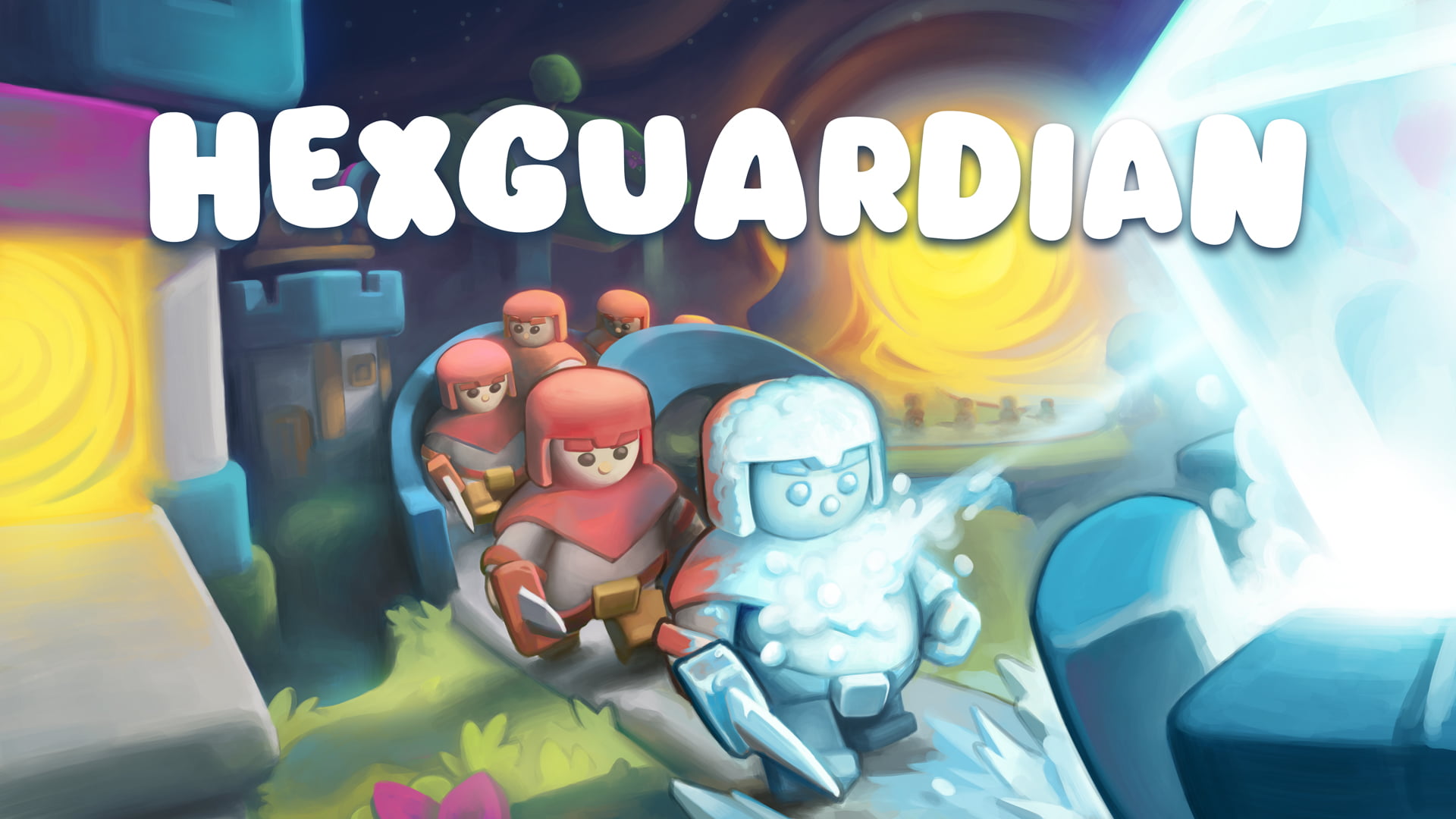
Hexguardian is a new tower defence strategy game by developers Split Second Games and published by Yogscast. I’ve spent the past week playing it, and have plenty to say — but before I do, I’d like to take you on a nostalgic journey back to my youth…
My final two or three years of high school were an interesting period of time in technology and gaming. It was prime time for ‘Flash’ based games — the types of games you’d play in your internet browser. It was a time before mobile phones were decent enough to play ‘good’ games (unless you were lucky enough to have a Nokia N-Gage like my friend Tom, but that’s another story), so playing them on your computer in Internet Explorer or Chrome was the best option.
READ MORE: Review | Rusty’s Retirement (PC)
I remember each week in IT class, I would race to complete my work so I could then jump onto a website that hosted these Flash games and play whatever game happened to be the flavour of the week or month. These websites would then get blocked by the IT team, who thought we should be doing school work instead of playing games. The students would then find ways to get around these blocks, and the cycle would continue.
My personal favourite memory is when the geekiest kid in our class figured out how to get CounterStrike 1.6 running off a USB and we’d play it over LAN during class. These are powerful memories that forged me into the gamer I am today.
Tower Defence Isn’t New
I spent a great deal of time in high school playing tower defence games (Bloons Tower Defence still holds a special place in my heart), so it was an interesting experience to return to the genre after 15-odd years. What I was most interested in was whether the genre could hold my attention in the same way it did when I was 16, in IT class and trying to avoid making a calculator in Visual Basic. In preparation for playing Hexguardian, I found a website hosting some of the old tower defence games I used to play in school and booted them up, to see how they played, to refresh myself on the strategies – but also just for a bit of a nostalgia hit.
READ MORE: Review | Planetiles ‘Tetris Had A Spherical, Galactic Baby!’ (PC)
For the uninitiated, tower defence games have been around since the mid-80s, but they blew up in popularity in 2007-08, when modders began using the Warcraft III map creator to create maps that involve the player building towers to defend their base from waves of enemy attacks. The popularity of these maps resulted in other developers using Flash to begin creating their own custom, browser based games and the genre blew up from there.
The concept is simple: you have a base that has hit points, enemies try to attack that base along a predefined route, and you build towers to defend it. Any further complexity to this concept is up to the specific game you are playing…
How does Hexguardian tackle Tower Defence?
Hexguardian describes itself as a roguelite, tower defence game. I’ve recently been part of a discussion about what is a roguelike vs a roguelite and I’ll be honest, I still don’t really get it – so I’ll leave those labels to the developers and other people who understand them. I’d say that Hexguardian is a tower defence game, with a complex progress tree, unique maps and interesting mechanics that help to ensure replayability.

The game is easy to understand if you’ve played Tower Defence games before, the genre in some ways provides a certain amount of predictability in terms of how a game will play and Hexguardian is no different. However, there are some new mechanics that the team at Split Second Games have introduced to their interpretation that take a bit of getting used to. Fortunately, the tutorial walks you through these features, so by the time you load up your first map you have a solid understanding of what you will need to do.
What have they done differently?
At the fore are what I have named the ‘Hexguardians hexes’ (it’s in the name!). As you kill enemies, you gain the ability to place new hexagons to expand the map, allowing you to dictate the route that enemies will take to reach your castle. This provides a seemingly infinite amount of flexibility to the game, as each map is randomly generated when the game starts, and you then expand it using randomly generated hexagon tiles. Not only can you use the hexagons to change the route enemies will take, you can use them to shut off some routes entirely to focus your enemies down a smaller number of pathways…
READ MORE: Review | Spirit City: Lofi Sessions (PC)

These hexes are really the make or break factor when it comes to how you progress through each map. You can have the best towers, with the best upgrades, but if you end up creating a map where your enemies are able to approach your castle through too many routes then you’re going to lose and you’re going to lose quickly!
The best (or worst) part, is that when you restart a level, the world is refreshed – so you have to form a new strategy each time you load a map. This sets the game apart from the Tower Defence games I’ve played in the past, where the maps are static entities, allowing you to form, refine and perfect a specific strategy for each map over time. Hexguardian forces you to think carefully and creatively each time you load into a game. It’s both frustrating but also satisfying to have to adapt your strategy on the fly depending on the map generated for you.
Growing the Talent Tree
At the end of each map, you’re awarded a number of trophies — with more trophies awarded depending on the number of waves you survived. These trophies can be used to unlock Talents in what is a fairly expansive Talent tree.

These Talents range from new towers, to stat increases (e.g., tower damage or range increases), to buildings that generate gold. As you begin to progress through the early maps, it becomes apparent fairly quickly that these Talents are integral to your ability to ‘complete’ maps. In saying that, ‘complete’ is a fairly fluid term when it comes to Tower Defence games, as the goal is to stay alive as long as possible – I’d say that surviving for 10 days in Hexguardian would classify as a success!
READ MORE: Review | Children of The Sun ‘One Bullet, One Goal’ (PC)
Talents provide you with the opportunity to unlock new towers and upgrades to allow you to move onto new maps, or new difficulty levels on existing maps. Even the ‘easy’ difficulty can be challenging if you have no Talents unlocked, so it’s important to keep an eye on the number of trophies you’ve unlocked and then choose your Talents carefully.
Night Turns into Day
The game features a day-night cycle, with enemies spawning at the beginning of the nighttime. Generally, you will kill all of the enemies prior to day rolling around again, although depending on how large your map ends up, you may sometimes find that dawn comes prior to you finishing off the current wave.

At any point in time, you can pause the game allowing you unlimited time to choose upgrades, decide where to build a new tower, or determine the best placement of a new hex. For this reason, the day-night cycle feels a little unneeded, as time is never your enemy in this game — currency is.
Money can’t buy you happiness, but it can buy you a new tower
Gold. It’s been a relatively safe way to store your wealth for thousands of years, and in Hexguardian you need as much as the game can throw at you. You earn gold by killing enemies, but also earn it passively from your castle, as well as small buildings that have a chance to spawn as you place new hexes. This passive generation should not be ignored (there’s a number of talents that buff this gold generation significantly), as you always need more gold, particularly on the harder difficulties.

You use this gold to build new towers or upgrade existing ones, with upgrades providing significant buffs — frequently it is a better choice to upgrade than build, particularly if it’s a tower in a powerful position.
Pick a card, any card
At the beginning of each day, you’re presented with three cards that will provide you with a buff to your towers, or the option to construct a new type of building, or even a spell that you can cast.

These cards are just as important to your success as your tower placement, but they are randomly drawn each day, so there’s a bit of fortune required to get the specific upgrades you may want in the order you need them!
I found that there were a few different strategies you could employ, depending on the cards that were drawn, as with other tower defence games I’ve played it all came down to trial and error.
There is a LOT to unlock…
After a few hours playing Hexguardian, I realised just how many trophies you would need to unlock all of the Talents in the progression tree… After completing all of the maps on the easiest difficulty, I’d only earned enough to unlock five or six of the cheapest of the one hundred odd Talents available. The question quickly arose in my mind of how likely it would be for me, or someone else, to sink enough hours into the game to grind out the trophies required to unlock everything. At least from my perspective, it would be unlikely…

I feel like the grind to unlock a 30% damage increase on your towers would be immense, and that the payoff when you eventually do unlock it would, unfortunately, lack the satisfaction you’d expect from that kind of grind. I’ve played games where I’ve had to grind at the ‘end-game’ before, and they need to be carefully developed to ensure that they can still provide you with some sense of progression as you grind towards the next upgrade/unlock. Hexguardian doesn’t feel like it quite has the depth to justify this type of grind.
What does Yogscast have to do with this?
As someone who was super into Minecraft back in the early 2010s, I feel like it was impossible not to end up watching the Yogscast on YouTube. I remember following along as their channel blew into the stratosphere alongside Minecraft. It was a time when YouTube was still emerging as a career but equally provided opportunities for creators to take the helm and push forward their own careers in whatever direction they wanted.
READ MORE: Review | Stellar Blade (PlayStation 5)
The Yogscast went in a lot of directions, with incredibly mixed results. It was a surprise, therefore, when I loaded up Hedguardian and saw that it was published by Yogscast games. I’d forgotten that they’d decided to push into the complex territory of game publishing — although it did bring back memories of a canned Kickstarter campaign that caused a fair amount of controversy in 2014.
These days, the Yogscast still publishes videos on their YouTube channel regularly, although at a glance they don’t seem to enjoy the same level of popularity that they did back in their heyday when Minecraft was popping off. It seems that they are also still dipping their toes into the world of game publishing…
Should you buy Hexguardian?
My forays into the Tower Defence genre in the past were all cast against the backdrop of a somewhat bored school student looking to dodge work. I played the game as a way to avoid work and then picked up other game when I got home onto my own computer… So how do I feel about playing a game like Hexguardian?

Well, it was a flashback to a different time in my life, but importantly, to a time when I was a completely different type of gamer. It’s rare that a game can throw you back to how you felt when you were gaming as a 16-year-old, but Hexguardian managed to flip me back into the headspace at least for a small amount of time.
It was fun while it lasted, but unfortunately, it doesn’t have the legs to continue to hold my attention going forward. While the hexes were a fun addition, the gameplay just didn’t have enough variety to keep me playing for the long term. But for the right person, the game definitely has enough content to keep you occupied for many hours.
It’s priced extremely reasonably at $17.75 AUD, with an introductory offer right now of $14.20. For this price, I think it’s a bargain — you’d pay more to see a movie these days. And the movie might not even be good…
Quest Daily scores Hexguardians:
7/10
A review copy of Hexguardians was supplied to Quest Daily for the purpose of this review.