Though you don’t need a helmet to breathe, you suit up and kick out through the airlock, drifting into the black void of space toward the old Solheim ship. You reach the bridge, noting that the twisted wreck looks ready to crumble; you’ll need to be careful when cutting your way in. CRISIS! One too many mistakes has caused a critical breach in the hull, if it’s not patched the whole thing could collapse on top of you!
The increased stress on the ship is putting increased stress on your crew, you’ll need to finish the job in the next few cycles. Inside, Juni analyses dusty computer terminals, locating the ship’s data core. Another cycle passes bringing more close calls and more stress, enough to put your pilot Serafin out of action; but you manage to extract the fragile core, ready for delivery to your client — that’s only if it all goes to plan…
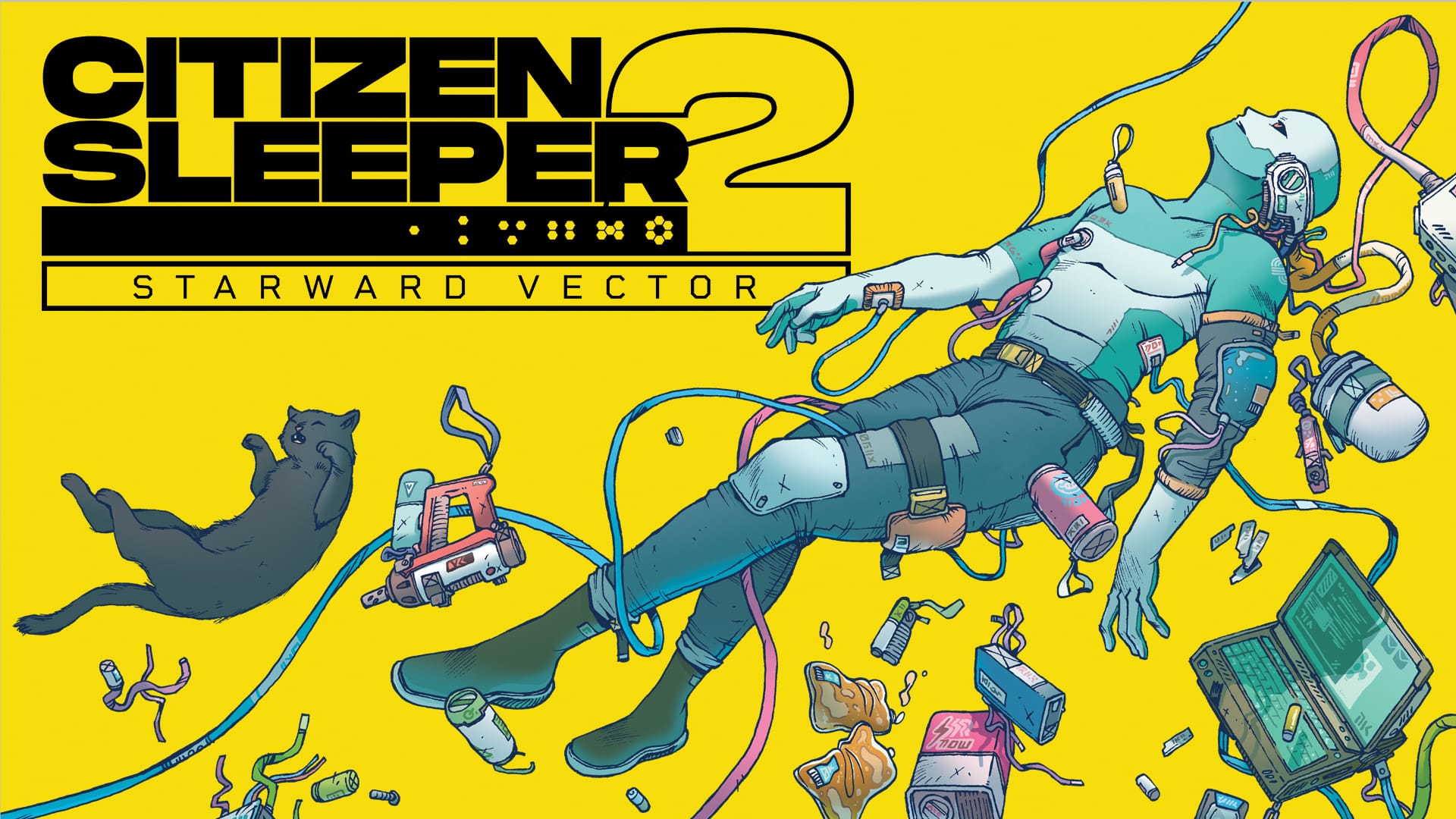
This is but one (crude summation of an) early scenario that Citizen Sleeper 2: Starward Vector presents its players. Inspired by tabletop roleplaying games (TTRPGs), it’s a thrilling journey full of tough dice rolls and tougher decisions, fantastically written characters and a hauntingly atmospheric soundtrack.
Wake up, Sleeper

You play as a sleeper, an emulation of a human mind inside a synthetic body, albeit a different sleeper than in the first game. This character is a new start in a familiar world, allowing for a neat side step of the issue of making a sequel to a game with multiple endings. My playthrough of Citizen Sleeper ended so perfectly for my character, the thought of having my choices erased in a sequel would’ve started the game off on a sour note.
Citizen Sleeper 2 starts with you being furiously woken up mid-reboot — a complicated and risky procedure to remove your body’s dependency on stabilising drugs. Being almost impossible to get, the crime boss Laine had used the drugs to keep you figuratively chained to him; his pet, his property. While the reboot was successful, the interruption damaged your body and caused most of your memories to be wiped; but with the help of fellow-captive Serafin, you make a break for it, commandeering a ship and blasting off into space.
READ MORE: Magic: The Gathering | Card Reveal: Aetherdrift ‘Canyon Vaulter’

To survive the harsh conditions of the Starward Belt, you’ll need to build a crew you can trust, complete contracts to pay for fuel and food, and stay one step ahead of Laine as he mercilessly hunts you down. What follows is a tense road-trip through a precarious asteroid belt: visiting ramshackle space stations and derelict satellites, never staying too long in one place for fear of being caught.
Being part TTRPG and part interactive novel, story and character are such a big part of the game — going too deep on details would be a disservice. Though, in general the game brings some fascinating ideas to the Sci-Fi space, and its futuristic dystopia is filled with endearing characters and emotional tales. All of the story content is brilliantly written, with side-stories receiving as much love, care and detail as main missions.
While I wouldn’t say I got a happy ending, I was happy with the ending I got. In such a harsh and melancholic world, ‘happy’ probably wouldn’t sit right anyway. When all the dust had settled and all the credits had rolled, I was left feeling a little sad, a little uncertain, but hopeful for the future.

Citizen Sleeper 2 brings a bigger, more diverse world than its predecessor, with the freedom to travel between multiple hubs within the Starward Belt. But with that expansiveness came a downside, I didn’t feel as connected to the world as I did in the first game. In Citizen Sleeper, you’re confined to a single, ramshackle space station, filled with characters that need your help in one way or another. With all the characters I loved in one place, I also grew to love the station itself.
Friend or Foe
A good story is nothing without good characters, and thankfully Citizen Sleeper 2 delivers on that front. From shifty scrap-dealers and friendly ship mechanics, to recluse scientists and abrasive salvagers; there are dozens of ‘belters’ to get acquainted with. They’re all masterfully written by solo game dev Gareth Damian Martin and illustrated once again by comic book artist Guillaume Singelin, whose striking artwork helps bring each character to life.
In the first Citizen Sleeper, Lem and his daughter Mina had the most impact on me by a long shot. The father’s relentless drive to provide a better life for his daughter really resonated with me as a father myself. While none of the characters in the sequel managed to hit that lofty level of emotional attachment, I do think that the quality of character writing has improved overall.
READ MORE: Review | Symphonia ‘Music To My Ears’ (Switch)

As the captain of your ship, the game forces you to make hard decisions for the future of yourself and your crew. Who to help, who to antagonise, which contracts to take on, which crew to take on those contracts, how far to stretch resources or push crewmates before they hit breaking point… There’s a lot to consider as you navigate the inky abyss.
As well as numerous side characters throughout the belt, there are over a dozen potential crewmates you can meet and recruit over the course of the game. Some are with you for only a few cycles as you complete a contract, others are more permanent shipmates, sharing in your successes and hardships, building camaraderie.
Serafin, your fellow escapee and ace pilot, is more a brother than a crewmate. From the drop, he treats you like a real person, a kindness not given by everyone you meet. Overly cautious by nature, he has deep trust for you as his captain and friend. Another favourite crewmate of mine — who’ll remain nameless — is a character from the first Citizen Sleeper game. Sporting a new look, it took me a little while to click that they were the same person. Their fondness for sleepers builds into a strong friendship, and they use their repair skills to act as a personal nurse for your synthetic body.

Laine, the game’s main antagonist, is a noticeable upgrade over his counterpart from the first game. In Citizen Sleeper you are pursued by a corporation you never see, via a bounty hunter that was easily dissuaded from bringing you in; I never really felt the fear of being hunted. In Citizen Sleeper 2 the tension is always there, knowing that if I stay too long in one place, I will eventually be caught. Laine can also force his way into your mind, like a cyberpunk-Voldemort, talking directly to you from across the belt. The feeling of never being physically or mentally safe, brought on a real sense of uneasiness, heightening the fear and anxiety I held for the sleeper.
With so many great characters in the game, it’s a shame there isn’t a glossary where you can read about them in more depth and admire their fabulous character art.
READ MORE: Final Fantasy VII Rebirth | Steam Deck Impressions and Recommended Settings
Skill Check
Citizen Sleeper 2 is a mixture of tabletop RPG mechanics and an shiny R.L. Stine ‘choose your own adventure’ book! I obsessed over those books as a kid, bookmarking every fork in the road so I could backtrack any fatal decisions. There’s no such safety net — or save scumming — in this game however, which brings extra weight and stress to every decision.
You start off by selecting your class of sleeper: Machinist, Operator or Extractor. Depending on what they were constructed for, each sleeper has a unique ‘push’ ability, and different levels of skill aptitudes.

Machinist – Designed to repair and modify automated systems, machinists excel in engineering, but lack the skills to engage with others. Their push ability ‘focus’ allows them to increase their chances of successfully performing a task.

Operator – Operators are built for more technical work like operating remote machines. They excel in interfacing with computers but have no endurance. With their push ability ‘reboot’ they can ‘re-roll’ their chances of completing a task.

Extractor – Built to withstand harsh environments, extractors have high endurance, but no intuition. Their push ability ‘rally’ allows them to inspire their crewmates to increase their chance of successfully performing a task.
Each class has one major skill weakness that cannot be overcome, so when performing a task related to that skill, you will always be at a disadvantage. As contracts don’t reveal what skills you’ll require before you start them, I always felt the need to bring along the same crew member who could cover my major weakness. It caused me to feel like I was missing out on interactions with other crewmates, but leaving my weakness uncovered might’ve put the mission in jeopardy. As most crewmembers are still on the ship anyway, it would’ve made more sense to assess the situation before picking who to send out.
With the exception of major weakness, skills can be upgraded over the course of the game, allowing for more successful dice rolls and skill checks. Push abilities can also be enhanced.
In Citizen Sleeper your choice of class was largely irrelevant, only giving you one less point in one stat and one extra point in another, so the more in-depth class system is a huge step in the right direction.
READ MORE: Monster Hunter Wilds: What Long-time Fans Can Look Forward To
Natural Six

The game uses dice rolls and skill checks to decide the outcome of actions. You have five ‘action dice’ that refresh each cycle, which can be ‘spent’ to perform a variety of tasks. That might be working to earn cryptocurrency, salvaging scrap to use on repairs, or any number of other tasks. Some actions require more than one successful roll to complete, each roll advancing the ‘progress clock’ until it’s full. When on a contract, the crewmates you bring along will have their own dice to help you fill up progress clocks faster.
The number on your dice determines how likely you are to get a positive, neutral or negative result when attempting a task. For example dice with the number 1 or 2 have a 50% chance of a neutral result and a 50% chance of a negative result — a high risk, low reward roll that I tried to avoid. However, a number 6 gives you a 100% chance of a positive outcome — stress free rolling.

Neutral and negative dice rolls can have detrimental effects, such as reducing your energy or increasing your stress. They can even affect external factors; too many failed attempts to hack into a system might alert guards to your presence, or repeated mistakes when cutting into the cargo bay of an old freighter might cause the whole thing to collapse. This goes for crew actions as well, and if they gain too much stress from bad rolls, they become unavailable for the rest of the contract.
Push skills can be used to affect your dice rolls, but you’ll incur a point of stress when you use them. Focus increases the number on your lowest dice, reboot rerolls your lowest dice, and rally increases the number on your crew’s lowest dice.
READ MORE: Assassin’s Creed Shadows: What We Learned After 4.5 hours With The Game

Too much failure can cause too much stress, which can result in your dice health decreasing. If a die loses all its health it will break, and be unusable until it’s repaired. Less dice means less chances to complete a task, and might lead you to make more risky decisions. Break all your dice and you will die, which either hits you with a significant permanent penalty, or a complete game over — depending on your game difficulty.
On one occasion, while infiltrating a hostile ship, my already damaged dice were put under immense pressure causing four of them to break! I was down to my last, all my crew dice were spent, and I still had one more task to finish. At the risk of it breaking, I decided to end the cycle and reroll my number 3 into something better. The gods of RNG smiled down upon me that day, gifting me a natural six, and allowing me to finish the contract. I was able to get back to the safety of a nearby settlement and repair my dice, but in that thrilling moment, the stress I felt was so very real!
Filling the Void

While completely devoid of voice acting, Citizen Sleeper 2 fills the silence with ethereal soundscapes and strategically chosen sound effects.
Composer Amos Roddy has returned with another stellar soundtrack, hitting a range of emotions throughout the story, in haunting ambient-electronica style. Roddy conveys so much character and expression through his music, providing another facet to the exceptional writing, and sparking the imagination. The slow reverberating synth gives the emptiness of space a certain melancholia, and even though science tells us that the void itself is deathly quiet, the music felt just right.
Sound effects are used sparingly, like the bustling ambience of a city street, the firing of engines as you travel to the next destination, or the gut-wrenching crack of a broken die. Actions that require ability checks have different sounds for positive, negative and neutral outcomes, meaning you could tell if you got lucky or not with your ears alone… I had a fair few closed eye dice-rolls, hoping for a Hail Mary play.
READ MORE: Review | Star Wars Episode I: Jedi Power Battles (PC)
Should you buy Citizen Sleeper 2: Starward Vector?

I love this game to bits. I was sucked into the Starward Belt and gripped by its moving narrative and multifaceted characters. The use of dice rolls brings a thrilling element of chance to the game, resulting in numerous close calls and nail-biting moments! When the time came, I was loath to end my journey.
But Citizen Sleeper 2 isn’t for everyone.
This may sound silly, but there is a LOT of reading in the game. I relished digging into the deep narrative, like I would a thick novel, but I can see the amount of reading being off-putting for some people. When playing handheld on the Switch some of the text was quite small — even after increasing the size in the options — which might amplify that barrier of entry.
You’ll spend a lot of time navigating the UI, which can be a bit awkward when using thumbsticks or the d-pad. I often found it fiddly to move to the icon I wanted to press, without the cursor shifting around to other icons first. It’s an unfortunate by-product of using sticks to play a game designed for mouse. Touch screen implementation would’ve solved this issue on the Switch, and would’ve fit perfectly with this style of game.
Small criticisms aside, Citizen Sleeper 2 is a magnificent game, made all the more impressive by the fact it was developed by one man studio, Jump Over The Age. If you’re a fan of tabletop RPGs, thrilling Sci-Fi, or games where your choices feel like they matter, then you should definitely give Citizen Sleeper 2: Starward Vector a go. While you CAN play the sequel without playing the first game, I would recommend you play them in order, as there are some recurring characters and locations mentioned… Plus they’re both just cracking good games.
Quest Daily scores Citizen Sleeper 2: Starward Vector:
9/10
Citizen Sleeper 2: Starward Vector releases on February 1st in Australia, for Nintendo Switch, PlayStation 5, Xbox via Gamepass, and PC. The first Citizen Sleeper is also on Gamepass.
Quest Daily was supplied with an early review copy of Citizen Sleeper 2: Starward Vector thanks to the publisher.