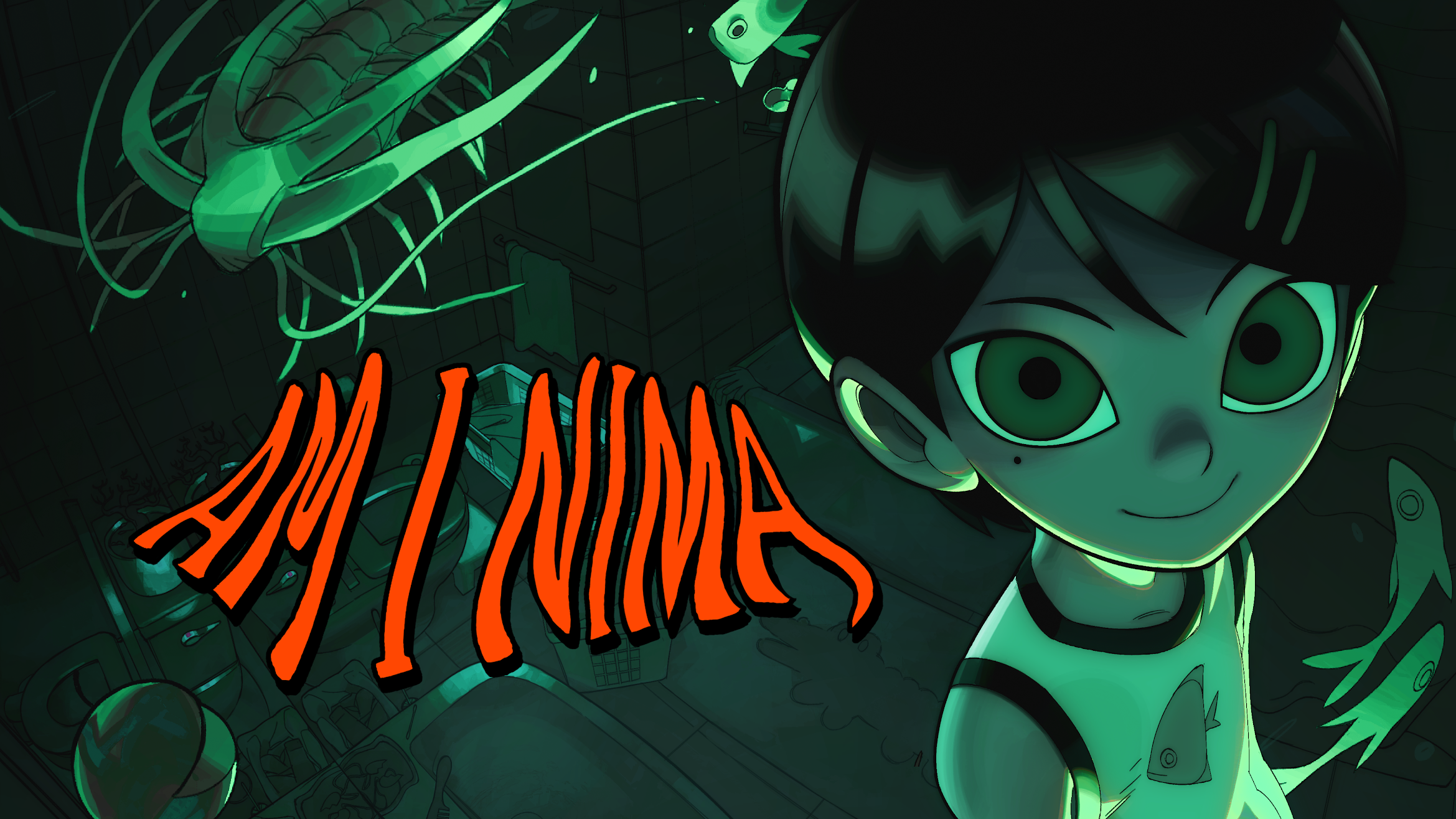
In October last year, developer HO! Games burst onto the scene with a demo for their palindromically titled horror game, Am I Nima. The game was part visual novel, part point-and-click adventure, and all psychological horror. It garnered millions of YouTube views and over 275,000 wishlists on Steam.
For all its hype, though, a few questions still remained. The most pertinent of them all was the one posed in the game’s inescapably enigmatic title: Are we, the player, Nima?
If you, like me, were hooked by that question alone, then I’ve got good news. Your quest to find the answer will require playing through what is a masterclass of interactive genre fiction, and one of the years best horrors!
An Introspective Whodunnit?
Am I Nima casts you as a young amnesiac. You wake up with no memory of the past, imprisoned in a basement and subject to the tests of a woman named Annabelle. Annabelle is Nima’s mother, and she is looking to prove whether or not you are her daughter.
The game plays out through a series of conversations. Annabelle interrogates the player for information that can verify their identity, while the player uses word association and context clues to piece together their character’s fractured memory and, hopefully, pass Annabelle’s tests.

READ MORE: Review | Allogloom: ‘A Gorgeously Gothic Glut’ (PC)
A Home Without Love is Just a Haunted House
The genius innovation of Am I Nima lies in the way it expresses the protagonist’s amnesia mechanically. Amnesiac protagonists are a trope almost as old as narrative video games themselves but few approach the concept as thoughtfully as this.

As you engage in conversation with Annabelle and explore the limits of your confinement, keywords begin to populate the edges of the screen. These words represent thoughts based on latent memories that linger in the protagonist’s mind. Combining keywords can uncover hidden connections and vital clues regarding your true identity. Those concepts are then used in conversation with Annabelle, either to fish for information about your past or to prove your identity as Nima.
Most keywords have some hidden relation to one another. For that reason, the number of thoughts in your character’s head can quickly spiral out of control. Merging thoughts in this way creates a tremendously engaging positive feedback loop. It manages to emulate both the overwhelming experience of acclimating to a new environment and the anxiety of brainstorming ways to evade your captor’s piercing questions.
These ludonarrative synergies continue into the conversations themselves. Nima’s mother has a history of controlling and abusive behaviour. She also refuses to take accountability for the damage caused by her actions. Players must choose their words carefully if they want to avoid damaging their relationship with the one person who can provide more information about their past. Fail, and they risk being subjected to further abuse.

READ MORE: Review | Terrible Lizards: ‘Welcome to Dalton’s Dinos, Please Keep Running’ (PC)
Second Guess Everything
Unfortunately, Annabelle’s avoidant personality makes it difficult to judge the accuracy of the information she gives you. While the truth is presumably in the game somewhere, the developers have written an impressive number of dialogue options. This means it consistently feels possible that all or nothing of what Annabelle is telling you could be the truth.
The highest praise I can give to Am I Nima is in regard to that aspect of its writing. Annabelle’s conversational rhetoric feels remarkably true to that of a manipulative parent. She is terrified of losing control over the narrative of her child’s life. She’s also scathingly persuasive in her efforts to make the player doubt themselves. Talking to her always feels like talking to a real person. That’s something difficult to maintain in a game with this much dialogue and a cast of essentially two characters.
Regardless of how much care you take, the odds that you will discover the truth of your identity in a single playthrough are slim. The game is intended to be completed over multiple playthroughs. The information you acquire in earlier playthroughs will be crucial to uncovering the game’s ultimate truth.
If the idea of a multi-playthrough logic puzzle sounds daunting, don’t worry. The game offers unobtrusive hints based on previous choices to assist you (don’t ask me how I know).
Can’t Choose Your Family
This is where my first criticism comes in. Though the initial loop of combining keywords is immersive and compelling, it’s unlikely to sustain your interest for more than two playthroughs at most. Similarly, exploring your confinement for clues loses its lustre after just one playthrough. This is a shame because the other gameplay loop — engaging in conversation with Nima’s mother — never gets old.
The scope of potential dialogue choices is the most unbelievable element of this game’s design, but it’s essential for giving the player something to look forward to with each loop.
My other critique concerns the overarching narrative of the game. Full credit to the writers: finding a satisfying way to pay off a story as layered and thematically dense as this one is difficult. The end result is ambitious, but emerges underdeveloped from the complex network of overlapping ideas that precede it.

A Deep-Rooted Identity Crisis
As mentioned before, the gameplay, themes and narrative context of this game operate in complete harmony. There are recurring motifs of parasites and symbiotic lifeforms that form a compelling mirror to the shifting codependency between a mother and her daughter. This metaphor also extends to the relationship between our self-image and the version of ourselves we present to others.
Additionally, the game highlights a symmetry between the changing ways we define ourselves in relation to our parents as we age, and the experience of playing as a character who can only define themselves through the perspective of an abusive parent.

As a horror game, Am I Nima is also genuinely unnerving. This is due, in large part, to art and animation work that perfectly fits the game’s unsettling tone. The visual presentation of Am I Nima is excellent and contains numerous surprises for the player that I don’t wish to spoil.
Alas, these strengths do not save an underwhelming narrative conclusion. When taken as a whole, the plot of Am I Nima does not tell a story befitting the very high standards set by the qualities of its component parts. However, Am I Nima is still an outstanding game and well worth playing. It seamlessly weaves its aesthetics, innovative gameplay design and rich thematic depth into a thoughtfully crafted psychological horror experience.
Quest Daily Scores Am I Nima:
8/10
Early access to this game was provided to QD by the publisher.