Monster Hunter Wilds is having an Open Beta this week, with PlayStation Plus members being able to get on a little earlier than other platforms.
The moment I saw the Beta was live, I set it to download on my lunch break and put on my hunting hat the second I got home.
Since then, I’ve had a few hours to check out the character (and Palico) creator and have a crack at hunting the three beta monsters Doshaguma, Chatacabra and Balahara. Below are my thoughts so far.

Character Creator
First things first, there are a hell of a lot of options for this character creator. You have the usual hair types, voices, basic clothing options, etc. But also hyper-specific things like hair colour between root and tip, sclera colour in your hunter’s eyes, and total control over colour options for your basic clothing, hair and most everything else. I tinkered a while but chose a good enough-looking character.
You can see some of the presets below:


Once I’d made my character, I spent way too much time creating my Palico and making her look as close to my real-life cat Zoe as I could.
READ MORE: Monster Hunter Wilds | All the biggest changes coming to the game (Part One)

It’s a thing; she’s been with me through all my Monster Hunting games. Palicos are your hunting buddy through thick and thin, they deal damage, stun monsters and heal you when you’re injured. They’re the best.
See a few options and the completed duo below.


Into The Wilds
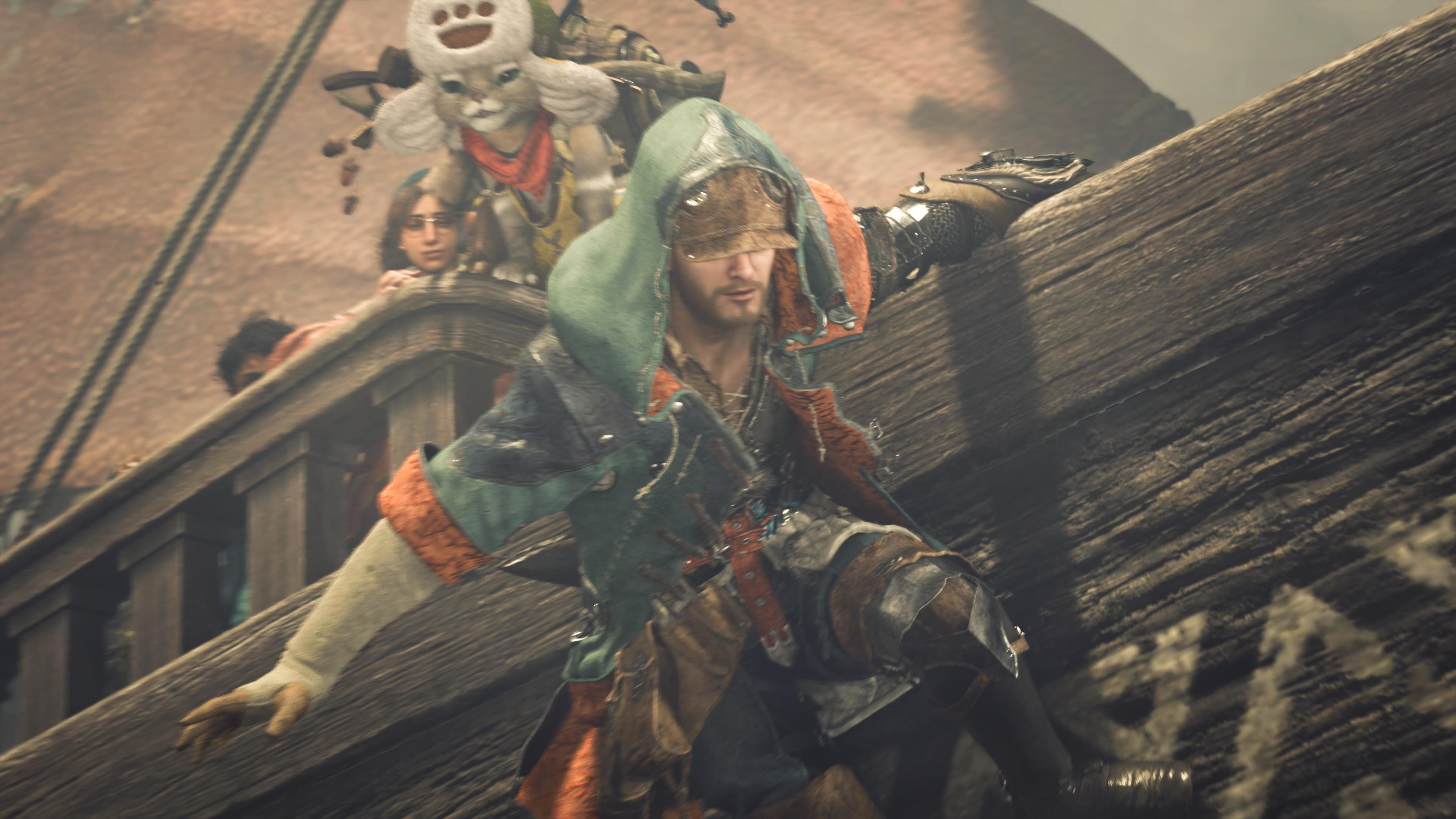
Characters created, we set off into the intro mission. Our hunter and expedition were hurtling across the sands in a sailing ship. We were following a herd of Balahara, which swim in a corkscrew motion and leap out of the sand in great sweeping arcs.
The initial quest seems to be to track down a young boy’s clan that lives in the area, but before long we were hunting the local fauna to make clothing out of.
READ MORE: Monster Hunter Wilds | All the biggest changes coming to the game (Part Two)
The first real action came when we have to leap from the ship and jump onto a Seikret — the new avian mount that quickly became my second best friend (second only to Zoe). We then learnt how to guide the Seikret through the swimming herds of Balahara, collect items from the surrounding and drop rock cliffs to stop them in their tracks.
It’s a very active, cinematic start to the game, and set the tone for a more agile, involved Monster Hunter than we’ve had before.

Getting out into the new environment was really exciting. From what I can see, the Windswept Plains is a huge map, with ground-level flowing sand dunes, rocks, and caves delving far beneath. Over the course of my playthrough so far, I’ve seen pristine, clear, sunny skies, huge dust storms that massively obscure vision. I’ve also witnessed lightning storms that scared monsters and set parts of the underbrush on fire. The variety on offer is huge, so hopefully the other areas are this varied.
Home Base
Before long, the expedition were setting up the new home base, from there I could see tents, shops, cooking fires and the most important element — the blacksmith. It seems like a great little spot to settle down for the first leg of the journey, and there’s nothing more adorable than watching Palicoes running around frantically setting up boxes and barrels of food.

The base itself is built into a ravine amidst rocky outcroppings in the middle of the Windward plains. Here I got the opportunity to check out the weapons, all relatively basic by Monster Hunter standards, but good to start.
Most importantly, I had the opportunity to check out some of the new outfits from early monsters in the game. Anyone who has played a Monster Hunter game knows that when your main activity is killing monsters to make pants out of them, the pants need to be on point.
READ MORE: New gameplay trailer for Monster Hunter: Wilds

Outside the base is a sprawling tundra filled with cascading sand dunes and herds of roving monsters.
Tools of the Trade
The big new feature for me in Monster Hunter Wilds is the ability to bring two weapons with you on every hunt. You carry one with you, and the second stays on your Seikret. This is great because when you get into a fight with a monster, your Seikret stays nearby and circles the combat. At any point, you can tap the d-pad and mount the Seikret, then quickly swap to your other weapon.

My go-to weapon for monster hunting is the Hunting Horn. It’s the closest thing that Monster Hunter has to a support weapon, but it’s also a heavy hitter that can knock around some of the biggest monsters. As a primer, while you’re swinging this giant musical weapon, you’re laying musical notes on a stave, and then you activate your special ability to play music and buff yourself and your team.
READ MORE: Review | Dragon Age: The Veilguard (PS5)
On these first few hunts, I took the Hunting Horn as my old standby and then folded in some other weapons to test how they’d changed. The biggest surprise for me was how much Focus Mode changes ranged weapons. Focus Mode is a new ability that lets you quickly change angle but also highlights weak points on the monster where you and your allies have damaged it. When I was trying out the Bow and later the Heavy Bowgun, these points were awesome because you can easily target them for big damage — it feels like a contextual weak point in a game like God of War. This change on its own might have me trying out more weapons more often when the game launches next year.

Oh, and side note – I found out that the buffs you play on the Hunting Horn carry over when you swap weapons, that’s wild – and might mean more folks join my merry band of musicians.
If you want to read more about the new weapon changes, we broke them down in a previous piece.
The Big Three
In the current open beta phase, there are three monsters to hunt: Doshaguma, Chatacabra and Balahara. They’re all distinctly different, but below are some thoughts on each.
Balahara is the first one you’ll see in the intro. The big thing here is that they can burrow through the sand of the Windswept Plains as if it were water and leap from the sand like dolphins with far more teeth. This makes the individual fight a balance between tracking its location and worrying about where it will pop up next. It also has an awesome ability to swim up overhanging sections of the environment and leap down onto you – of course, you can drop these on top of them as well, so win-win. Here’s hoping in the final game, we see Balahara in larger herds (pods?) like we saw in the opening sequence.

Speaking of herds, Doshaguma is the big, bad beastie of the beta period — and you need to hunt the Alpha. Doshaguma is shaped like a yak, but with a big grumpy bulldog face on the front. They’re towering monsters, and as implied by the ‘Alpha’ comment, they like to move in packs. In my first hunt, they roamed in groups of three, and you need to use items – in this case, hurl dung at them – to get the pack to split up so that you can isolate the big one. They’re slow-moving, but hit like an absolute truck when they come down, so fighting a pack of them at once was a big no for me.

Lastly, Chatacabra is what you’d get if you crossed a frog with the Batman villain Bane – he’s huge, bulky, immense and other synonyms for large. But the kicker – or licker – is that he has a bulbous tongue to lash out at you with when you’re outside of punching reach. He has a tendency to telegraph these huge attacks, like hunkering down on his back feet to spring up at you or getting up really tall to slam down. However, just because you can see it coming doesn’t mean it won’t hurt.

Monster Hunter games have always been about learning. Every time you set out on a new hunt, you must quickly understand the monster you’re after, their abilities and weaknesses. Then, over time, you build a mental map of how they fight and create a kit to take them down. Stepping into the Monster Hunter Wilds beta is so exciting because it’s a whole new arena, with new monsters to learn and, oh, so many new pairs of pants to make.