I’ve been playing Overwatch since its release, starting with the original 21 heroes. Almost seven years later, Overwatch ended with 32. Fast forward just over a year into Overwatch 2, and we’ve now got 39 heroes in the lineup. That’s A LOT of options.
As each hero steps onto the battlefield of Overwatch 2, they bring a unique blend of abilities, altering strategies, and reshaping team dynamics. Players are encouraged to mix up strategies and create solutions to new problems until it all makes sense again. Thus creating a new “meta”.
READ MORE: Review | Atari 2600+ ‘Relive the magic’
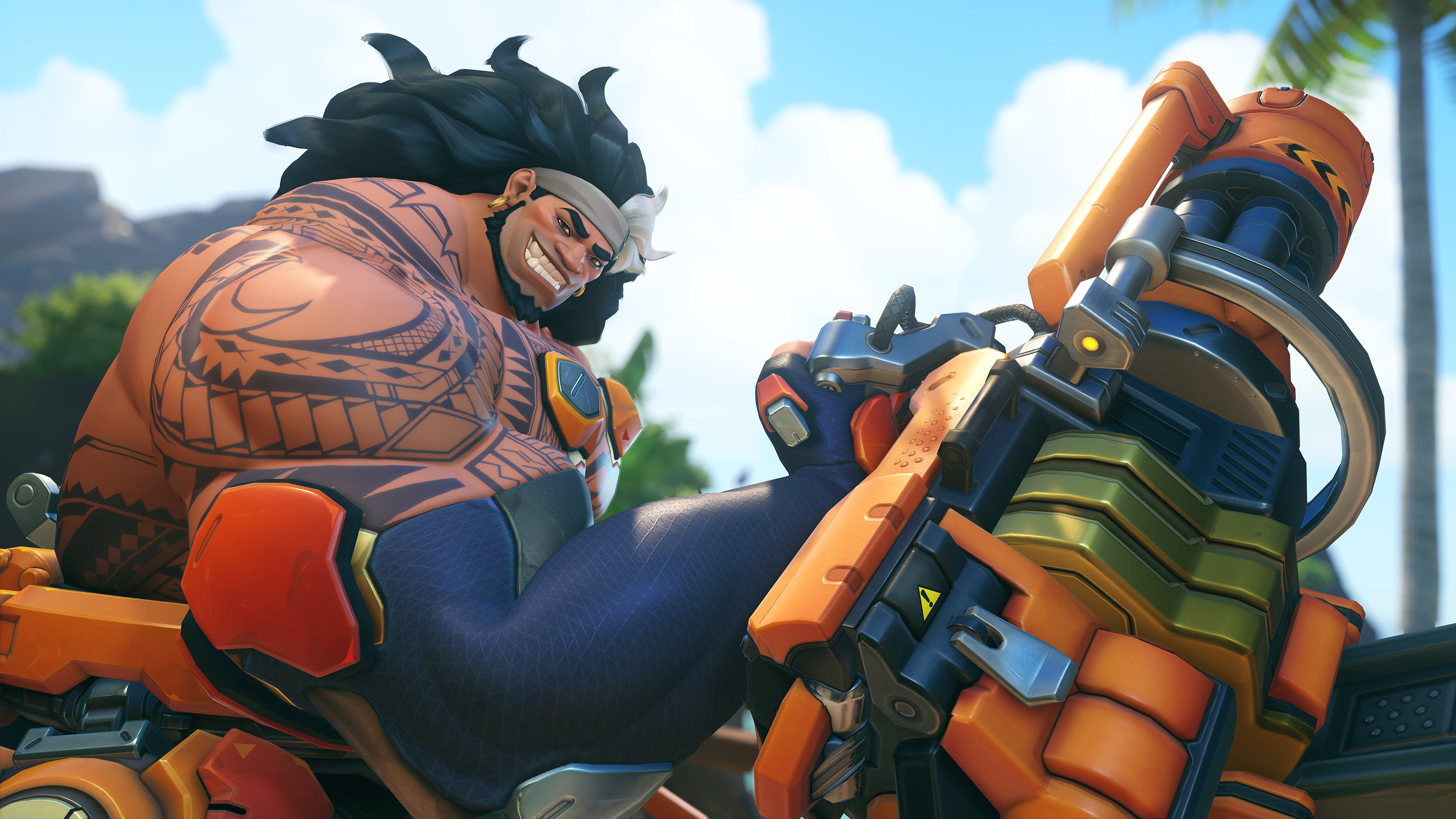
As the most recent addition to Overwatch 2’s ever-expanding roster, Maugaloa Malosi, otherwise known as ‘Mauga’ emerges as a force to be reckoned with… Under the right conditions and strategic prowess.
The addition of this incandescent hero has seemed to create a little bit of division among players, let’s investigate why.

Gunny and Cha-Cha
Armed with dual chainguns, though named affectionately, are capable of incinerating foes, and asserting fiery dominance. Mauga, in the right circumstances, is as terrifying as he seems. It’s quite possible to make quick work of Overwatch 2’s lower-health heroes with just these. Demonstrated during the Battle of the Beasts event, Mauga could blaze through a large chunk of the beast’s health at an alarming rate if uninterrupted.
But these chainguns aren’t exactly alike. Mauga’s primary chaingun is Incendiary, which means players are also ignited after being hit with consecutive bullets which cause about 50 burn damage over 3 seconds. His secondary is the Volatile chaingun which deals critical damage to ignited players.
It’s a pretty deadly combo that when used correctly and can melt away the enemy. But from a distance, these guns don’t perform as well.

Turbulent Tango – Overrun
Enter, Overrun.
Overrun is an engaging new ability that works similarly to Reinhardt’s charge but with some minor improvements. Unlike Reinhardt, Mauga in his charging state is immune to crowd control. And turning is a little easier than in Rein’s. You can travel about 30m and at the end Mauga Stomps the ground with an impact that deals 80 damage in its inner ring and briefly stuns enemy players. Its outer ring does a little less damage and rather than a stun, it’s a knockback. Overrun is a helpful maneuver that allows you to single someone out. However, I felt this charge was set back by a couple of things.
Firstly, the wind up to the charge was obvious, you can very quickly anticipate this and move out of the way if your hero movement allows depending on the charge distance.
READ MORE: Review | Born of Bread (PlayStation 5)
Secondly, the stomp creates a recovery animation meaning loss of control of the hero and hoping the unaffected enemy just doesn’t collectively turn and fire on you.
By running into the enemy, Mauga is potentially putting his team in a risky situation.
Sustain and Conquer – Cardiac Overdrive
Thankfully his kit makes up for this a little, with the next ability reinforcing his team with a healing aura: Cardiac Overdrive. This grants the team damage resistance and allies are healed by a percentage of the damage they deal. The ability lasts 5 seconds and has a 10-second cooldown.
READ MORE: Review | Dredge: The Pale Reach DLC (PlayStation 5)
We were seeing stats up to 30k of damage on Mauga in game modes like Battle of the Beasts. And with Cardiac Overdrive plus his passive, Berserker, I saw that he was also reaching 10k-20k in both team and self-healing without needing to actively press a button like Roadhog would.
In regular games, the stats vary and tend to be a little lower, but Mauga’s existence seems to be correlated with inflated stats regardless.

Hell in a Cell – Cage Fight
His ultimate Cage Fight, unleashes a brutal barrier, similar to the mechanics of Symetra’s barrier, but cylindrical. You can pass through only one way and cannot leave. Trapping enemies whilst Mauga unleashes a relentless barrage of unlimited ammunition. This barrier can be torn down and starts at 1500 health but otherwise lasts 10 seconds.
READ MORE: No Man’s Sky dev’s new project ‘Light No Fire’
I found that the ultimate ability was most effective when being used to create 1v1 or 1v2 situations. Any more than this, and you run the risk of losing the fight and dying. So if you’re team is spread out, try to only use the ult when you know support or DPS have an ultimate they can use with you. However, allies can fire in from outside the barrier walls too, meaning they don’t have to be inside the ‘cell’ to help you.

A Chaotic Symphony of War
Mauga was built for aggressive, close-range combat. Everything in his kit screams run and gun. He is terrifyingly awesome and is a clear winner in the hearts of players affectionately known as “M1+W”.
Charge towards your enemies, lock them in a cell and empower yourself and your teammates as you let Gunny and Cha-Cha run hot. However, there are a few factors that can make or break this play style.
Size Matters: Healer’s Delight or Nightmare?
However, beneath the surface of this colossal hero lies a delicate balance. Mauga lacks compensatory tools despite his imposing size, boasting the largest tank hitbox without the corresponding survivability. Following player feedback during the free trial weekend, adjustments were made to Mauga. His chainguns’ power has been enhanced as well as Armor HP for increased durability, allowing him to be in the fight for longer. Despite this buff, players, myself included, are struggling to increase sustain in fights without having a dedicated pocket healer. And Mercy alone is simply not always enough. It feels more valuable to have burst healers babysit Mauga. During one game as Ana, I sat behind and watched a Mercy pocket an aggressive Mauga not utilising cover whatsoever. I purposely withheld healing to watch how much the Mercy could do, and very quickly I learnt: not much. I had to jump in quite quickly. This meant that for the rest of the game, it was Mercy and myself in what felt like a game of Babysit the Mauga. Which wasn’t fair on the rest of our team.
READ MORE: Review | A Highland Song (PC)
Mauga’s dependence on heal bot healers creates a dichotomy in gameplay, making the experience mundane as a support. The relationship becomes reminiscent of the Heavy-Medic dynamic from Team Fortress 2, limiting the diversity of strategies in the game. Unlike Reinhardt, who can contest space with a shield independent of healing, Mauga’s survival hinges on constant attention from the supports.
However, in the hands of skilled players, Mauga’s potential becomes evident. Mauga does rely on heavy heals, but not as much IF the player utilises cover and strategy.
Mauga’s Gambit
Having Mauga consistently engaging in 1v2 or 1v5 scenarios won’t lead to success. However, when you have a Mauga player who adeptly utilises their abilities to select favourable matchups like 2v1s, 2v2s, or even the classic 1v1, that’s when you truly experience the essence of playing Mauga. Annihilate the opposing supports and isolate a high-impact DPS. But how you play will always depend on your team’s composition. Naturally, if you’ve got a Genji or Tracer in your ranks, their primary focus would be eliminating low-health enemies in the backline, particularly supports, allowing you to capitalise on taking down the heavy hitters.
READ MORE: Review | Like a Dragon Gaiden: The Man Who Erased His Name (PS5)
Mauga is a hero with a low-skill floor but a towering skill ceiling. Those who master the art of disengagement, efficient use of cover, and manipulation of the enemy tank as a healing battery will unlock the true potential of this behemoth. Creating 1v1 or 1v2 situations with Mauga’s ultimate becomes a strategic imperative, introducing an element of risk that adds depth to his gameplay.
Mauga offers players opportunities for critical shots and asserts his presence in diverse situations. However, vulnerabilities exist; Sombra’s hack, Ana’s anti-healing grenade, Kiriko’s cleanse, and Zenyatta’s damage amplification serve as checks and balances to Mauga’s formidable presence.
The intricate dance of power and vulnerability must be mastered if we want Mauga to remain a strong tank against the rest. Yet, amidst these challenges, Mauga unfolds as a unique disruptor in Overwatch’s meta.
You can learn more about Mauga’s lore and origin story in the video below: