My experience with Atlas Fallen has been a bit of a roller coaster; highs, lows and plateaus; but in the end I’m glad to have been along for the ride.
I went into the game thinking I knew what kind of experience I was in for, an open-world action game with beautifully rendered cutscenes, but I soon found myself a little disappointed.
Regardless I pushed forward and found an unexpected second wind.
Graphics
Deck 13‘s Atlas Fallen was revealed last year at Gamescom with a stunning CG trailer showing off a fantastical world full of magic, sand surfing and monstrous creatures.
Sadly that’s the best it will ever look, Atlas Fallen doesn’t have rendered cutscenes, instead opting for in-game camera movements that don’t feel as polished or curated.
The game never hits the visual highs of that initial reveal:
Subsequent trailers also used CG scenes in combination with gameplay, which gave me a bit of a false expectation of what the game would be.
READ MORE: Review | Pikmin 4 ‘Better than Tears of the Kingdom’
That’s not to say games need cutscenes, but I do find it harder to connect with a story and characters when a game doesn’t have them.
Animated storyboards popped up every so often to dump a bit of lore, but I didn’t find them particularly interesting.

I wouldn’t exactly call the game beautiful, it can look quite dated at times, but while traversing the Calardias Desert at high speeds the rough edges melt away and lower-quality surroundings can be overlooked. Unfortunately, that’s not a luxury afforded to NPC interactions. As you’re stood still and locked in place, all you can do is analyse the character models; they look decidedly ‘last-gen’, low quality and just not quite right.
There’s a decent amount of enemies within the game, with some pretty unique designs. Though as the beasties are all made of sand, they all had the same drab colour palette and I found myself craving something more vibrant.

Story
There wasn’t much I liked about the story of Atlas Fallen, I found it tropey and predictable.
It’s a struggle to remember any noteworthy characters, very few had interesting personalities or backstories.
The same goes for story missions, side quests and the world building in general… It was all just bland.

You start off creating a character and soon find out they’re part of a lower class called ‘unnamed’ that are referred to by their job title, ‘tracker’, ‘cook’, ‘smith’ etc.
The ‘unnamed’ seem to be the bottom rung of society, treated little better than trash by soldiers and the upper class.
READ MORE: Magic the Gathering’s new Commander set is giving 2003 Oscar vibes
To my knowledge, the class system isn’t ever really explained properly. Why don’t they have their own names? Why are they treated like shit?
NPCs seemed to know I was an ‘unnamed’ when meeting me for the first time, so is it something visual? Or poor writing?
It really paled in comparison to the deep and fleshed out class-system in the recent Final Fantasy XVI.

Anyway, your character finds a magical talking gauntlet that has amnesia (sure why not) and you’re put on the path to restoring the gauntlet, and its memories, to full strength.
There are a few somewhat predictable twists along the way and you fight the ‘big bad’ at the end, but that’s pretty much the story in a nutshell.
Dialogue & Voice Acting
The weakest part of the game is easily the dialogue. It’s written so clunkily and the way characters interact with each other feels so unnatural.
It isn’t helped by the performances which are ‘just fine’ at best. Many characters sound like they’re monotonously reading lines off a page, they feel generic and dull and only there for that one conversation with you in the game. They don’t feel real.
READ MORE: Video games releasing in August 2023
Often the voices had a strange reverb to them, as if they’d been recorded in an echo chamber.
Sometimes dialogue choices would pop up in conversation, though I got the impression that whatever you chose would result in the same outcome, the choices felt empty and pointless as if shoehorned in as an afterthought.

A few hours in and I felt like throwing in the towel, in a year filled with so many outstanding releases, I was struggling to find the motivation to keep playing.
However, as I pushed through and started to tune out the story, I found myself really enjoying what else the game had to offer. Exploration, traversal and combat.
I’d found the fun and suddenly the big problems I had with the game didn’t seem to matter as much anymore.
Gameplay
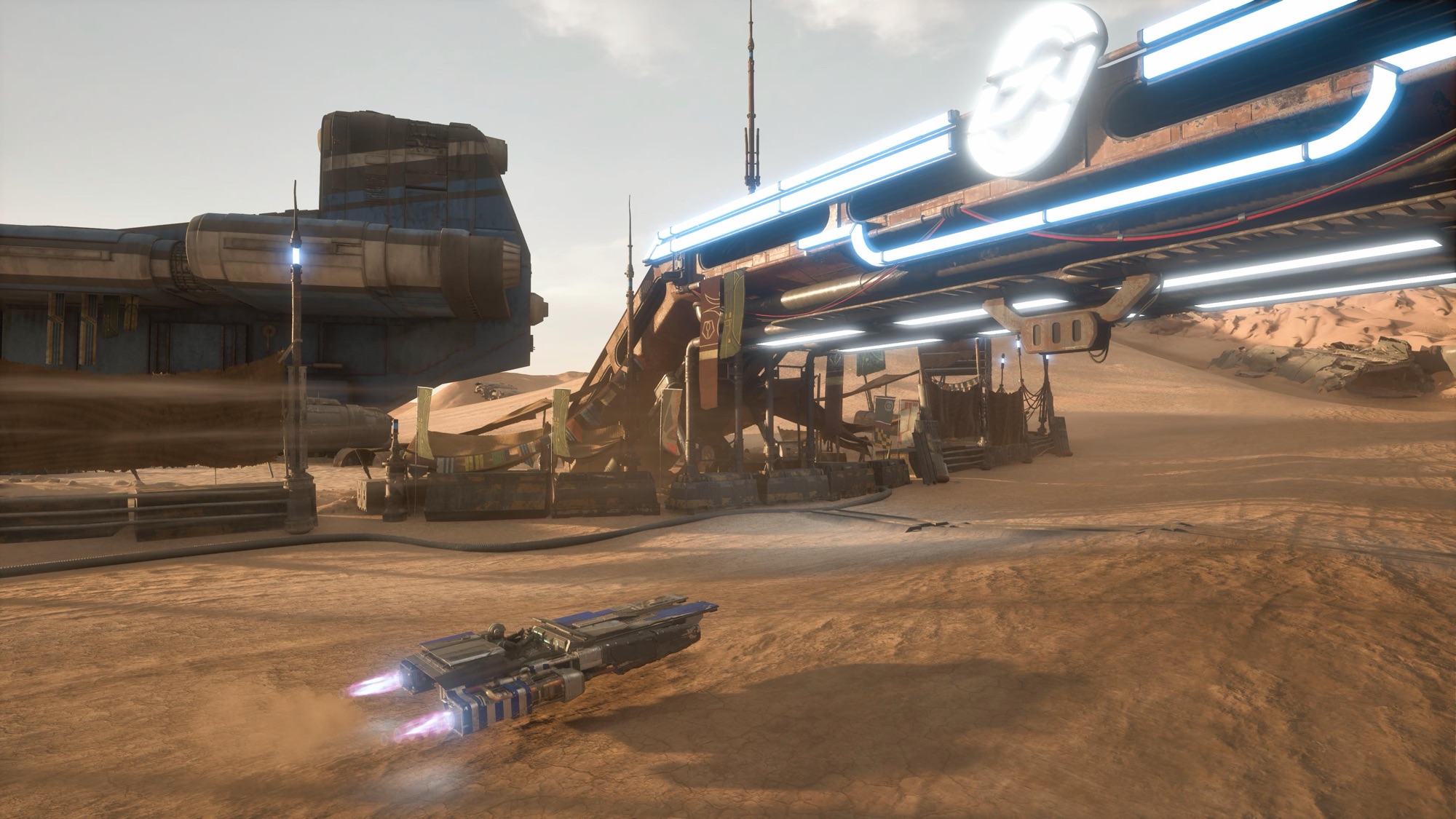
Where the game really shines is in its open-world and traversal. Your magic gauntlet allows you to skate along on the sand, making getting around both fast and fun. Developers really nailed the feeling of high-speed motion, and even in a sizable open-world I would prefer to sand-surf than fast travel everywhere.
There’s also a perk you can unlock, that gives you a speed boost when you run over any plants while surfing, this really kicks you into top gear and sends you blasting forwards like a rocket.

Not just in the open world, but combat too; you feel fast, nimble and maneuverable enough to avoid enemy attacks most of the time.
You also gain the ability to dodge, double jump and air dash multiple times, making exploring the open-world almost like a platformer.
There’s a lot of verticality to the open world; tall mountains and structures begging to be explored. Curiosity is almost always rewarded, with resources and valuable items waiting for you in hard to reach areas.

As you progress through the game you’ll come across little optional challenges around the world.
- Towering altars to a false god that can be destroyed for valuable ‘essence’, used to upgrade armour sets and abilities. You’ll need to strike the giant altars in specific places to bring them down, and figuring out how to get within striking distance can prove a challenge.
- There are platforming puzzles across floating ruins, that disappear if you’re too slow to jump between them and reach the reward at the end.
- My favourite ‘mini-game’, was one I like to call ‘Totem Races’, where you activate a special stone and it shines a laser some distance across the map. You have to hurry to activate the next stone in the sequence before the laser powers down.
They can be quite challenging, some requiring you to speed as fast as possible to the next stone, others requiring you to find the optimal platforming path.
Your map has markers for all the activities available to you, and I had a great time chucking on a podcast and methodically clearing the ‘areas of interest’ from the map.
It reminded me of Assassin’s Creed Valhalla in that sense, where it just feels so satisfying to tick things off the list.
Combat
In Atlas Fallen, combat is fast, intense and can pose quite the challenge!
Fights usually consist of one bigger enemy that can periodically summon a number of smaller minions to aid it in battle; you’ll have to decide whether to take out the weaker supports first so you’re not hindered when attacking the main unit… Or just go H.A.M. on the boss to try to finish the fight quickly.
READ MORE: Xbox’s Games with Gold gets one last hurrah this August

Felling bigger enemies will often net you essence stones, which can be used to add perks and abilities to your momentum gauge.
What’s that you ask? Well during battle, you generate momentum from successful attacks and parries, filling up a gauge. As your momentum builds it activates the essence stones you have equipped; the amount of damage you deal AND receive also increases.
An essence stone activation can be a passive effect like a damage buff, or specific abilities like healing or special attacks. My go-to trio of abilities were:
- Disruptive Throw, a projectile that interrupts an enemies attack and slows them down for 5 seconds.
- Healing Strike, an AOE attack that heals you based on the amount of damage dealt.
- Celestial Doom, which calls down a massive hammer, dealing a huge amount of AOE damage.
There’s 150 essence stones in the game that provide different buffs, debuffs and abilities. The stones can also be further upgraded to increase their potency or unlock additional effects.
Meaning there’s a huge variety of possible builds for you to test out and find what suits your combat style best.
The gauge is also used to fuel your ‘shatter’ ability which is a devastating attack that uses up every last drop of generated momentum. Best used when you’re confident you’re close to landing a killing blow.
If you spend too long on the defensive, just running and evading attacks, your gauge will begin to decrease, so it encourages you to stay in the heat of battle, building up to stronger attacks.
It was a really well thought out and developed combat system.
Performance
I felt like the game ran pretty well during my 22-hour play-through, there were a number of small bugs, like spots of missing textures in the world that look like holes into the Matrix, but they didn’t affect game-play.
Throughout my whole play-through, whenever my character was talking to someone, or experiencing an in-game story moment, my camera settings switched back to the default. As I play with an inverted Y-axis and lower stick sensitivity, the temporary setting swaps were annoying to say the least.
READ MORE: Review | Viewfinder ‘A fantastic debut’ (PS5)
Unfortunately, I did have a few major bugs pop up as well.
I had around a half dozen hard crashes that sent me back to my PlayStation dash, and a really bizarre bug where both my camera and movement controls somehow got mapped onto the same analogue stick, making it nauseating to move around. I had to shut down and relaunch the game to get rid of that one.

There’s a laundry list of known bugs that the devs are looking to have ironed out before launch day so I can only hope the more serious ones are fixed in the day 1 patch.
After struggling with my enjoyment of the game early on, I dug a little deeper in the sand and found a huge amount of passion and love from the developers, poured into the world, combat and traversal systems. Atlas Fallen wasn’t what I wanted going into the game, but what I eventually got out of the experience was rewarding and fun.
Quest Daily Scores Atlas Fallen:
7.5/10
Quest Daily was supplied a copy of Atlas Fallen by the publisher for the purpose of this review.