I have a bit of a love-hate relationship with precision platformers; I love the dopamine hit they provide after navigating a particularly tricky run of death traps… But I hate that I’m really not that good at them! What I am though, is persistent, so I managed to cross the finish line on this one!
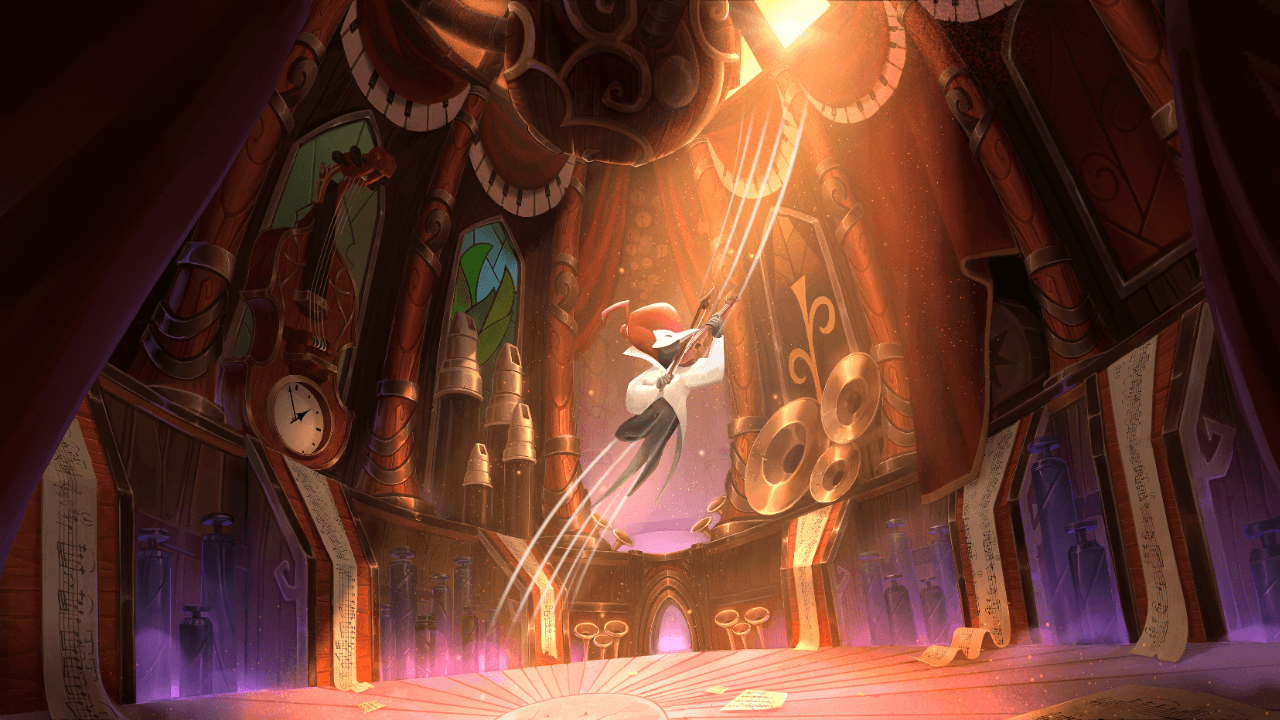
Developed by Sunny Peak, Symphonia is a 2D precision-platformer that stands out from the crowd. Its quirky setting, charming visuals, and enchanting classical soundtrack make this short adventure worth undertaking.

With no dialogue — voiced or otherwise — the story is told quite passively; what’s there is just enough to get you into the gameplay and on your way. The world of Symphonia, which runs on musical energy, has fallen into decline after the members of the orchestra vanish. You play as Philemon, a mysterious violinist, awoken by a robotic conductor and tasked with reassembling the ensemble to restore the world to its former glory.
Sights and Sounds
Symphonia is not only a tight 2D Platformer, it also treats you to a night out at the auditorium, with elegant symphonies backing your playthrough. I won’t pretend to have a deep knowledge of classical music, but composer Olivier Esman has crafted a delightful soundtrack, performed exquisitely by the Scoring Orchestra Paris. It’s such a beautiful OST, I do hope it makes its way onto Spotify sometime soon.
At any time during gameplay, you can make Philemon whip out his violin and play a solo. Not only does this sound lovely, but you can use it to discover collectibles, activate dormant machinery, and fast travel to already-discovered locations.
READ MORE: Review | Threefold Recital ‘A Lot To Digest’ (PC)

Symphonia looks as sweet as it sounds, with beautiful design, animations, particle effects, and cutscenes. They’ve really gone hard on the musical imagery, with oversized instrument pieces adorning the backgrounds and foregrounds of the levels, drums that launch you high into the sky, tightly drawn violin strings to slide down, as well as loose strings to bounce around on.
As Philemon moves and jumps around, they leave a small trail that looks like the staff lines on sheet music. Playing the violin produces beautiful musical notes and other particle effects, and Philemon even uses their violin bow to help traverse the world.
Run the Gauntlet
Symphonia mostly sticks to the greatest hits of platforming abilities with a few fancy flourishes here and there. Curiously, they’ve implemented the classic double jump as an unlockable accessibility setting that you have to turn on yourself in the settings menu, but there’s a good reason for that. There’s also wall sliding, wall jumping, a grappling hook, and a quick hover. But it’s the violinist’s bow that is the true standout.

You use the bow to poke downwards into the ground, launching yourself into a boosted jump. As you come back down, you can do this again, pogoing off into a higher jump. Chaining these bow-bounces together builds up momentum, allowing you to zip around at pace. You can also stab the bow into cushions, bend it back, and catapult yourself across hazards or up to hard-to-reach places. I imagine the bow is the reason why the classic double jump is relegated to being an accessibility tool, you can already bounce so high that it’s unneeded — but there to make things easier for players having a tough time… Because, yeah, this game can be tough!
Symphonia is devoid of combat, opting instead to hone in on platforming, and Sunny Peak have brought some real magic to the table. Rapid projectiles fire at you as you dodge and weave through rooms of spiked floors and walls, clinging to rotating platforms and slingshotting across bottomless chasms, navigating gusty air currents and darting between grapple points. There’s a lot of platforming goodness packed into this five hour adventure.
READ MORE: Final Fantasy VII Rebirth | Steam Deck Impressions and Recommended Settings

The best moments by far were when the game played around with gravity. Some of the gauntlets you come across have directional arrows stuck to the wall, hitting one of these changes the direction of gravity to the way the arrow is pointing. These levels broke my brain at times, the change of gravity confused my brain into jumping in the complete wrong direction, resulting in my death. Not only a literal gauntlet, but an emotional one too; delighting me with the creativity of the mechanic, utterly frustrating me with how hard I found it, and ultimately giving me great satisfaction when I finished them.
Symphonia is a speed-runner’s dream, with fast-paced traversal and plenty of corners to be cut if you’re good enough. When you’re moving at pace, seamlessly transitioning between pogoing, grappling, and sling-shooting around as you avoid death by a hair’s breadth… It just feels amazing.
Should you play Symphonia?

With its eye-catching visual style, harmonious soundtrack, and fantastic traversal, Symphonia has pogoed its way onto the list of great precision platformers.
I could’ve done with a teensy bit more story to fully hook me in, and the lack of a map was a slight annoyance when trying to gather missed collectibles. I did hit a couple of bugs through my short playthrough that needed a hard reset to rectify, but overall, the game ran really smoothly on the Switch.
If you enjoy precision platformers, or love a bit of classical music, Symphonia might be the game for you. I would love to see an encore from Sunny Peak at some stage in the future!
Quest Daily scores Symphonia:
8.5/10
Symphonia is out now on Nintendo Switch, PlayStation, Xbox and PC, retailing for about $30.
Quest Daily was supplied with an early review copy of Symphonia thanks to the publisher.