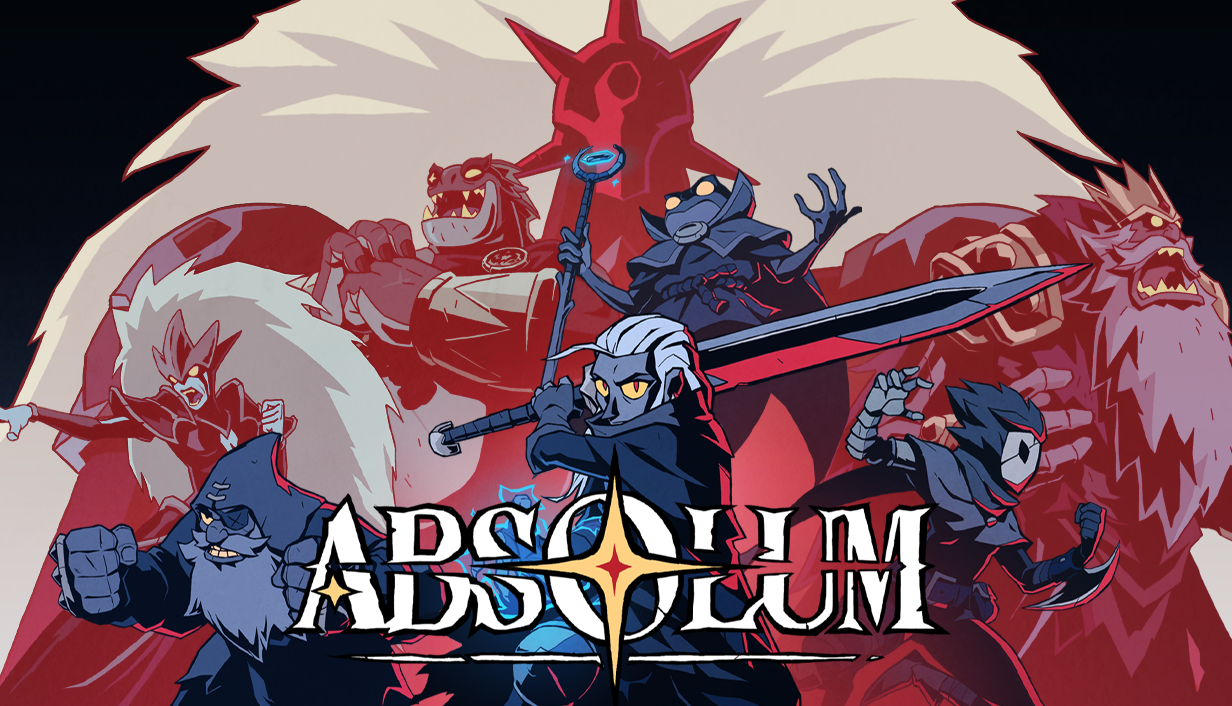
For the past week, I’ve been battling an addiction. Whenever I’m at work, I find myself longing for battle: to cut through swathes of undead warriors with my flaming blade. On the train home I’m scheming about what rituals, inspirations and trinkets will combine well together to transform me into the ultimate warrior. And late at night, long after my bed-time, I’ve been echoing the mantra of the roguelite “Just one more run”. In short, I’ve been playing Absolum.
The self-styled “rogue ’em up” combines side-scrolling Beat ‘em up gameplay, roguelite elements, and a fantasy world brimming with lore.
The World of Talamh

Absolum is a brand new fantasy IP set in the world of Talamh, ruled over by a ruthless dictator — Sun King Azra — who has outlawed magic for everyone but his own Crimson Order; you control a band of resistance fighters, working to overthrow the tyrannical regime and bring peace back to the land.
Mother Uwachi — the leader of the rebels — uses her ancient root magic to bring you back to life when you fall in battle. However, Azra has a similar power and will also resurrect his forces before each run — creating the roguelite loop. Your chosen champion needs to battle through and defeat the Sun King in one fell swoop to take him down for good.
READ MORE: Review | Keeper: ‘Hypnotic, Engaging and Evolving’ (Xbox Series X)

The visual design in Absolum is stellar. The use of bold colour, heavy contrast, and hand drawn aesthetics make it feel like a graphic novel come to life.
There are multiple paths to take and regions to venture through — like goblin-infested woods and crumbling dwarven ruins — before you can challenge Azra. Shadowy foreground vignettes and detailed background elements add more depth to each level: distant landscapes, decaying shipwrecks, the skeleton of an ancient dragon, citizens cheering at a coliseum deathmatch — it all brings the world to life.

Character designs are also on point, from hulking goblin-brutes and undead dwarf-kings to the four main characters themselves. Everyone felt unique and well designed.
Questing
In addition to the main plot, there are numerous sub-plots and side-quests to uncover. I’ve been double-crossed on a grand heist, escorted a skeletal bard through haunted ruins, and unlocked an ancient vault housing the last dragon, to name but a few.
Character side quests explore their individual motivations and troubled pasts. Brome the Mowlai (humanoid frog) is one of the last of his species, determined to pull his people back from the brink of extinction. While Cider is half person, half puppet, driven to uncover her murky past by tracking down the puppeteer who modified her.
READ MORE: Review | Baby Steps: ‘Failing Upwards’ (PC)

Often, quests develop across multiple runs, the world changing due to your involvement. On one run, I met a knight who beseeched me to negotiate with the Goblin Chieftain and allow the humans to rebuild their broken bridge. On my next run, the bridge was rebuilt, and I was able to cross into a new area. When I eventually returned to the goblins, they were furious at me because the humans had used the bridge to increase their attack on them in greater number. And in what felt like a retaliation to this, the goblins installed spiked floor-traps and massive swinging iron balls in the forests to ambush intruders with.
Uchawi’s Hearth

Whenever you’re killed, you revive back at Uchawi’s Hearth, the rebel base of operations. It’s here that you can unlock permanent upgrades, chat with NPCs, and swap between heroes.
Your run is assessed each time you die and you’re rewarded on performance. You can use these rewards to unlock new special moves and upgrade your magic, which can be a game changer on your next run. I gravitated toward special moves that did a lot of AOE damage to better handle mobs, but it was fun to experiment with each one.

You can use the crystals gained from your run to unlock permanent buffs at the Soul Tree: more health, increased odds of rare loot drops, second chance revivals, etc.
There’s also a training area to run you through the basics of movement and combat, but the game is in need of a glossary or compendium to keep track of tutorials, lore, characters, and enemy descriptions.
Punch, Die, Repeat

Absolum’s core gameplay loop has you battling through a series of levels as one of four unique characters, defeating enemies and acquiring upgrades along the way. You’ll face tough mini-bosses and punishing level-bosses, while working your way to the final boss.
Being a roguelite, you’re going to be retreading the same locations a lot, but there’s plenty of variation that keeps each run feeling fresh. Different routes put different enemies in your path, but there’s also the chance to spawn elite enemies, as well as magic portals that drop in random monsters from different parts of the world.
You can also hire mercenaries to fight for you and temporarily ride various mounts into battle. Jumping on the back of a hog never got dull!

Combat is super satisfying; juggling groups of enemies in the air, side-stepping projectiles, parrying attacks, and activating special moves to control the flow of the fight.
You have various attacks at your disposal: quick hits that form strings of combos, character skills like Cider’s grapple-hand that pulls an enemy close, flashy power-moves, and devastating Ultimate attacks. It’s a mix of button mashing and strategic use of special moves that really hit the sweet spot for me.

To become powerful enough to beat the Sun King, you need to build up your array of rituals, inspirations, and trinkets. These bolster your build and can be obtained after combat encounters or purchased from shops.
Rituals affect attacks and movement, such as leaving flames in your wake when you dash, or adding an element to your strikes. Inspirations are character specific, like Karl’s ability to ‘reload’ his mana, or Galandra’s mid-air spinning blade attack. Trinkets have all sorts of effects, like increasing movement speed, dealing more backstab damage, or obtaining gold when you destroy random objects.
These upgrades are run-specific, so you’ll start from scratch on each new run. But that’s where half the fun lies, in crafting a different build each time and testing what enhancements synergise well together.

One of my favourite runs with Cider started out poorly… Or so I thought. I’d picked a ritual that caused enemies to drop ‘thorn daggers’ when attacked, but the daggers didn’t seem that strong. I was sure this was going to be one of my shorter runs.
READ MORE: Review | BALL x PIT: ‘A Hole New Ballgame’ (PC)
But as I progressed, I bolstered the build: a trinket gave me a chance of getting throwables back after using them, another ritual made my thorn daggers split into three when thrown, and an inspiration caused throwables to be multiplied when thrown. I slowly became a powerhouse, able to pummel the strongest enemies to dust in seconds with the sheer volume of daggers I was throwing at them… And if I ran out, I just had to punch some enemies for a bit and have them drop more.
What started as a ‘hopeless run’ ended up being the first time I actually beat final boss and rolled credits!
Should You Play Absolum?

Absolum’s fresh “rogue ’em up” take sets it apart from others in the roguelite genre. Dotemu and Guard Crush (Streets of Rage 4) have once again proven that they’re best-in-class when it comes to crafting satisfying Beat ‘em ups, and the roguelite elements only elevate the game further, keeping each run varied and interesting. Though I didn’t try it out, the game also supports local and online multiplayer.
Perhaps the only criticism I have is that the game has a steep learning curve at the beginning. The world and its monsters can be brutal and unforgiving over your first dozen runs, as you slowly build up those permanent upgrades. But its story and characters carry you through the tough times.
It’s a rare treat to get so much focus on story within a roguelite (the only one that really comes to mind is Hades), not to mention the fully voice acted cast of characters and NPCs. I’m usually a ‘story-first’ sort of gamer, so I really appreciated getting both kick-ass gameplay AND interesting characters and stories. Even after beating the game multiple times, I’m still running it back, testing my skills and uncovering new secrets.
Quest Daily scores Absolum:
9/10
Quest Daily was supplied with a review copy of Absolum thanks to the publisher.